

Introduction
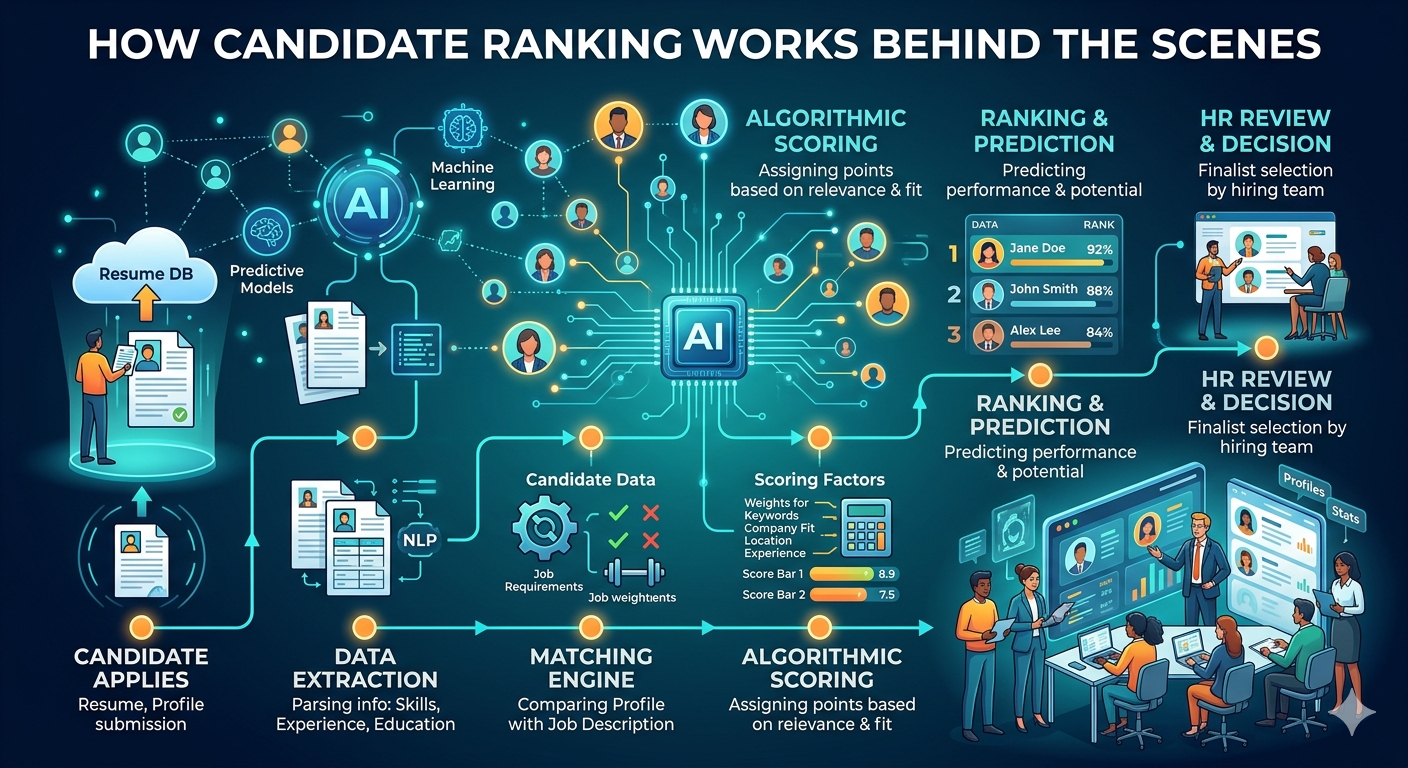
Most candidates believe hiring decisions depend only on interview performance or technical skills. However, behind the scenes, recruiters and hiring teams use a structured approach to rank candidates across multiple factors. This process involves comparing strengths, risks, and overall fit rather than selecting the “best” candidate in isolation. This explains exactly how candidate ranking actually works behind the scenes in modern hiring systems.
Ranking helps organizations make consistent, fair, and strategic hiring decisions. It ensures that the final selection aligns with both immediate role needs and long-term business goals.
Initial screening creates the first ranking layer
First, recruiters create an initial shortlist based on resumes. They evaluate factors such as relevant experience, skill alignment, and role-specific keywords.
Candidates who closely match job requirements receive higher initial ranking. Others may still be considered but ranked lower based on relevance.
This stage filters large applicant pools into manageable groups.
Interview performance adds structured evaluation
After screening, candidates go through multiple interview rounds. Each round focuses on different aspects such as technical skills, communication, and problem-solving.
Interviewers often score candidates based on predefined criteria. These scores contribute to an overall ranking system.
Consistent performance across rounds improves a candidate’s position.
Hiring signals go beyond technical ability
Ranking does not depend only on technical performance. Recruiters also consider soft signals such as communication clarity, confidence, and adaptability.
Candidates who explain their thinking clearly and handle feedback well often receive higher rankings, even if their technical answers are not perfect.
These signals reflect real workplace behavior.
Role fit plays a critical role
Not every strong candidate is the right fit for every role. Hiring teams evaluate how well a candidate aligns with the specific requirements of the position.
For example, a candidate with strong backend skills may rank lower for a frontend-focused role. Alignment with job needs influences ranking significantly.
Fit matters as much as capability.
Cultural alignment influences ranking
Cultural fit is another key factor in ranking candidates. Teams assess whether candidates align with company values, communication style, and work environment.
Candidates who demonstrate strong collaboration and adaptability often rank higher than those who may struggle to integrate into the team.
Cultural alignment reduces long-term risk.
Consistency across interviews matters
Candidates who perform well in one round but struggle in others may receive lower rankings. Hiring teams prefer consistent performance across all stages.
Consistency signals reliability and readiness for real-world responsibilities.
Stable performance improves ranking position.
Feedback aggregation shapes final ranking
After interviews, hiring teams collect feedback from all interviewers. This feedback is discussed collectively to compare candidates.
Each interviewer may highlight strengths, concerns, and overall impressions. These inputs are combined to create a final ranking list.
Collaborative evaluation ensures balanced decisions.
Risk assessment affects candidate position
Hiring involves risk. Recruiters evaluate potential risks such as skill gaps, communication issues, or cultural misalignment.
Candidates with lower perceived risk often rank higher, even if another candidate has slightly stronger technical skills.
Risk reduction influences final decisions.
Business priorities can shift rankings
Sometimes, business needs change during the hiring process. A role may require faster onboarding, specific skills, or immediate availability.
In such cases, candidate rankings may shift based on updated priorities. Flexibility becomes an important factor.
Business alignment impacts final selection.
Final decision balances multiple factors
The final ranking is not based on a single score. It reflects a combination of technical ability, communication, cultural fit, consistency, and risk evaluation.
Hiring managers select candidates who provide the best overall value rather than focusing on one strength.
Balanced evaluation leads to better hiring outcomes.
Conclusion
Hiring decisions involve a structured and multi-layered evaluation process. That is precisely how candidate ranking actually works behind the scenes in modern recruitment.
Recruiters consider technical performance, communication, cultural fit, consistency, and risk before making final decisions. Candidates who perform well across all these areas increase their chances of ranking higher and securing job offers. Understanding this process helps candidates prepare more effectively and approach interviews with a broader perspective for long-term success.
Find Your Dream Job Today – Explore Endless Career Opportunities and Secure Your Next Role with Best Job Tool.






Comments
Be the first to leave a comment.