

Introduction
Now technology tools and work process is our changing past, and people who depend on their existing skills only becomes out dated quick. If you need to compete with the fast changing job market, then you need to learn new technology tools and work processes quickly. That’s why learning ability has become a most valuable professional skill.
Companies prefer only those people who are curious, take feedback positively, and have learning mindset. Learning ability means capability of thinking, understanding, and applying in any situation.
In this article, we will understand how companies evaluate learning ability of a candidate at the hiring time, as well as after joining.
What Is Learning Ability in a Professional Context?
The meaning of learning ability in professional context is understanding new skill quickly, applying them in practical work, and being open for continuous improvement. A professional who has a strong learning ability, find solutions by analyzing situations instead of just following instructions.
An important aspect of learning ability is accepting feedback and working on it. In workplace, people who take feedback positively and improve their performance, companies see them as a fast learner. Also, adopting new tools and processes are also a part of learning ability.
Professional learning ability also includes curiosity, problem solving mind set, and adaptability. When any employee does not fear from new challenges, instead see it as an opportunities to learn, then company see that candidate ready for long term growth.
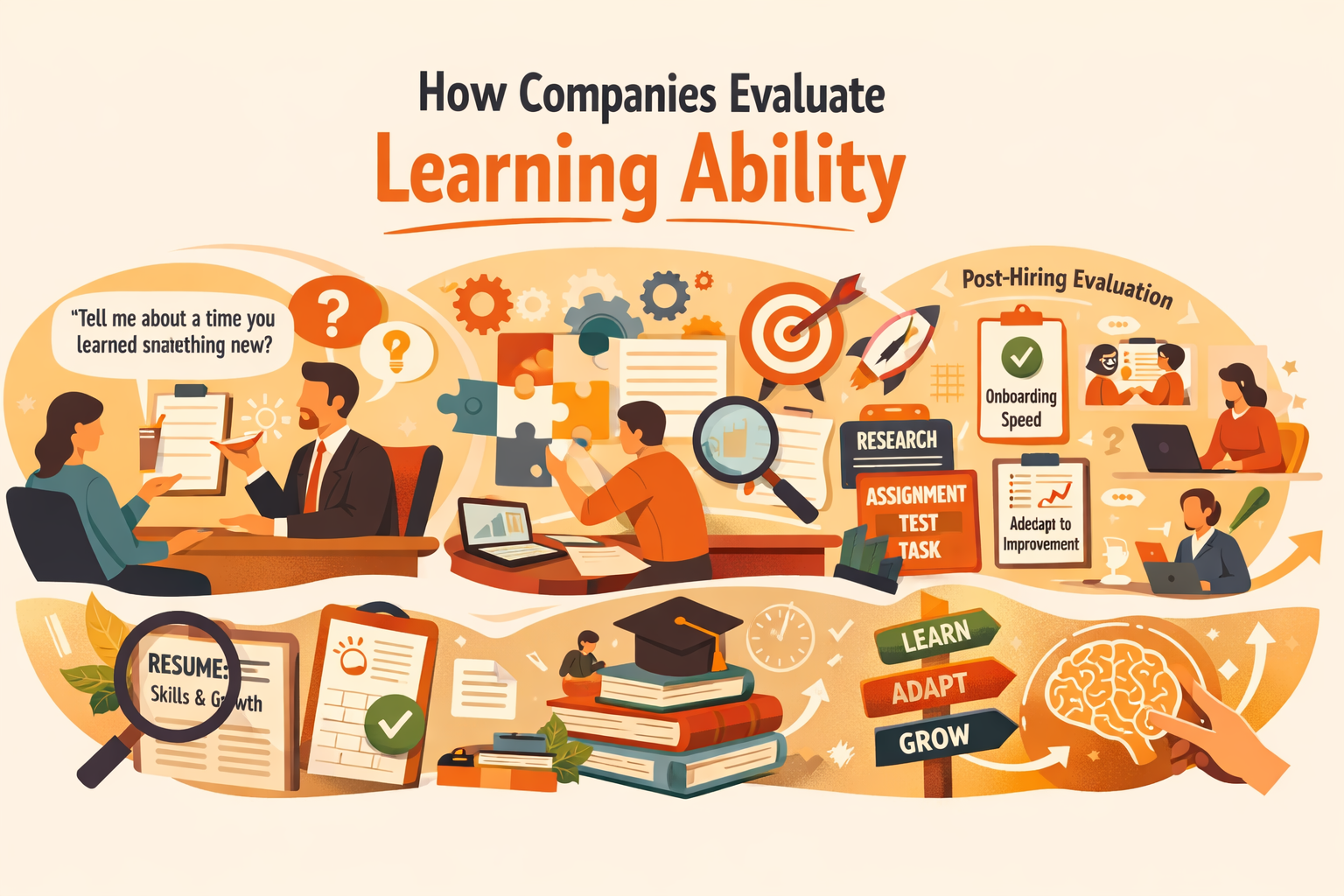
How Companies Evaluate Learning Ability During Hiring?
1. Learning Ability through Behavioral Interview Questions
Behavioral interview question is the most common way of companies to evaluate learning ability of a candidate. Mostly recruiter ask questions such as, have you learnt any skill quickly, or what you did when you do not have knowledge by task. The purpose of these questions are not just listening answers, it is to understand how can the date approach the process of learning.
Companies observe how clearly a candidate can explain their morning journey, whether they share only about result or share about process, mistakes, and improvement steps. Candidate who mention their feedback, experimentation, and self improvement at the time of the learning, they become a strong learners for recruiter.
2. Problem-Solving & Case-Based Questions
Companies use problem solving and case-based questions when they have to see how candidate handle unknown situation. These questions are mostly based on real life work scenarios, where candidates do not have complete information. Here, thinking process is more important than correct answers.
Recruiter see how candidate breaks questions, how they make assumptions, and whether they follow logical approach or not. If candidate tells clearly that what he is trying to first understand, then how he will learn, and then implement solution, then it is a sign of strong learning abilities. Companies prefer those people who show the approach of learning.
3. Skill Assessments & Assignments
Skill assessment and assignments help companies to evaluate how candidate apply learning practically. Multiple times, assignments are slightly unfamiliar to test how candidate research, understand its tool, and how works with limited guidance.
Companies also observe how candidate handle feedback at the time of assignment, whether they implement feedback or become defensive. Strong learners are those people who implement feedback and show clear improvement in next attempt. Assessment like this, tells companies that a candidate is skilled, as well as learnable and growable.

Learning Ability in the Workplace (Post-Hiring Evaluation)
1. Speed of Onboarding
At the time of on-boarding, companies see how quickly new employee understand new system, processes, and tools. Employees who start their work effectively by learning quickly, they are seen as fast learners. Speed of on-boarding is not just to complete task, but it also include working with the team by understanding work flow with minimal guidance.
Usually, fast learners take tips from their peers, read documentation quickly, and file solutions through trial and error. Companies judge with these observations whether employee is ready to handle growth and responsibilities for long term or not.
2. Response to Feedback
Taking feedback and acting on it is the most clear indicator of learning ability at workplace. Employees who take constructive feedback as positive and try to improve their approach, they are taken as high learning potential candidate.
Companies see whether candidate accept their mistakes, do not repeat it again, and apply better approach next time or not. Employees who ignore feedback or become defensive, company see as candidate with limited learning ability. Strong learners identify their weaknesses and follow improvement plan, and it shows their professional maturity and adaptability.
3. Adaptability to Change
Changes are common in a workplace, such as new project, tools, processes, or team dynamics. To evaluate learning ability, companies check how quickly employee adjust with the change.
Adaptable employees see new challenges as a chance or opportunity to learn. They quickly understand new requirements and implement in their work flow. Apart from this, adaptable employees develop cross-functional skills, and their overall contribution is more valuable for team and company.
Conclusion
In today’s fast-evolving workplace, learning ability has become one of the most valuable skills a professional can have. Companies no longer just look at experience or degrees—they prioritize employees who can adapt quickly, absorb new knowledge, and apply it effectively. From interviews to daily work performance, learning ability is assessed through problem-solving, feedback response, adaptability, and continuous growth mindset.
For candidates, demonstrating a strong learning ability—through examples, projects, and a willingness to evolve—can set them apart in competitive hiring and accelerate career growth. Ultimately, those who embrace learning not only succeed in their current roles but also stay prepared for the challenges of tomorrow.
Explore more career related blogs with the Best Job Tool.






Comments
Be the first to leave a comment.