

Introduction
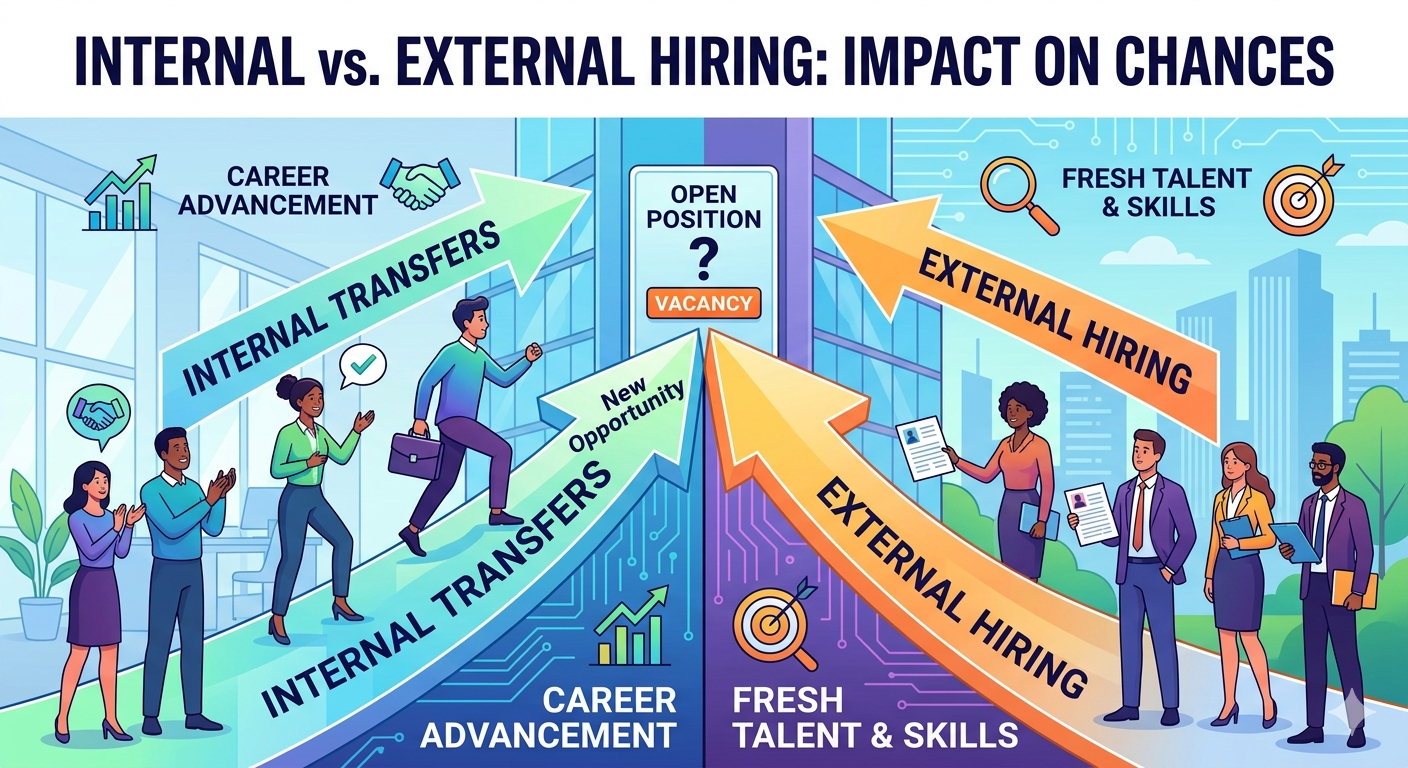
Many job seekers assume that every job opening offers equal opportunity to all applicants. However, in reality, companies often consider internal employees for open roles before selecting external candidates. Internal transfers can significantly influence hiring outcomes, even when the job is publicly listed. This explains exactly how internal transfers affect external hiring chances in modern recruitment processes.
Organizations prefer internal mobility because it reduces hiring risk, saves time, and strengthens employee retention. As a result, external candidates may face hidden competition from within the company.
Internal candidates reduce hiring risk
First, companies already understand the performance, behavior, and reliability of internal employees. Managers have direct experience working with them.
This familiarity reduces uncertainty compared to hiring someone new. External candidates, no matter how strong, always carry some level of unknown risk.
Lower risk often leads to preference for internal transfers.
Faster onboarding and productivity
Internal candidates already know the company’s systems, processes, and culture. They can adapt quickly to new roles without extensive training.
External hires, on the other hand, require onboarding time to understand workflows and expectations.
Because of this, companies often prioritize internal transfers to maintain productivity.
Cost efficiency in hiring decisions
Hiring externally involves multiple costs such as recruitment efforts, onboarding, and training. Internal transfers reduce these costs significantly.
Organizations can fill roles more efficiently by moving existing employees rather than starting a new hiring cycle.
Cost savings influence decision-making.
Cultural alignment advantage
Internal candidates already align with the company’s culture, communication style, and work environment.
External candidates must prove cultural fit during interviews, which adds another evaluation layer.
Cultural familiarity gives internal candidates a strong advantage.
Job postings may include internal competition
Many companies post jobs publicly even when they are considering internal candidates. This practice ensures transparency and compliance with hiring policies.
However, internal candidates may already be strong contenders before external interviews begin.
Understanding this dynamic helps external applicants set realistic expectations.
External candidates raise the hiring benchmark
Even when internal candidates are preferred, external applicants still play an important role. They provide comparison points for hiring teams.
If an external candidate demonstrates significantly stronger skills or better alignment, they can still secure the role.
Competition ensures better hiring decisions.
Leadership preference for internal growth
Organizations often encourage internal mobility as part of employee development strategies. Promoting or transferring employees boosts morale and retention.
Leaders may prioritize internal candidates to reward performance and support career growth within the company.
Internal growth strategies influence hiring outcomes.
External hiring still happens for fresh perspectives
Despite the advantages of internal transfers, companies also value fresh ideas and external perspectives.
External candidates bring new experiences, industry insights, and innovative approaches. When these benefits outweigh internal advantages, companies choose external hires.
Balance between internal and external talent shapes decisions.
Role complexity influences decision
For highly specialized or new roles, companies may not find suitable internal candidates. In such cases, external hiring becomes necessary.
External candidates have a stronger chance when the role requires unique skills or expertise not available internally.
Skill gaps create opportunities for external applicants.
How candidates can improve their chances
External candidates can still succeed by focusing on differentiation. They should highlight unique skills, industry experience, and fresh perspectives.
Clear communication, strong problem-solving ability, and cultural alignment can help external candidates compete effectively.
Standing out reduces the internal advantage.
Conclusion
Hiring decisions involve multiple factors beyond interview performance. That is precisely how internal transfers affect external hiring chances in modern organizations.
Internal candidates offer familiarity, lower risk, and faster onboarding, which often gives them an advantage. However, external candidates can still succeed by demonstrating strong value, unique expertise, and alignment with business needs. Understanding this dynamic helps job seekers approach applications strategically and improve their chances in competitive hiring environments.
Find Your Dream Job Today – Explore Endless Career Opportunities and Secure Your Next Role with Best Job Tool.






Comments (1)
Thanks for such useful content.