

Introduction
In every workplace, managers assign work based on confidence, deadlines, and risk. It is not only about who is available. It is about who can deliver with the least confusion. This is where learning curves play a major role. When a person needs more time to learn a task, managers adjust responsibilities accordingly.
Understanding how learning curves affect role assignment helps professionals grow faster. It also helps freshers and new joiners reduce pressure and perform better. Learning curves are normal. However, how you manage them decides how quickly you get better opportunities.
Learning curve means ramp-up time, not intelligence
A learning curve is the time it takes to become productive in a role. It does not measure intelligence. It measures familiarity with tools, systems, processes, and expectations.
For example, someone may be smart but new to a company’s workflow. They may take time to learn reporting formats, approval steps, or internal tools. That learning period affects what work they receive initially.
Managers usually assign tasks based on the risk level. If a task has high impact, they prefer someone who already understands the process. If a task is lower risk, they may assign it to someone still learning.
So, learning curves influence assignments in a practical way.
Managers assign tasks based on speed to execution
Workplaces run on timelines. Even when managers want to support learning, they still need delivery.
If a project has a tight deadline, managers often choose the person who can execute quickly. This does not mean the fastest person is always the best. It means speed reduces risk when time is limited.
A shorter learning curve gives managers confidence. It tells them the task will be completed without repeated revisions. It also reduces dependency on senior team members.
As a result, people with faster ramp-up often receive more responsibilities early.
Early assignments are usually low-risk by design
When you join a new team, your first tasks are rarely the most critical. This is intentional. Managers use early assignments to test understanding and work style.
These tasks help managers observe how you learn, ask questions, and manage time. They also show how well you follow instructions and handle feedback.
If you perform well, you gain trust. Then the manager gradually increases complexity. This is a common pattern in role assignment.
So, if your first tasks feel basic, it does not mean you are undervalued. It means the team is building confidence in your execution.
Learning curves affect ownership and independence
Managers value independence. If someone can complete work without constant supervision, they become a stronger choice for important tasks.
A longer learning curve often means more check-ins, more questions, and more corrections. That is normal, but it increases workload for the manager and senior team members.
Because of that, managers may assign complex tasks to people who already have context. They want to reduce review time and avoid delays.
Once you start delivering with fewer revisions, you gain ownership naturally. You also get opportunities to lead small parts of projects.
Independence is one of the biggest benefits of reducing your learning curve.
Role assignment depends on learning attitude, not only skill
Many professionals assume role assignment depends only on skill level. In reality, attitude matters just as much.
Managers notice who learns quickly from feedback. They also notice who repeats the same mistakes. A positive learning attitude makes the curve shorter.
People who document processes, ask clear questions, and apply feedback immediately become reliable faster. They create less friction for the team.
On the other hand, people who resist learning or avoid clarification slow down progress. Managers may hesitate to assign them important tasks.
So, your learning mindset directly affects the work you receive.
Teams balance workload by mixing experience levels
Managers do not assign work only based on ability. They also balance team workload.
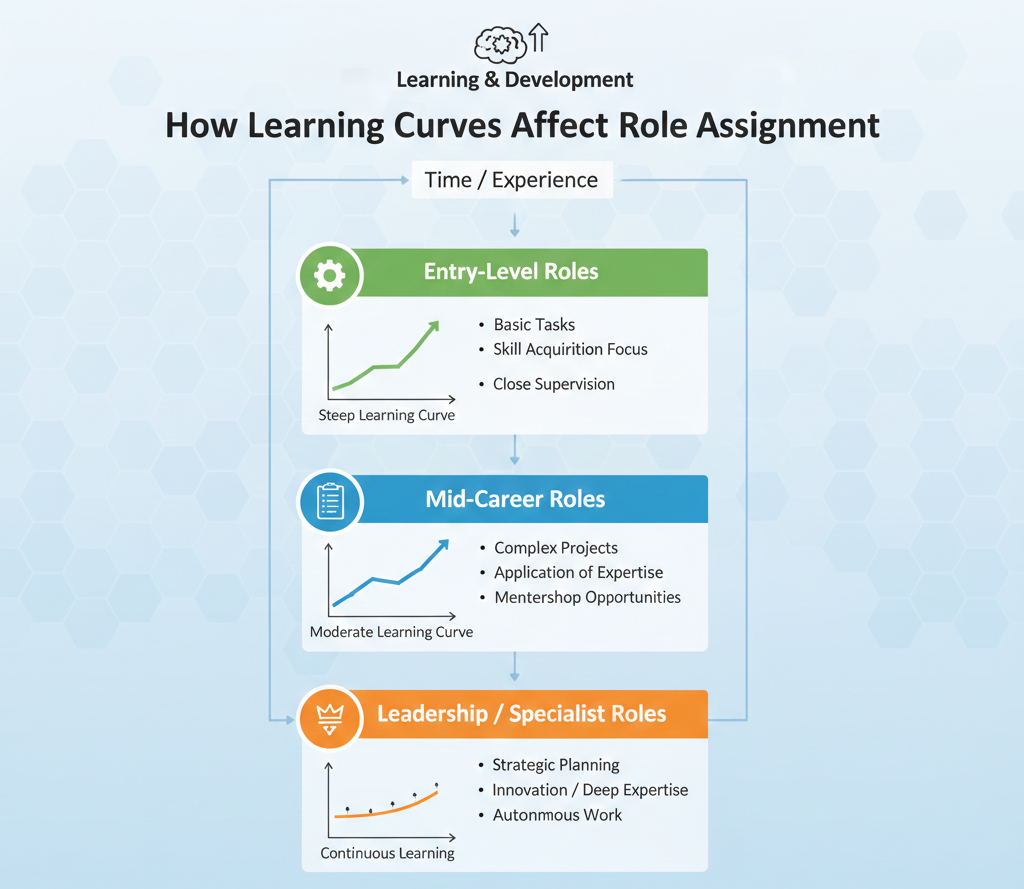
In many teams, senior members handle high-impact tasks. Mid-level members handle execution-heavy work. Freshers support with simpler tasks and gradually grow.
This structure protects quality while building talent internally. It also prevents project risk.
So, even if you are capable, you may not receive certain tasks immediately. The team may already have a structure that works.
Over time, as your learning curve improves, your position in that structure changes.
Learning curves influence how managers set timelines
Role assignment is not only about tasks. It is also about deadlines.
When managers assign work to someone new, they often add extra buffer time. They expect more learning and more revisions. This is part of planning.
If you deliver earlier than expected, you create a strong impression. You show reliability and speed. That increases your chances of receiving bigger tasks next time.
If you consistently miss timelines, managers may reduce your responsibility temporarily. They do it to protect delivery goals.
So, your learning curve impacts both assignment and timeline trust.
How professionals reduce learning curves strategically
You cannot eliminate learning curves, but you can manage them professionally. The goal is to reduce ramp-up time without sacrificing quality.
Start by understanding expectations clearly. Ask for examples of good work. Use documentation and templates. Take notes during feedback. Repeat the process until it becomes automatic.
Also, break tasks into steps. Confirm priorities early. Share quick updates instead of waiting until the end.
Most importantly, learn the tools that matter for your role. Tool confidence reduces dependency and improves speed.
When you reduce your learning curve, managers trust you with more ownership. That is how careers accelerate.
Conclusion
Learning curves are a normal part of growth. They shape role assignment because managers must balance speed, quality, and risk. Understanding how learning curves affect role assignment helps you stay patient and work smarter. It also helps you build trust faster through consistency and improvement.
When you learn quickly, communicate clearly, and deliver reliable work, you naturally receive better responsibilities and stronger career opportunities.
To explore roles that match your current skill level and support your growth, use the best job tool.
Find Your Dream Job Today – Explore Endless Career Opportunities and Secure Your Next Role with Best Job Tool.






Comments
Be the first to leave a comment.