


Introduction
The effect of salary negotiation is not just on your current income but also impacts financial growth. When you take 5000 to 10000 extra at the time of your first salary or job change, then this amount is multiplied in your future increments, annual hikes, and bonuses. For example, if you take a 10% annual increment, then a higher starting salary means bigger hikes every year. This small difference creates a huge gap in 5 to 10 years. If you do not negotiate, then you will get a lower base, which will slow down your salary growth in the future. That’s why, don’t think that negotiable is a one-time increasing salary; this is a long-term earning multiplier that increases your whole career income.
Why Negotiation Confidence Matters Before Interviews?
Salary negotiation does not only mean asking for more money, but it means asking for the real value of your work. When you negotiate, you are sitting on a strong financial base for yourself, on which increments, bonuses, and promotions are calculated in the future. If you take 5,000 to 10,000 extra, then the small difference creates a huge gap, it is called the compound effect.
Many people think negotiation means becoming greedy, but it’s not like that, it is a professional way to get the real value of your work. And employers appreciate when you negotiate and understand what you are worth and are confident in. If you do not negotiate, that means you are not accepting growth in your career. That’s why you should not avoid negotiation.
Myths About Salary Negotiation
Many people don’t want to negotiate because Myths are swirling in their minds like
- They will negotiate, and then the boss will think that he or she is a greedy person.
- The offer will get rejected.
- His or her image will get ruined in the company.
Reality is, negotiation is a standard practice in the professional world. Employers already expect that you will talk according to your worth. If you negotiate, then it is a sign for them that you know the real value of your work and you are confident about it. Negotiation doesn’t mean rudeness, it means presenting yourself according to your value, the market rate, and your achievements. People miss their opportunities and rights because of myths, and they accept a lower salary, which decreases their future growth.
How to Build Negotiation Confidence Before Interviews?
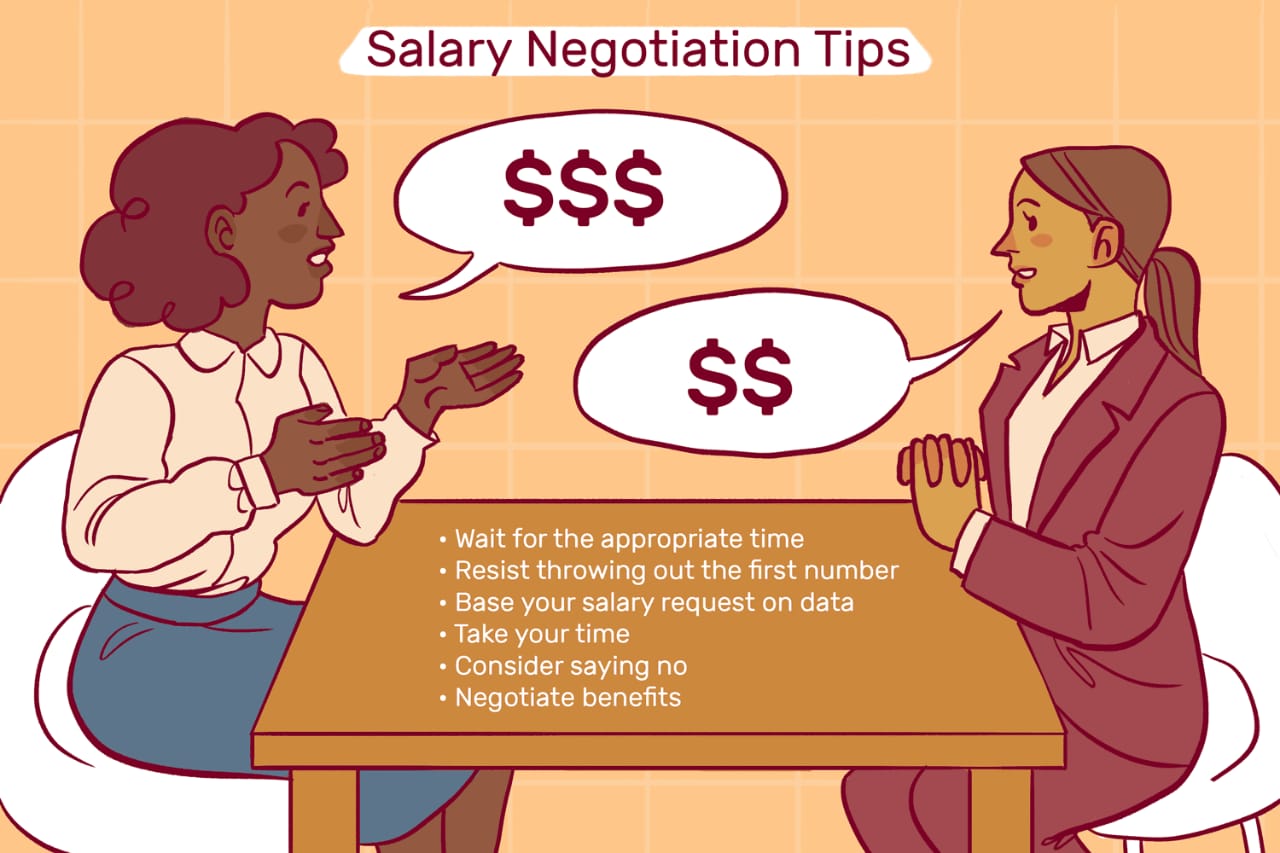
1. Know Your Market Value Before Negotiating
How to research market salary data?
Before negotiating your salary you have to be aware of the market rate of your role. To understand the market rate, you can use free tools like Glassdoor, Payscale, and LinkedIn Salary.
- With the help of the Glassdoor free tool, you can see the location-wise and company-wise salary range.
- You can take a salary report by using your skills, experience, and job role in the pay scale.
- LinkedIn provides an idea of the industry average and its benefits.
This research gives you confidence to speak with facts during the time of negotiation. When you have data then instead of “I think” you can use “according to market data”.
Understanding your value beyond your job title
Your worth is not decided solely by your job title. A combination of skills, experience, and results defines your real value. For example, if your title is “Marketing Executive,” but you increased sales by 30%, implemented new tools, or ran campaigns with high ROI on a low budget — your value can be higher than the market average.
The best way to impress employers is to showcase the measurable results of your work. Saying “I am hardworking” is less powerful than saying “I increased team productivity by 25% in one year.” This combination of skills, experience, and results gives you a strong position in negotiation.
The stronger your skills, the more value you bring to the table during negotiations. My article How to Upskill for Your Dream Job shares practical ways to enhance your expertise so you can confidently ask for the salary you deserve.
2. Prepare Your Achievement List
If you want to negotiate your salary, then first you have to start tracking your achievements. Making a daily work list is not enough, you should start recording measurable results of your work. For example, instead of saying “I started a campaign for a client,” you should say “I have started a campaign that increases 25% of my client’s sales”. Numbers, percentages, and specific metrics show your value clearly. You can maintain your record using an Excel sheet, Google Docs, or Notion. When you see the negotiation table then this data will give you a solid base to prove your worth with facts.
3. Learn the Language of Confident Negotiation
Negotiation is not just about what you ask for — it is also about how you communicate your expectations. The language you use can instantly make you appear confident, clear, and self-aware.
Confident negotiators use words that express clarity instead of confusion. They avoid apologetic statements like “I’m not sure,” “If it’s okay,” “I don’t mind taking less.” Instead, they use structured, respectful, and assertive language.
Here are examples of confident negotiation language:
- “Based on my research and skills, I believe a fair range would be…”
- “I would like clarity on the compensation structure before moving forward.”
- “For this level of responsibility, the industry-standard salary is…”
- “I’m open to discussing options that align with my experience and contribution.”
- “Thank you for the offer. I’d like to explore if there is flexibility.”
Using clear, logical statements shows the interviewer that you know your worth, you’ve done your research, and you are not afraid to talk about money professionally.
4. Know the Company and Its Compensation Style
Every company has a unique compensation structure. Understanding how the company pays and what benefits it offers allows you to negotiate more strategically.
Before the interview, research:
- Salary Trends of the Company
- Check platforms like Glassdoor, AmbitionBox, or Indeed to understand:
- The average salary for your role
- The company’s reputation for fair pay
- Whether employees feel satisfied with compensation
- Type of Compensation They Offer
Some companies offer:
- A fixed salary with predictable monthly income
- A variable salary that depends on performance
- Bonuses, commissions, or incentives
- Benefits like insurance, travel allowance, laptop, or training
Knowing the structure helps you ask informed questions like:
“Could you explain how the fixed and variable components are divided?”
- Company Size and Stability
- Startups may offer lower fixed pay but higher learning opportunities
- MNCs usually offer structured salary ranges
- Growing companies may offer more negotiation flexibility
The more you know about how a company pays, the stronger and more realistic your negotiation approach becomes.
5. Build a Clear Salary Range Before the Interview
A confident negotiator enters the interview with clarity, not confusion.
You must know your worth before the employer asks, “What are your salary expectations?”
A salary range helps you answer confidently and avoid giving a number that’s too low or too high.
Here’s how to build your range:
- Research the Market
Check salary data on job portals and compare: Job role, Location, Experience level, and Industry.
This gives you your market minimum and market maximum.
- Define Your Personal Minimum Acceptable Salary
Calculate: Monthly expenses, Future savings, Transportation costs, and Skill level.
This number is the minimum below which you should not accept the job.
- Identify Your Ideal Range
Example:
If your market value is ₹20,000–₹25,000
Your ideal range might be ₹22,000–₹25,000.
This makes your negotiation sound confident and well-researched.
Instead of saying, “Anything is fine,” you can say:
“My expected salary range is ₹22,000–₹25,000 based on my skills and industry standards.”
6. Understand Your Skills and Non-Salary Negotiables
Negotiation isn’t only about money — your value as a candidate includes your skills, strengths, and what else you can negotiate beyond salary.
- Know Your Skills That Add Value
List the skills that directly contribute to the job: Communication Technical skills, Software proficiency, Creativity, Problem-solving, Leadership, and Certifications.
When you understand your strengths, you negotiate from a place of confidence.
- Identify Non-Salary Negotiables
These benefits can make a huge difference in your career even if the salary is slightly lower: Work-from-home flexibility, Remote or hybrid work options, Paid time off, Training and certification support, Growth opportunities, Mentorship, Flexible working hours, Projects you get to work on, and Learning budget.
Sometimes a company cannot increase the salary but is flexible with benefits.
Knowing these negotiables helps you say:
“If we cannot adjust the salary, I’d like to explore flexibility with training support or remote work days.”
This shows professionalism and maturity.
7. Practice Assertiveness Skills
“We don’t have budget” – how to respond
If the employer says that they do not have a budget, then this doesn’t mean that negotiation is not possible. You can calmly respond to discuss alternative options. First acknowledge their limitations, then repeat your value point, like your achievement, market salary data, and the impact of your work. For example, say “I understand the budget constraints, but considering the value I bring, can we explore other forms of compensation or plan for a salary review in the next 6 months?” If you speak this way, then you will look flexible, and the doors of the future Hike will be open. You have to keep in mind that negotiation doesn’t always mean to increase your salary; sometimes it is also referred to as securing better terms.
“This is the best we can offer” – negotiating non-monetary benefits
When the employer says, “This is the best we can offer,” that means the chances of increasing salary are low, but this doesn’t mean the conversation has ended. In this situation, you can negotiate non-monetary benefits. For example, you can request flexible work, extra vacation days, paid training programs, professional development courses, help benefits, or even a signing bonus. You can say, “If the salary can’t be adjusted, would it be possible to consider additional benefits such as remote work days or support for skill development?” By this, you can show the employer that you appreciate value, but you are also proactive in your growth.
Asking for perks, bonuses, flexible hours, or extra vacation
In salary negotiation, only fixed pay is not important; the overall compensation package is also equally important. If the base salary does not match your expectations, then you can negotiate for perks and benefits like performance-based ones, such as a yearly incentive, extra paid leave, work-from-home days, flexible working hours, travel allowance, health insurance, or training reimbursement. These benefits improve your work-life balance and add long-term monetary value. For example,” if we can’t increase the base salary, I would like to discuss the possibility of a performance bonus and an extra week of paid vacation”. Like this, you can maximize your total package even if your base salary remains the same.
8. Build Financial Awareness to Reduce Fear
Why money stress reduces negotiation power
Creating a basic budget before job interviews
Understanding how much income you realistically need
9. Prepare Scripts for Common Negotiation Questions
Tone and freezing methods are used a lot during salary negotiations. It becomes easy for the employer to consider you if you request positively and in a professional manner. For example, instead of saying “I feel the salary is very low,” you should say “Based on my skills and market data, I believe a salary of ₹X would reflect my value better”. You look collaborative with positive phrasing not demanding. Your every point should be in a solution-oriented tone to keep the conversation constructive. This keeps a friendly mood during the negotiation.
Examples of questions are;
- “What are your salary expectations?”
- “Why do you want this salary?”
- “Can you join at a lower package?”
- “We don’t have the budget you’re asking for.”
10. Understand When to Push and When to Pause
Best times to discuss salary
- The best time to discuss salary is when you get a formal job offer. At this time, the company has already decided to hire you, so you have strong leverage in negotiations.
- The second best moment is after reviewing your performance, after giving the proof of your achievements.
- Third, perfect timing is when you achieve something big, such as delivering a successful project, saving a major cost for the company, or exceeding sales targets.
In these moments, employers’ trust and appreciation are high, which increases the chances of your salary hikes. Overall, it means waiting for the right moment for the negotiation.
Recognizing bad times to negotiate
Just as it is important to choose the right time for negotiation, it is equally important to avoid the wrong time. Negotiating salary at a bad time can greatly reduce your chances of success. For example, if the company is going through a financial crisis, facing budget cuts, or conducting layoffs — the employer’s focus will be on cost-cutting, not giving raises. Another bad time is when you have recently made a mistake or your performance has been weak, as your bargaining power will be low in such situations. You should also avoid talking about salary during the early stages of an interview, because first, you need to establish your worth. If you negotiate at the wrong time, the employer may feel that you do not understand their situation, which can negatively impact your image.
Building strong professional connections can often give you inside information about salary ranges and open doors to better opportunities. Read my article on Networking Strategies for Job Seekers to learn how to connect with the right people and gain insights that can strengthen your negotiation power.
Conclusion
Negotiation confidence does not come from being aggressive — it comes from clarity, preparation, and self-awareness. When you learn the right language, research the company, build a realistic salary range, and understand your non-salary negotiables, you enter the interview with a strong mindset. You know what you want, why you deserve it, and how to communicate it professionally.
A well-prepared candidate not only negotiates better but also earns the interviewer’s respect.
With the right preparation, you can walk into any interview with confidence, clarity, and the courage to ask for what you deserve.






Comments
Be the first to leave a comment.