

Introduction
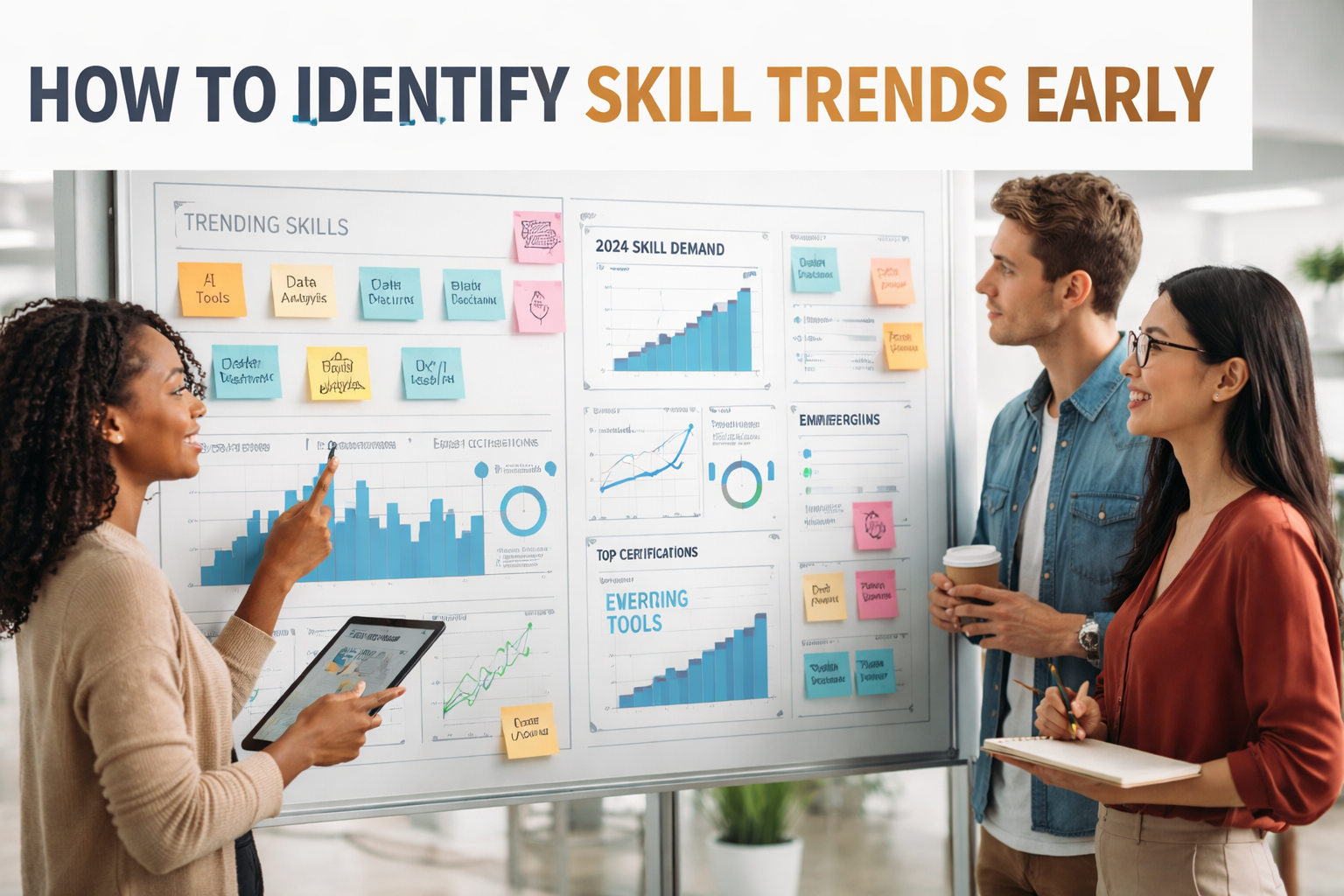
In today’s fast-changing world, skills become outdated faster than ever before. What was highly valuable five years ago may not carry the same weight today. Technology evolves, industries shift, and new opportunities emerge almost silently. The people who grow consistently in their careers are not just hard workers — they are early observers. They identify skill trends before they become mainstream.
But the real question is: How do you identify skill trends early?
You don’t need to be a futurist, don’t need insider information. You simply need awareness, curiosity, and a structured approach. In this article, we’ll explore practical ways to recognize skill trends before they become crowded.
How to Identify Skill Trends Early?
1. Observe Industry Shifts, Not Just Job Titles
Most people look at job titles. Smart professionals look at skill requirements.
Go to job platforms like LinkedIn, Indeed, or company career pages. Search for roles in your field and carefully read the required skills. Notice patterns:
- Are multiple companies asking for the same new tool?
- Is there a specific certification appearing repeatedly?
- Are soft skills like “data-driven decision making” or “AI literacy” becoming common?
For example, five years ago, very few marketing jobs required knowledge of AI tools. Today, understanding AI-assisted content or automation tools is becoming increasingly important.
When the same skill appears across multiple companies, it’s no longer random — it’s a signal.
2. Follow Early Adopters and Industry Leaders
Trends don’t start everywhere at once. They usually begin with:
- Startups
- Tech companies
- Thought leaders
- Innovative teams
Follow professionals who are slightly ahead of you in your field. Watch what they are learning. See what tools they recommend. Observe what conferences they attend.
If many respected professionals suddenly start talking about the same topic, that’s not coincidence — that’s momentum building.
Pay attention to what they are experimenting with, not just what they have mastered. Early experimentation often indicates upcoming trends.
3. Study Funding and Investment Patterns
Money predicts movement.
When investors start funding certain industries heavily, it often signals growth. For example:
- The rise of fintech created demand for blockchain and financial compliance skills.
- The growth of edtech increased demand for instructional designers and online course creators.
- The expansion of health-tech created opportunities for digital health analysts.
You don’t need to be a financial expert. Simply read startup news, funding announcements, or industry reports. When capital flows into a sector, skills connected to that sector usually grow in demand.
4. Watch What Problems Are Increasing
Skills grow where problems increase.
Ask yourself:
- What challenges are businesses struggling with?
- What complaints are customers repeatedly sharing?
- What inefficiencies are visible in your workplace?
For example:
- As remote work increased, companies struggled with communication and productivity. This created demand for remote collaboration tools and project management skills.
- As data volumes increased, businesses needed people who could interpret data effectively.
When a problem becomes common, a skill that solves it becomes valuable.
5. Analyze Freelance Platforms for Skill Trends
Freelance marketplaces are often faster indicators than corporate job boards.
Search for:
- Most posted projects
- Frequently requested tools
- Skills with rising hourly rates
If you notice clients frequently requesting specific tools or knowledge areas, it shows real market demand. Freelance trends often reflect early adoption because companies test new needs through freelancers before hiring full-time employees.
6. Monitor Technology Announcements for Skill Trends
Whenever a major technology platform launches a new feature, ask:
“Who will need to learn this?”
When new software is introduced, new skill gaps are created. Early learners fill those gaps first.
For example:
- Automation tools created demand for workflow specialists.
- AI writing tools increased demand for AI content strategists.
- Data visualization software increased demand for dashboard experts.
Instead of feeling overwhelmed by new tools, see them as opportunities.
7. Look for Skill Combinations, Not Single Skills
Trends often emerge at intersections.
Instead of thinking:
- “Coding”
- “Marketing”
- “Design”
Think:
- Marketing + Data
- Design + Psychology
- Writing + SEO + AI
The most valuable skills in the future are often combinations. When two industries overlap, a new niche forms. If you position yourself at that intersection early, competition remains lower.
8. Track Certification Updates for Skill Trends
Professional certifications change when industries change.
If certification bodies update their syllabus to include new modules, it indicates industry transformation. For example:
- New data privacy laws created demand for compliance certifications.
- Cloud computing growth increased demand for cloud certifications.
- Cybersecurity updates led to new security certifications.
Certification updates are often official recognition that a skill is becoming essential.
9. Notice Conversations in Communities for Skill Trends
Communities reveal trends early.
Join:
- Professional forums
- Slack groups
- LinkedIn communities
- Industry-specific groups
Observe what people are asking. When many professionals start asking similar questions about a new tool or concept, it shows curiosity and early demand.
Questions often predict trends before headlines do.
10. Watch Salary Shifts for Skill Trends
Salary growth indicates skill scarcity.
If a specific skill suddenly commands higher compensation, it means supply is low but demand is rising.
You can:
- Compare salary reports annually.
- Track freelance hourly rates.
- Observe compensation discussions.
When companies pay more for a skill, it signals urgency.
11. Study Global Trends, Not Just Local
Skill trends often start in one country and spread globally.
If you notice a skill becoming popular in developed markets, there’s a high chance it will expand to other regions. Being early in your local market can give you a significant advantage.
For example:
- Digital marketing expanded globally after early adoption in tech hubs.
- Remote work tools grew internationally after initial startup adoption.
Look beyond your immediate environment.
12. Pay Attention to Tool Integrations
When major platforms integrate with a tool, it signals long-term adoption.
For example:
- When productivity tools integrate AI features.
- When social platforms integrate analytics dashboards.
- When CRM systems integrate automation features.
Integration means the technology is stabilizing and becoming mainstream. Learning those tools early increases your relevance.
13. Analyze Your Own Workflow
Sometimes trends are visible in your daily work.
Ask:
- Which tasks are repetitive and likely to be automated?
- Which tasks require human creativity and judgment?
- Which areas consume the most time?
If automation is reducing repetitive work, skills related to strategy, analysis, and creativity may become more valuable.
Personal observation is powerful.
14. Look for Skill Gaps in Teams
In your workplace, observe:
- What tasks are outsourced?
- Where does the team struggle?
- What expertise is missing?
If companies repeatedly outsource a specific function, it may indicate rising demand and limited internal expertise.
That gap can become your opportunity.
15. Read Industry Reports and Forecasts
Every year, consulting firms, research institutions, and industry bodies publish reports on future skills.
Instead of reading headlines, analyze the detailed sections:
- Emerging technologies
- Workforce predictions
- Automation impact
- Digital transformation
Patterns across multiple reports often indicate strong future direction.
16. Learn to Differentiate Trend vs Hype
Not everything new is a trend.
Ask:
- Does this solve a real problem?
- Are businesses paying for it?
- Is adoption increasing steadily?
- Is there infrastructure supporting it?
A hype fades quickly. A trend grows steadily.
Sustainable trends usually:
- Solve practical problems
- Improve efficiency
- Reduce costs
- Increase revenue
17. Build Small Experiments for Skill Trends
You don’t need to fully commit immediately.
When you identify a possible trend:
- Take a short course.
- Do a small project.
- Test it in your current work.
- Offer it as a side skill.
Experimentation reduces risk while increasing awareness.
Early learning gives you confidence before competition increases.
18. Focus on Transferable Foundations
While identifying trends, also build foundational skills:
- Communication
- Critical thinking
- Problem solving
- Adaptability
Trends change, but foundational abilities remain relevant. The best professionals combine strong fundamentals with trend awareness.
19. Track Patterns Over Time
Don’t react instantly. Observe over months.
If a skill:
- Appears repeatedly in job descriptions
- Gains consistent discussion
- Shows steady salary growth
- Is integrated into mainstream tools
Then it’s likely a long-term trend.
Consistency matters more than noise.
20. Develop a Habit of Curiosity
Finally, the most important skill for identifying trends is curiosity.
Ask questions daily:
- What is changing?
- Why is it changing?
- Who benefits?
- Who needs to adapt?
People who stay curious rarely become obsolete.
Conclusion
Identifying skill trends early is not about prediction — it’s about observation.
The future leaves clues in:
- Job descriptions
- Conversations
- Investments
- Technology launches
- Salary changes
- Community discussions
Most people notice trends when they become crowded. Smart professionals notice them when they are still quiet.
If you train yourself to observe patterns, experiment early, and stay adaptable, you won’t chase trends — you’ll ride them before they become mainstream.
In a competitive world, timing matters. And the earlier you prepare, the stronger your career advantage becomes.
The future doesn’t belong to the most talented.
It belongs to the most aware.
And awareness is a skill you can start building today.
To read more such blogs, visit the Best Job Tool.






Comments
Be the first to leave a comment.