

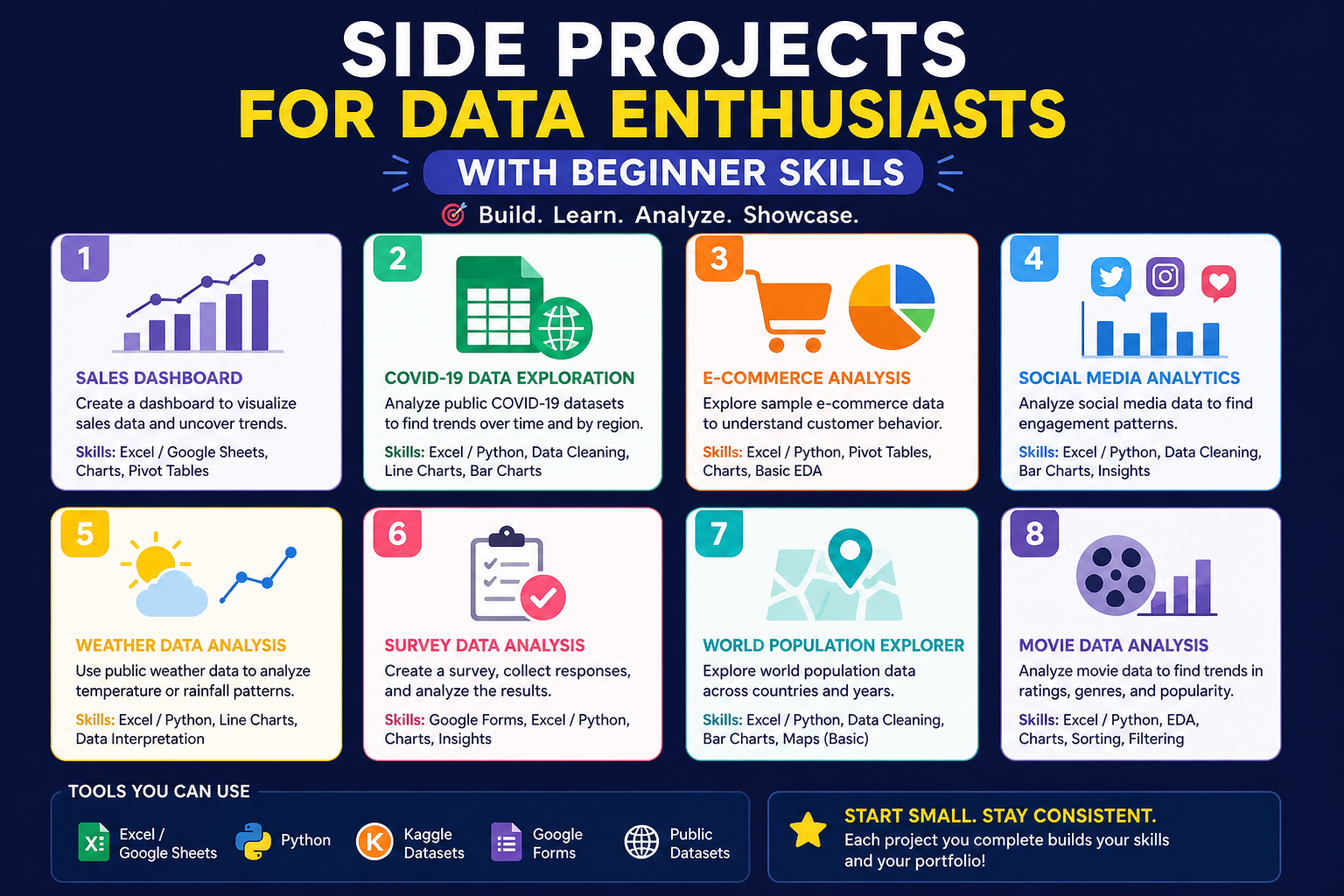
Introduction
Starting a career in data can feel overwhelming, especially when you lack real-world experience. However, the most effective way to build practical skills is through side projects. These projects help you apply theoretical knowledge, understand real datasets, and demonstrate your capabilities Enthusiasts to employers.
For beginners, the goal is not complexity but consistency. Simple, well-structured projects can be more impactful than advanced but incomplete work. By focusing on clarity, problem-solving, and presentation, you can create a portfolio that reflects strong foundational skills.
Work With Public Datasets
One of the easiest ways to begin is by using publicly available datasets. These allow you to practice without needing access to proprietary data.
You can:
- Analyze sales, healthcare, or education datasets
- Explore government open data portals
- Work with datasets from platforms like Kaggle
- Study trends in population, economy, or user behavior
Focus on asking clear questions such as trends over time, comparisons, or Enthusiasts patterns. The objective is to show your ability to derive insights from raw data.
Build Simple Data Cleaning Projects
Data cleaning is a critical skill that many beginners Enthusiasts overlook. Real-world data is rarely perfect, and handling messy datasets is highly valuable.
Start with projects where you:
- Remove duplicates and inconsistencies
- Handle missing values
- Standardize formats (dates, categories, etc.)
- Prepare datasets for analysis
Document your process clearly. Employers value your approach to cleaning data as much as the final output.
Create Basic Data Visualizations
Visualization helps communicate insights effectively. Even simple charts can demonstrate strong understanding when used correctly.
You can create:
- Bar charts to compare categories
- Line graphs to show trends over time
- Pie charts for distribution analysis
- Dashboards using tools like Excel or Power BI
Focus on clarity rather than design complexity. Each visualization should answer a specific question.
Perform Exploratory Data Analysis (EDA)
EDA projects allow you to explore datasets and uncover patterns without predefined hypotheses.
In these projects, you can:
- Identify correlations between variables
- Detect outliers or anomalies
- Understand distributions and patterns
- Generate insights through summary statistics
Explain your findings in simple language. The ability to interpret data is more Enthusiasts important than just running analysis.
Build Small End-to-End Projects
As you gain confidence, combine multiple steps into one complete project.
An end-to-end project may include:
- Data collection
- Cleaning and preprocessing
- Analysis and visualization
- Final insights and recommendations
For example, you could analyze customer behavior data and suggest strategies to improve engagement.
Using tools like the Best Job Tool can help you organize your workflow, track progress, and document each stage clearly for your portfolio.
Work on Real-Life Problem Statements
Projects become more impactful when they solve practical problems.
You can try:
- Analyzing local business sales trends
- Studying social media engagement patterns
- Evaluating product pricing strategies
- Examining job market trends
Real-world relevance makes your work more compelling to employers and easier to discuss in interviews.
Practice Basic Automation
Automation is a valuable addition even for beginners. It shows efficiency and forward-thinking.
Start with simple tasks such as:
- Automating data cleaning steps
- Scheduling data updates
- Creating reusable scripts for analysis
- Generating reports automatically
Even small automation projects demonstrate your ability to optimize workflows.
Document and Present Your Work Clearly
A project is only valuable if others can understand it. Presentation plays a major role in how your work is perceived.
Ensure each project includes:
- Problem statement
- Dataset source
- Steps taken
- Key insights
- Final conclusion
Use simple language and clear structure. Avoid unnecessary technical jargon.
Many beginners use the Best Job Tool to organize projects, maintain documentation, and present their work in a structured way that aligns with career goals.
Conclusion
Side projects are the foundation of a successful data career, especially for beginners. They provide hands-on experience, improve problem-solving skills, and build confidence.
By starting with simple datasets, focusing on data cleaning and visualization, and gradually moving toward end-to-end projects, you can create a strong and practical portfolio. With consistent effort and structured tracking using tools like the Best Job Tool, you can position yourself effectively for entry-level data roles.
The key is to start small, stay consistent, and focus on clarity over complexity.






Comments
Be the first to leave a comment.