

Introduction: A Global Shift in Hiring Trends
The job market is undergoing a massive transformation as companies increasingly look beyond borders to find the best talent. By 2026, hiring international professionals will no longer be a niche strategy; it will be industries hiring international talent 2026 a mainstream business necessity. Companies are realizing that the key to innovation and competitiveness lies in building diverse, globally distributed teams.
Remote work, digital collaboration tools, and flexible visa policies have made cross-border hiring easier than ever before. Organizations now have access to a worldwide talent pool where skills, not geography, determine opportunities. Whether it’s AI engineers in India, marketing strategists in the UK, or data analysts in the Philippines, the global hiring wave is reshaping industries at a remarkable pace.
In this blog, we’ll explore the top industries hiring international talent in 2026, what’s driving this global demand, and how professionals can position themselves to take advantage of these growing opportunities. From tech and finance to healthcare and education, these sectors are setting the stage for a new era of global employment.
Technology: The Backbone of Global Hiring
AI, Data Science, and Cybersecurity in High Demand
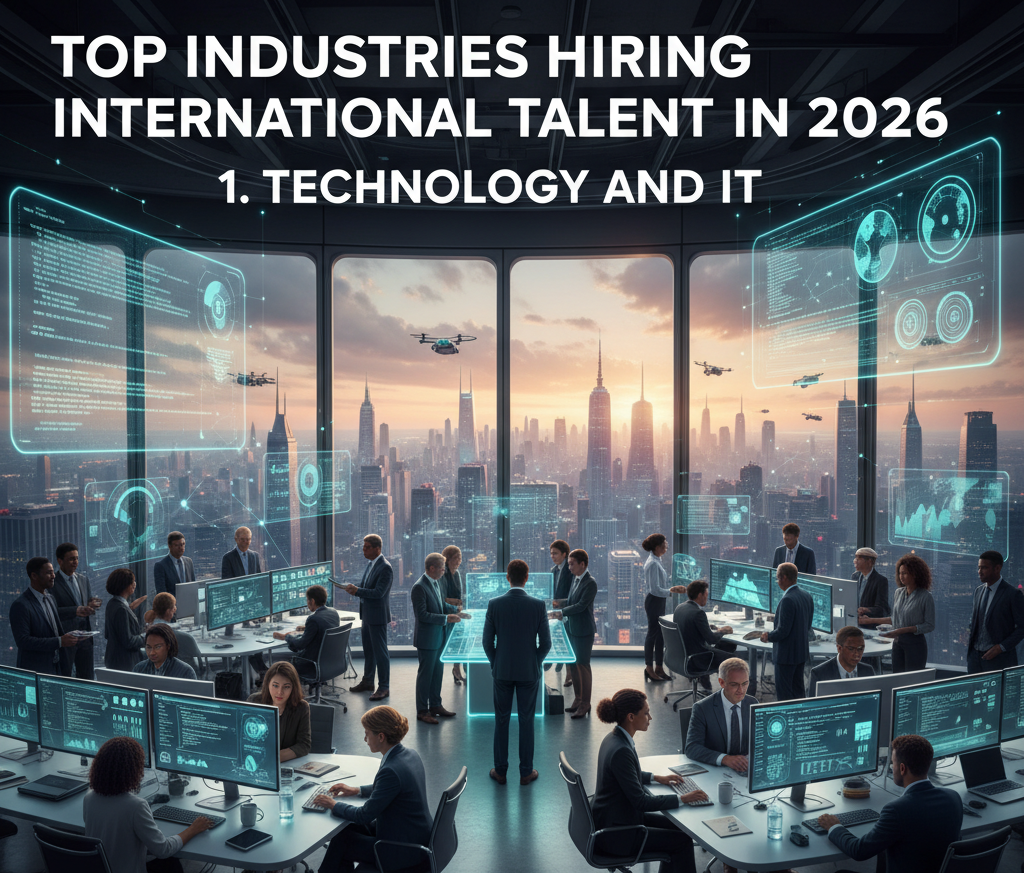
No surprise here, the technology sector continues to lead the global hiring race. By 2026, the demand for skilled professionals in artificial intelligence, data science, and cybersecurity will reach new heights. With digital transformation now industries hiring international talent 2026 a core business strategy across industries, companies are searching for experts who can build smart systems, protect networks, and turn data into actionable insights.
Remote work has further accelerated this demand. Tech firms in the U.S., Canada, and Europe are hiring developers, cloud architects, and machine learning engineers from India, Vietnam, and Eastern Europe. The growing acceptance of remote collaboration tools like GitHub, Slack, and Jira has made international teamwork seamless and efficient.
Emergence of Global Remote Tech Hubs
Interestingly, new “tech hubs” are emerging in places like Bangalore, Warsaw, and Nairobi. These regions are now recognized for their innovation ecosystems and highly skilled workforces. Startups and multinational corporations alike are setting up hybrid teams, where half of the workforce operates remotely from different time zones.
In 2026, expect more companies to adopt “follow-the-sun” models where projects continue around the clock as global teams hand off work between regions. This model not only increases productivity but also ensures companies can tap into diverse problem-solving perspectives.
Finance and FinTech: Expanding the Global Talent Map
Digital Banking and Crypto Careers Go Global
The finance industry is rapidly digitizing, leading to a surge in international hiring. From blockchain developers to financial analysts specializing in cryptocurrency, the demand for global financial expertise is exploding. FinTech companies, in particular, are recruiting remote professionals who understand both finance and technology.
The rise of decentralized finance (DeFi) and digital banking platforms means companies are no longer restricted to local hiring. Firms like Revolut, Stripe, and Coinbase have already set a precedent by employing cross-border teams that operate across multiple continents.
Why Global Financial Skills Are in Demand
Financial regulations differ from country to country, so hiring talent with regional expertise gives companies an edge. For example, a U.S.-based firm expanding into Southeast Asia might hire compliance officers and analysts familiar with ASEAN regulations. Similarly, risk management experts from India or Singapore are in high demand due to their experience in emerging markets.
By 2026, international finance careers will be among the most mobile, allowing professionals to work for global organizations without relocating physically. Those with certifications such as CFA, CPA, or FinTech-focused credentials will find particularly strong opportunities across borders.
Healthcare and Life Sciences: Global Collaboration for Better Outcomes
Medical Professionals and Researchers Crossing Borders
The healthcare industry is entering a global hiring boom driven by the rise of telemedicine, biotechnology, and health data analytics. Countries facing healthcare staff shortages, especially in nursing, laboratory science, and clinical research, are increasingly turning to international talent.
By 2026, the demand for cross-border collaboration in healthcare will reach record levels. Telehealth platforms are allowing doctors in one country to consult patients in another. Pharmaceutical companies are hiring international data scientists and research associates to accelerate drug discovery using AI-driven models.
Biotech and AI Healthcare: The Next Frontier
Artificial intelligence is reshaping medical diagnostics, personalized treatment, and preventive healthcare. This shift has created new roles for professionals skilled in bioinformatics, machine learning, and genomics research. The intersection of technology and biology is producing a wave of opportunities for global collaboration.
Countries like Germany, Canada, and Australia are simplifying visa processes for healthcare workers to address domestic shortages. As a result, skilled medical professionals and researchers can expect broader career options and competitive salaries in 2026 and beyond.
Education and E-Learning: A Global Classroom Revolution
Digital Learning Creates Worldwide Teaching Opportunities
The global e-learning boom is one of the most significant employment shifts of the decade. The pandemic triggered a surge in online education, but the trend is continuing strongly into 2026. From industries hiring international talent 2026 online tutoring to curriculum development, international hiring in education has never been higher.
Educational technology (EdTech) platforms are recruiting instructors, course designers, and content creators from around the world. Professionals with language skills, subject expertise, and digital teaching experience are finding stable and rewarding roles through platforms like Coursera, Udemy, and Byju’s.
Cross-Border Knowledge Exchange and Innovation
As education becomes more digital, knowledge has no boundaries. Universities are hiring remote faculty, academic researchers, and learning designers globally to support hybrid programs. The adoption of virtual reality (VR) and AI-driven learning platforms is also fueling demand for professionals who can blend technology with pedagogy.
By 2026, the education industry will be one of the most inclusive sectors for international talent, as online learning bridges cultural and geographical divides. For educators and trainers seeking global exposure, this is a golden era to build international teaching careers without leaving home.
Creative and Digital Marketing Industries: Global Storytelling Takes Center Stage
Content, Design, and Branding Without Borders
As global commerce moves online, businesses are competing for attention in a digital-first world. This has made creative and marketing professionals some of the most sought-after international hires.
Companies want storytellers who can connect with diverse audiences across languages and cultures. Copywriters, graphic designers, SEO specialists, and social media strategists are being recruited globally to bring fresh perspectives and local insights to international campaigns.
Remote Creativity and Global Collaboration
Thanks to collaboration tools like Canva, Figma, and Trello, marketing teams can work efficiently across continents. Agencies are increasingly building distributed creative departments, where campaign ideas are brainstormed by multicultural teams working remotely.
By 2026, digital marketing and content creation will remain key industries hiring international talent 2026 drivers of cross-border hiring. Businesses recognize that creative diversity leads to better brand storytelling, helping them reach global audiences with authenticity and relevance.
Conclusion: The Future Belongs to Borderless Talent
The shift toward hiring international talent is not just a passing trend; it’s a defining feature of the modern global economy. By 2026, industries across technology, finance, healthcare, education, and marketing will depend on global collaboration more than ever before.
For professionals, this means endless opportunities to grow, learn, and contribute on a global scale. The best candidates will be those who combine technical expertise with adaptability, cultural awareness, and strong communication skills.
For companies, the message is clear: the future of innovation lies in diversity. Building cross-border teams isn’t just about filling roles; it’s about unlocking creativity, agility, and global competitiveness.
As technology continues to break down barriers, the next wave of global hiring will redefine what it means to work together, not as employees separated by geography, but as one interconnected global workforce shaping the industries of tomorrow.
Find Your Dream Job Today Explore Endless Career Opportunities and Secure Your Next Role with Best Job Tool






Comments (11)
Some really nice stuff on this site, I like it.
Thanks for sharing. I read many of your blog posts, cool, your blog is very good.
I don’t think the title of your article matches the content lol. Just kidding, mainly because I had some doubts after reading the article.
Your point of view caught my eye and was very interesting. Thanks. I have a question for you.
Your article helped me a lot, is there any more related content? Thanks!
Can you be more specific about the content of your article? After reading it, I still have some doubts. Hope you can help me.
Your point of view caught my eye and was very interesting. Thanks. I have a question for you. https://www.binance.bh/si-LK/futures/ref?code=LBF8F65G
Your article helped me a lot, is there any more related content? Thanks!
Your article helped me a lot, is there any more related content? Thanks! https://accounts.binance.com/register/person?ref=QCGZMHR6
Your point of view caught my eye and was very interesting. Thanks. I have a question for you.
Thanks for sharing. I read many of your blog posts, cool, your blog is very good. https://accounts.binance.com/register/person?ref=JW3W4Y3A