

Introduction
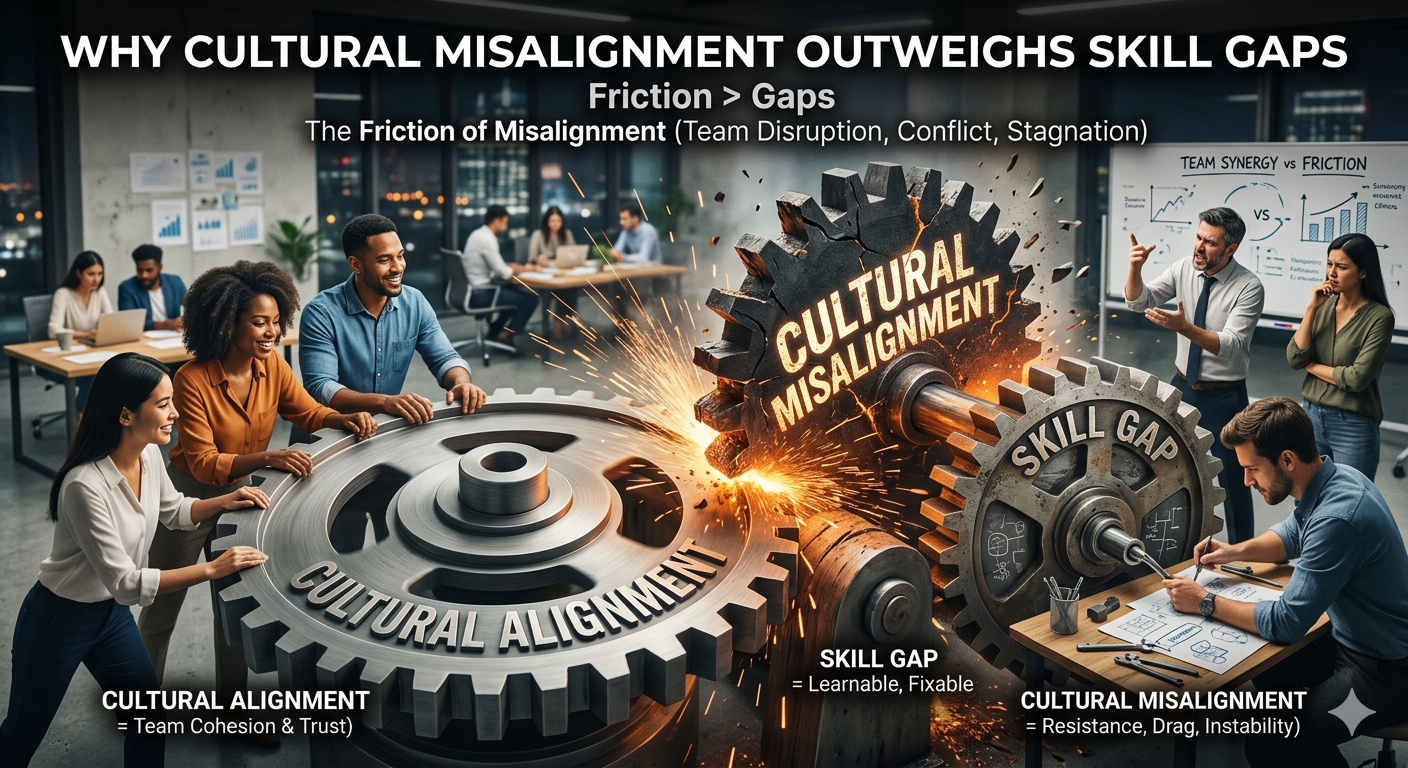
Many candidates believe that strong technical skills guarantee success in hiring and long-term job performance. However, organizations often reject highly skilled candidates if they do not align with the company’s culture. At the same time, they may hire candidates with moderate skills who fit well with the team. This reality explains exactly why cultural misalignment outweighs skill gaps in modern hiring decisions.
Companies build teams, not just individual contributors. Therefore, how a person communicates, collaborates, and adapts to the work environment often matters more than how much they know technically.
Culture affects daily collaboration
Workplace culture defines how teams communicate, share feedback, and solve problems. If a candidate’s working style does not match the team, daily collaboration becomes difficult.
For example, a highly independent individual may struggle in a team that values constant communication. Similarly, someone who prefers structured processes may feel uncomfortable in a flexible startup environment.
Cultural alignment ensures smoother teamwork and productivity.
Skills can be learned, mindset is harder to change
Technical skills evolve over time. Employees can learn new tools, frameworks, and processes through training and experience.
However, mindset, attitude, and behavior patterns are much harder to change. Companies therefore prefer candidates who already align with their values and work culture.
Hiring for mindset reduces long-term risk.
Communication style impacts team efficiency
Effective communication plays a major role in team performance. Misalignment in communication style can lead to misunderstandings, delays, and frustration.
For instance, some teams prefer direct and fast communication, while others value detailed discussions and consensus. Candidates who adapt to the team’s communication style integrate more easily.
Strong alignment improves workflow efficiency.
Conflict resolution depends on cultural fit
Every workplace experiences disagreements. Cultural fit determines how individuals handle conflicts.
Employees who align with company values resolve conflicts constructively and maintain positive relationships. In contrast, misaligned individuals may escalate issues or create tension within teams.
Healthy conflict resolution supports long-term team stability.
Work environment expectations vary
Different organizations operate differently. Startups may require flexibility, fast decision-making, and risk-taking. Enterprises may emphasize structure, process, and consistency.
Candidates who do not align with these expectations may feel dissatisfied or underperform. Cultural alignment ensures that employees adapt to the work environment comfortably.
Fit with environment improves job satisfaction.
Retention risk increases with misalignment
Employees who do not fit the company culture are more likely to leave early. This increases hiring and training costs for organizations.
Employers prefer candidates who are likely to stay and grow within the company. Cultural alignment reduces turnover and improves long-term stability.
Retention plays a key role in hiring decisions.
Team morale depends on alignment
One misaligned individual can affect the morale of an entire team. Negative behavior, lack of collaboration, or poor communication can reduce team performance.
Organizations therefore prioritize candidates who contribute positively to team culture. A well-aligned team works more efficiently and maintains a healthier work environment.
Team harmony improves productivity.
Performance depends on comfort and alignment
Employees perform best when they feel comfortable in their work environment. Cultural alignment helps individuals understand expectations, communicate effectively, and contribute confidently.
Misaligned employees may struggle to adapt, even if they are technically strong. This mismatch can reduce overall performance.
Comfort drives consistent output.
Hiring decisions consider long-term impact
Hiring managers think beyond immediate skill requirements. They consider how a candidate will fit into the team over time.
A technically strong but culturally misaligned candidate may create challenges in collaboration, retention, and team dynamics. Therefore, companies often prioritize cultural fit over skill gaps.
Long-term impact influences hiring choices.
Balance between skills and culture
Cultural fit does not mean ignoring technical ability. Companies still require a baseline level of skills for the role.
However, when candidates meet the minimum skill requirement, cultural alignment becomes the deciding factor. The best hires combine both technical capability and strong cultural fit.
Balance leads to successful hiring outcomes.
Conclusion
Technical skills are important, but they do not guarantee success in team-based work environments. That is precisely why cultural misalignment outweighs skill gaps in modern hiring decisions.
Employers prioritize candidates who align with their values, communicate effectively, and contribute positively to team dynamics. Skills can be developed over time, but cultural fit determines how well an individual integrates and performs within an organization. By focusing on both capability and alignment, candidates can improve their hiring success and build stronger, long-term careers.
Find Your Dream Job Today – Explore Endless Career Opportunities and Secure Your Next Role with Best Job Tool.





Comments
Be the first to leave a comment.