

Introduction
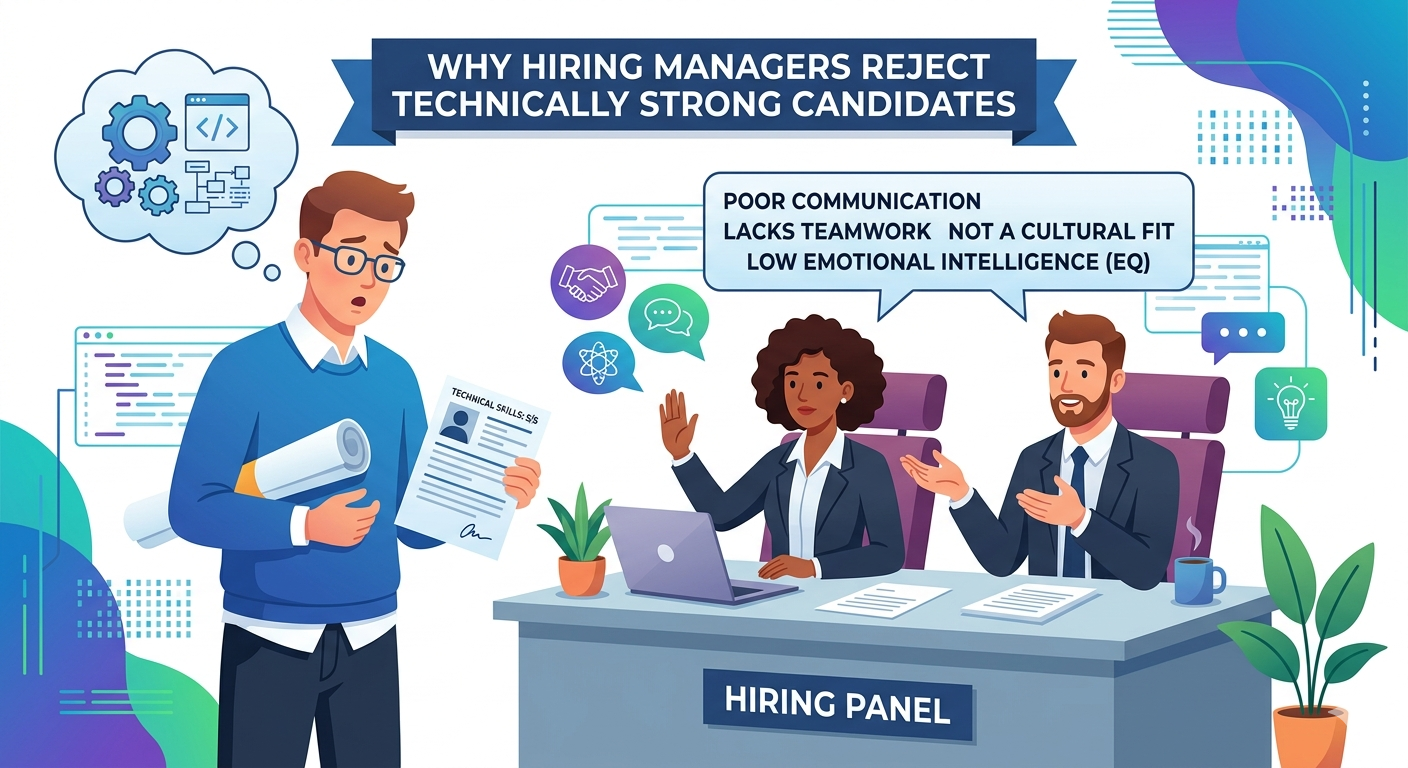
Many candidates believe that strong technical skills guarantee job offers. They focus on mastering coding, tools, and domain knowledge to stand out. However, in real hiring scenarios, technically strong candidates are often rejected. This happens because hiring decisions involve multiple factors beyond raw skill. This explains exactly why hiring managers reject technically strong candidates in modern recruitment processes.
Companies hire people who can work effectively within teams, communicate clearly, and contribute to long-term goals. Technical ability alone does not ensure success in these areas.
Poor communication during interviews
First, communication plays a major role in hiring decisions. Candidates who cannot explain their thought process clearly create uncertainty for interviewers.
Even if their solutions are correct, unclear explanations make it difficult to assess their thinking. Hiring managers prefer candidates who communicate simply and confidently.
Clarity builds trust during evaluation.
Lack of problem-solving structure
Some technically strong candidates jump directly to solutions without explaining their approach. This behavior makes it hard for interviewers to evaluate their reasoning.
Hiring managers look for structured thinking, including problem breakdown, assumptions, and step-by-step logic.
A clear approach often matters more than a perfect answer.
Overconfidence and poor attitude
Confidence is important, but overconfidence can create negative impressions. Candidates who dismiss feedback, interrupt interviewers, or appear inflexible may be rejected.
Hiring managers value humility, openness, and willingness to learn. Attitude plays a key role in team environments.
Professional behavior influences hiring outcomes.
Weak collaboration signals
Modern workplaces rely heavily on teamwork. Candidates who focus only on individual performance may not demonstrate collaboration skills.
Interviewers assess whether candidates can work with others, accept feedback, and contribute to shared goals.
Lack of teamwork signals can reduce a candidate’s ranking.
Misalignment with role requirements
Not all roles require advanced technical expertise. Some positions focus on practical implementation, maintenance, or incremental improvements.
Technically strong candidates may be rejected if their skills do not align with the role’s actual needs.
Role fit is as important as technical strength.
Cultural misalignment with the team
Cultural fit plays a significant role in hiring decisions. Candidates who do not align with company values or team dynamics may struggle to integrate.
Hiring managers prefer candidates who match the team’s communication style, work approach, and environment.
Cultural alignment reduces long-term risk.
Inability to simplify complex ideas
Technical roles often require explaining complex concepts to non-technical stakeholders. Candidates who cannot simplify their ideas may face rejection.
Interviewers evaluate whether candidates can communicate effectively with different audiences.
Simplicity improves real-world effectiveness.
Ignoring real-world constraints
Some candidates focus on ideal solutions without considering practical constraints such as scalability, cost, or time.
Hiring managers prefer candidates who balance theoretical knowledge with real-world limitations.
Practical thinking strengthens decision-making.
Inconsistent performance across rounds
Candidates who perform exceptionally well in one round but poorly in others may raise concerns about reliability.
Hiring teams look for consistent performance throughout the process. Consistency signals dependability.
Unstable performance can lead to rejection.
Higher perceived risk for employers
Hiring decisions involve risk. Technically strong candidates with poor communication, attitude issues, or misalignment may be seen as risky hires.
Employers often choose candidates who offer balanced strengths and lower risk rather than those with only technical excellence.
Risk assessment influences final decisions.
Conclusion
Technical skills are important, but they do not guarantee hiring success. That is precisely why hiring managers reject technically strong candidates in many real-world scenarios.
Employers evaluate communication, problem-solving approach, collaboration, cultural fit, and consistency alongside technical ability. Candidates who develop these complementary skills increase their chances of success and build stronger, long-term careers. By focusing on both technical expertise and professional behavior, candidates can stand out more effectively in competitive hiring processes.
Find Your Dream Job Today – Explore Endless Career Opportunities and Secure Your Next Role with Best Job Tool.






Comments
Be the first to leave a comment.