

Introduction
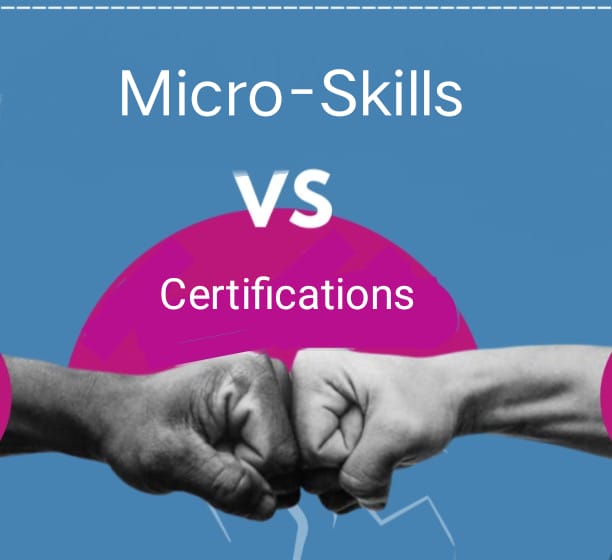
Have you ever thought that you won’t get a good job just because you don’t have big certifications and just have micro-skills?
If you think so, then you’re wrong, because today skills have become more important than certificates. If you have the right skills, you can stand out even among people who have big certifications. You can still get a good job because you have what a company truly needs — the ability to perform your work effectively and contribute to growth.
And if you still don’t believe it or don’t know how to start building these skills, then this article is for you.
This article will explain what micro-skill is, why they are the building blocks of real expertise, why they matter more than big certifications, and how you can develop them.
So, let’s begin.
Definition of Micro-Skills.
Micro-skills refer to small practical skills used in daily work. They are those small abilities that enhance your productivity, communication, decision-making, and work quality. For example – writing a good email, active listening, time management, clear communication, notes taking, research, problem solving.
These micro skills are small abilities but they have a strong impact on your overall performance. These are the basic skills that’s why many people ignore them but they don’t know that these skills only help them to become smarter, faster, and professionally strong.
Why Micro-Skills Are the Building Blocks of Real Expertise?
Micro-skill works like small investments—you develop them in tiny steps, but their impact keeps growing over time. When you improve even one micro-skill, such as clarity in communication or better attention to detail, it strengthens your entire workflow.
For example, improving your note-taking helps you understand tasks better. Better understanding leads to fewer mistakes. Fewer mistakes build trust. Trust opens up more opportunities.
This is how micro-skills compound: one small improvement multiplies into many long-term benefits.
Why Micro-Skills Matter More than Big Certifications?
1. Certifications show knowledge & micro-skills show execution
If someone has a certificate, it only tells us that the person has knowledge of a particular field. But it does not tell us whether they can actually perform the work well or not. Having a certificate does not guarantee good performance. Sometimes, a person without any certificate may have stronger micro-skills, which allow them to do the job even better than someone who is certified.
This is why micro-skills are essential for building real capability. Without micro-skill, you cannot execute any task properly, no matter how much theoretical knowledge you have.
Certificates represent theory, while micro-skills represent the practical side of that knowledge.
2. Micro-skills improve employability in every industry
If an employee has strong micro-skills, it means they can perform well in the company. When an employee uses micro-skill in their work, they are able to follow every step properly because they have practical knowledge of each task. This leads to better results for the company.
For example, imagine a person who has a content writing certification. But when they start working for a company, they struggle with basic tasks. They cannot write clear emails, they lack basic data interpretation skills, they cannot manage their time, they don’t listen actively, and they are unable to communicate with clients. In this situation, the certified employee becomes a loss for the company.
On the other hand, someone without any certification but with strong micro-skills becomes an asset. They know how to write clear emails, understand basic data, manage time effectively, listen actively, and communicate well with clients. These skills directly improve the company’s performance and contribute to its growth and profit.
That’s why micro-skills are more important than big certifications.
3. The hidden advantage
If a person has strong micro-skills, they don’t need additional training to start working in any company. Micro-skills are extremely helpful—not just for performing well in a company, but also for improving daily life activities. Small habits make our lifestyle easier and better, and when our lifestyle improves, our way of working also becomes smoother and more effective.
If we have micro-skills—such as communicating clearly, managing time efficiently, and handling problems easily—we can complete every task properly and deliver better output to the company. Recruiters also prefer candidates who have strong micro-skills rather than only big certifications. This is because recruiters know that if they hire someone who already has micro-skills, the company will not need to train them much. They can handle their work easily and work without constant supervision.
This becomes beneficial for both the recruiter and the candidate. Since the candidate already knows how to manage their tasks from day one, they get better support in the company and can adjust quickly.
That’s why having micro-skill is truly essential.
4. Easier and faster to learn
If you think you don’t have time to learn micro-skill, then you are absolutely wrong. Micro-skills do not require a lot of time—you can learn them easily and quickly. You don’t need long courses or expensive classes to develop micro-skills. You can learn them simply by observing your surroundings.
Micro-skills are learnable through practice, short videos, internships, and everyday work. You can learn by observing your seniors, setting a daily 15-minute practice routine, and improving one micro-skill at a time. If you love listening to music, you can even use that time to improve yourself. You can take feedback from mentors, strengthen your decision-making through small daily choices, and improve step by step.
So don’t assume that learning micro-skills is difficult or time-consuming. You just need to stay active, focused, and open to learning from your environment.
5. Help you to stand out without expensive degrees
A candidate with great communication and research skills can easily outperform someone who only has expensive certifications. Just because a person has costly certificates doesn’t guarantee that recruiters or seniors will notice them. But if you have strong micro-skills and you use them to work effectively, recruiters and seniors will definitely notice your performance.
If you have micro-skills, you can handle many tasks that a certified person may still struggle with. Micro-skills make you stand out among many people, make you a strong employee, and even shape you into a better individual. These skills help you grow faster in your career.
With strong micro-skill, you can go much further in your professional journey, and your chances of getting promotions also increase.
If you want to grow bigger and achieve success in life, you must develop micro-skills.
6. Micro-skills improves workplace relationships
Micro-skills help in building good relationships between colleagues. If an employee has micro-skills like teamwork, feedback-taking, and understanding instructions properly, the work becomes smoother and employees can coordinate well with one another.
Because of micro-skills, one employee can build trust with another. When someone has strong micro-skill, they complete their tasks with full responsibility, which automatically builds trust among team members. Employees understand each other’s feedback better, take it positively, and use it to improve themselves. They listen to instructions carefully, understand them clearly, and follow them correctly. This ensures that every step of the task is completed properly, and the work is finished on time and efficiently.
These micro-skills also help reduce conflicts in the workplace and significantly improve overall productivity.
7. It make you highly adaptable in changing job markets
When an employee has strong micro-skill, they can easily adapt to changes in the job market. Today, technology is evolving very quickly—every month new tools and new systems are introduced. This creates challenges for many employees, and it also leads to conflicts within teams.
However, when employees have micro-skills, they adjust to these changes smoothly and work according to the new requirements. This increases their productivity, keeps teamwork conflict-free, and contributes to the company’s overall growth and profit.
On the other hand, having big certifications does not guarantee adaptability. A certified person may have knowledge of older tools and technologies that they learned earlier. But when new technology is introduced, they may struggle to learn and adjust.
Someone with strong micro-skills can adapt to any change easily without facing major difficulty.
If you want to know how to prepare for further job market change, then visit here.
How to Start Developing Micro-Skills?
- Daily 15-minute practice routine
To develop skills, create a simple 15-minute routine. Practice any one micro-skill every day for just 15 minutes—whether it is active listening, email writing, time management, communication, or anything else.
- Learn by observing seniors
It’s not necessary to sit in one place with a notebook or watch videos to learn micro-skills. You can learn them from your surroundings as well. For example, you can observe your seniors who work with you—notice their working style, how they manage their time, how they communicate with people, and how they handle different situations. By observing them, you can strengthen and improve your own micro-skill.
- Work on communication & writing
To develop strong skills, you need to focus mainly on your communication and writing abilities because these two are the foundation of almost everything. Communicate well with the people around you, and to improve your writing skills, practice writing an article or an email every single day.
- Ask for feedback
To develop your micro-skill, make use of feedback. Take feedback from your seniors, mentors, parents, or the people around you. Apply that feedback positively to improve your skills and your work. Work carefully on every piece of feedback, try to improve it, and then take feedback again from the same person to see whether you have improved compared to before.
- Practice decision-making
To practice decision-making skills, you don’t need to take big decisions. You can develop this skill by making small daily decisions thoughtfully. Make every small decision carefully, think it through, and consider its pros and cons before choosing. This also helps you strengthen your decision-making ability.
Conclusion
Micro-skill might look small on the surface, but they shape the foundation of real professional success. In today’s fast-changing work environment, companies don’t just want degrees or certificates—they want people who can communicate clearly, solve problems, manage time, adapt quickly, and deliver consistent results. These abilities come from micro-skills, not from expensive courses.
The best part is that micro-skills are easy to learn. You can build them through daily practice, observing others, taking feedback, and improving step by step. When you develop strong micro-skill, you work more confidently, build better relationships, reduce conflicts, and become the kind of employee every recruiter notices.
If you want long-term growth, faster promotions, and a successful career, start investing in micro-skills today—because these small skills create the biggest impact.
For more such blogs, visit here.






Comments
Be the first to leave a comment.