

Introduction
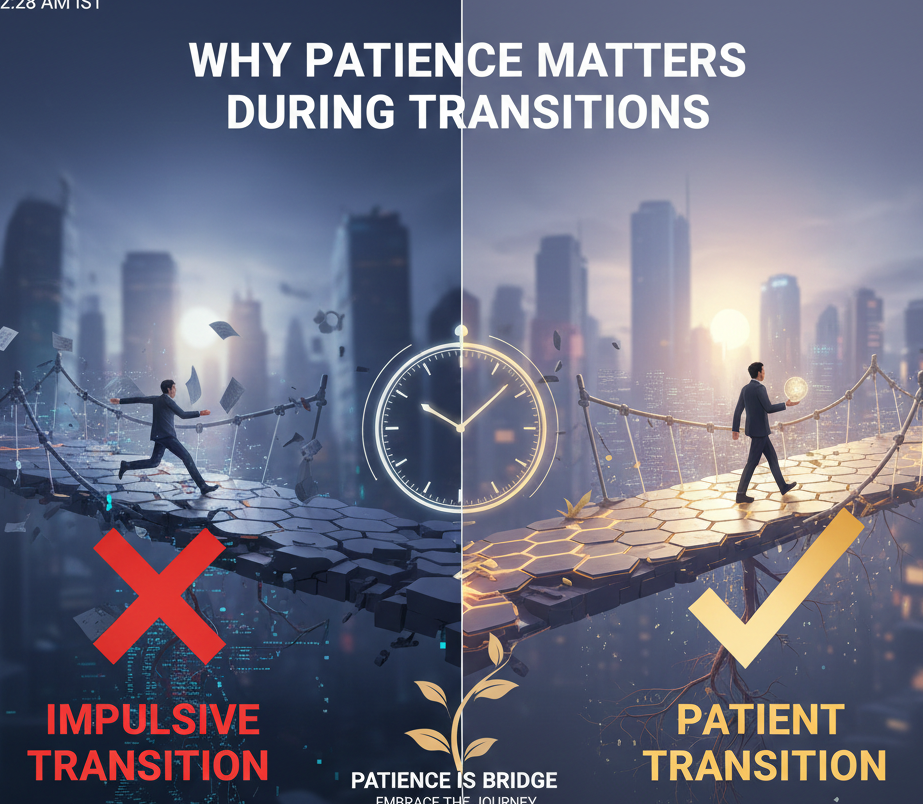
Career transitions often look simple from the outside. However, the reality can feel uncertain and demanding. Whether you are starting a new job, switching industries, or returning after a break, progress may not feel immediate. This is exactly why patience matters during transitions. It helps you stay composed while you adjust, learn, and rebuild momentum.
Patience is not passive waiting. It is a professional skill that supports better decisions, stronger performance, and long-term growth.
Transitions involve adjustment before results
Every transition requires a period of adaptation. You may need time to understand new expectations, internal processes, and team dynamics. Even when you are capable, unfamiliar systems can slow execution in the early stage.
This phase is not a sign of weakness. It is a natural part of entering a new environment. Patience allows you to focus on learning without unnecessary pressure. It also helps you stay consistent while your confidence catches up with your new responsibilities.
Patience protects decision-making under pressure
Transitions can trigger urgency. Many professionals feel they must prove themselves quickly. As a result, they may make rushed decisions, overcommit, or react emotionally to small setbacks.
Patience creates space for thoughtful action. It helps you evaluate feedback objectively. It helps you respond strategically instead of impulsively. This is especially important during job changes, career switches, or probation periods, where stability and professionalism matter.
When you stay patient, you stay in control.
Learning curves are part of every new role
Even experienced professionals face learning curves. A new role can introduce unfamiliar tools, new stakeholders, and different standards of quality. The ability to learn steadily often matters more than early speed.
Patience supports learning because it reduces stress and improves focus. It also encourages better communication. When you are patient, you ask clearer questions, document processes, and improve faster over time.
This creates a strong foundation for consistent performance.
Patience strengthens confidence and credibility
Confidence during transitions is built through repetition and results. It does not appear instantly. Early mistakes and slower delivery are common, especially when you are adjusting to new expectations.
Patience helps you treat early challenges as feedback, not failure. Over time, you become more accurate, faster, and more independent. This progression increases credibility with managers and teammates.
A calm, steady approach also signals maturity. That perception can influence future responsibilities and opportunities.
Trust and relationships take time to develop
Transitions are not only about tasks. They are also about people. In a new team, trust is built gradually through reliability, communication, and collaboration.
Trying to accelerate trust through overperformance can sometimes create pressure. Patience helps you observe team culture first. It helps you understand decision-making styles, communication norms, and expectations.
As relationships strengthen, work becomes smoother. Your role also becomes more stable.
Progress is often invisible during transition periods
Many professionals feel stuck during transitions because outcomes are not immediate. However, progress often happens quietly.
You may be learning how the organization works. You may be improving your workflow. You may be building better habits, communication skills, or decision-making ability. These changes may not be visible right away, but they create long-term performance improvement.
Patience keeps you consistent until your effort starts showing measurable results.
How to stay patient while staying productive
Patience becomes easier when you have structure. You do not need to wait for confidence to arrive. You can build it through disciplined action.
Focus on understanding priorities early. Break work into manageable steps. Share updates consistently. Ask questions when clarity is needed. Document feedback and apply it quickly.
Also, set realistic expectations for yourself. Measure progress weekly, not daily. Avoid comparing your timeline with others, because every transition has different challenges.
Patience combined with consistent execution creates steady career momentum.
Conclusion
Career transitions test stability, confidence, and decision-making. That is why patience matters during transitions. It helps you adapt without panic, learn without pressure, and grow without losing focus.
With patience, you build credibility through consistency. You also make smarter choices and perform better over time. Most importantly, you give yourself the space to succeed in the new phase.
If you are currently navigating a career transition and want better opportunities aligned with your goals, use the best job tool.
Find Your Dream Job Today – Explore Endless Career Opportunities and Secure Your Next Role with Best Job Tool.






Comments
Be the first to leave a comment.