

Introduction
Earlier, most candidates were hired mainly through their resumes, or sometimes a recruiter would take a short interview and select the candidate. But now the job market has become very competitive. Almost every candidate looks perfect on paper, and it has become very difficult for hiring teams to choose the right one. That is why, today, recruiter do screening to select the best candidate.
It is very important to understand how recruiter screening is different from hiring manager screening. But before that, it is even more important to understand what screening actually is.
When a candidate sends their resume to the hiring team, the first step in the hiring process is resume screening. In this stage, the employer carefully reviews every piece of information mentioned in the resume. They clearly examine the details and decide which candidates should move forward in the process.
Screening is a type of filtering process. In this process, all irrelevant candidates are removed, and only relevant candidates are selected. Screening can be done by a recruiter, by a hiring manager, or sometimes by both, so that they can choose the best candidate.
During screening, keywords are matched, basic eligibility is checked, and the resume is reviewed properly. Sometimes, phone screening or video screening is also conducted as part of the screening process.
Why Resumes Rejected by Recruiters Sometimes Pass Managers?
1. Difference in Screening Goals of Resumes
The first reason that makes recruiter screening different from hiring manager screening is purpose. The purpose of screening for a recruiter and a hiring manager is not the same.
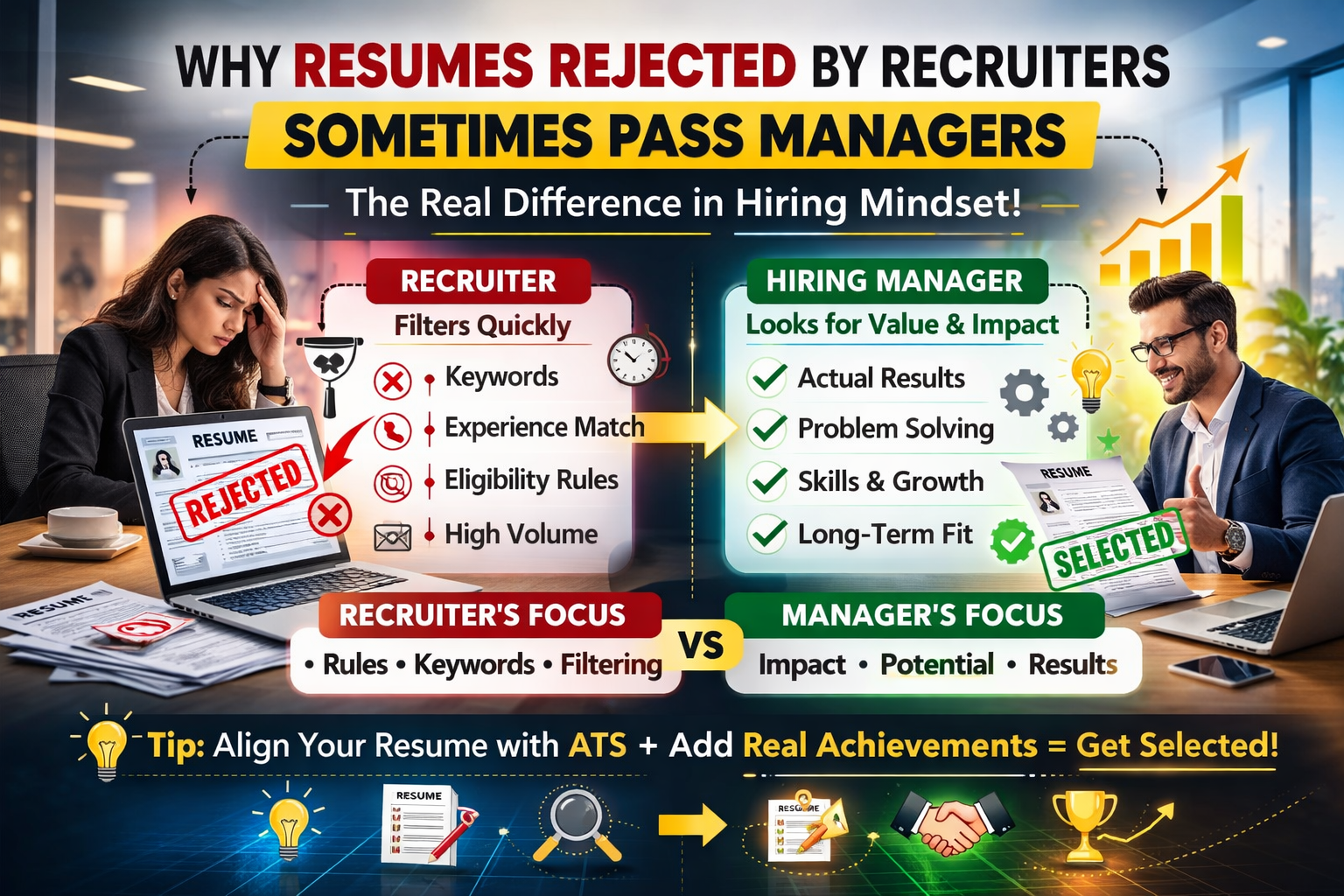
A recruiter mainly screens resumes to select candidates who are eligible for the role. Their focus is on meeting the basic requirements of the job. On the other hand, the hiring manager’s purpose is to select a candidate who actually has the right skills and is capable of performing the job effectively.
A recruiter usually looks at your experience level, education, location, salary expectations, and other basic criteria. Their job is to go through a large number of applications and filter out candidates who meet the basic eligibility requirements while rejecting those who are irrelevant.
However, a hiring manager focuses more deeply on the candidate’s skills. They check whether the candidate has real work experience, strong problem-solving ability, and practical knowledge. They also think about how the candidate will contribute to the team and whether they are the right fit for the specific job role.
This difference in purpose is what clearly separates recruiter screening from hiring manager screening.
2. High Volume Resumes vs Deep Review
Today, competition is very high. Because of this, for one job role, sometimes more than 100 applications are received. Due to this heavy volume, a recruiter can give only a limited amount of time to each resume. That is why recruiters use a structured screening process to quickly and efficiently select eligible candidates.
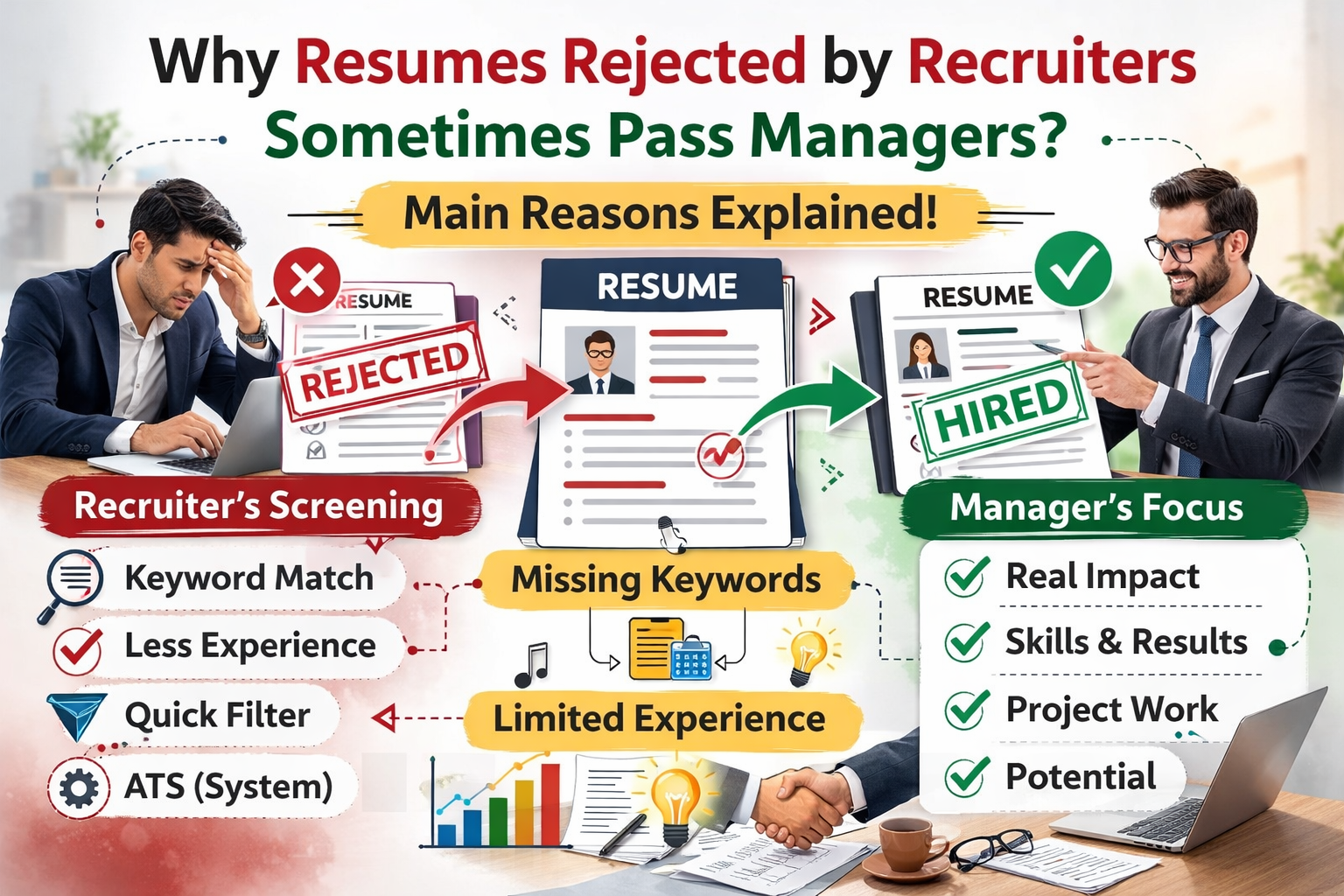
Since recruiters receive hundreds of resumes, they mainly focus on basic things. They check whether the skills and keywords in the resume match the job description. If the resume matches the required criteria, it is shortlisted. If it does not match clearly, it is rejected.
On the other hand, hiring managers do not usually review all 100 resumes. They only receive the shortlisted resumes selected by the recruiter—maybe 5, 10, or 20 profiles. Because of this, hiring managers can spend more time on each resume. They carefully read and analyze every profile. They check what skills the candidate has, what projects they have completed, what responsibilities they handled, and what achievements they accomplished. After deep thinking and evaluation, they decide whether the candidate should move forward.
That is why sometimes it happens that a candidate rejected by a recruiter may actually impress the hiring manager. The hiring manager may find that same resume strong and consider the candidate eligible based on skills and potential.
3. Keyword Matching vs Real Experience
One of the biggest differences between recruiter screening and hiring manager screening is the use of an Applicant Tracking System (ATS).
An Applicant Tracking System is a software tool that companies use to filter a large number of applications and select eligible candidates. Recruiters mainly use this tool because they receive a high volume of resumes and cannot read each one manually in detail. The ATS scans resumes and matches keywords with the job description. Based on this matching process, it shortlists candidates who meet the required criteria.
However, because of ATS, sometimes highly skilled candidates get rejected. This usually happens when their resumes do not contain the exact keywords mentioned in the job description. Even if the candidate has strong skills, the resume may not pass the automated filtering system due to missing keyword alignment.
If you want to avoid rejection because of keyword mismatch, it is important to understand how ATS works and how to optimize your resume accordingly.
On the other hand, hiring managers usually do not directly use ATS for filtering. By the time resumes reach them, they are already pre-screened and shortlisted by the recruiter. That is why hiring managers carefully read, understand, and evaluate each resume in detail. They focus more on skills, achievements, and overall value before making a final judgment about the candidate.
4. Eligibility Criteria vs Potential
Another important point that makes recruiter screening different from hiring manager screening is the focus area. Recruiters and hiring managers focus on different things while reviewing a resume.
A recruiter mainly focuses on basic requirements. They compare your resume directly with the job description. If your resume matches the keywords mentioned in the job description, you are more likely to be selected. For example, the required skills, experience level, qualifications, and specific terms mentioned in the job posting should also appear clearly in your resume. If everything matches the job description, the recruiter shortlists the resume. If it does not match properly, the recruiter may reject it.
However, a hiring manager is very different from a recruiter. A hiring manager focuses on your ability and overall potential. They look at the impact of your past work, your achievements, the quality of projects you have handled, and your real skills. The hiring manager wants to understand how you can help the company grow and how your skills can contribute to the team and business goals. If the hiring manager feels that your skills and experience truly fit the role, then only you are selected for the next step.
In simple terms, a recruiter checks what you have on paper, while a hiring manager checks how what you have can create value for the company.
5. Type of Questions Asked
The screening questions asked by recruiters and hiring managers are also very different, which makes their screening process different.
Recruiters usually ask basic and structured questions because their main goal is to check eligibility. They want to confirm whether you meet the basic requirements of the job. So their questions are simple and direct, such as:
- What is your current salary?
- What is your current location?
- Can you briefly explain your current role?
- Do you have experience in this specific skill?
- Are you available to join within the required notice period?
These questions help recruiters quickly decide whether you fit the basic criteria.
On the other hand, hiring managers ask detailed and in-depth questions. Their goal is not just eligibility, but understanding how you actually use your skills in real situations. They try to evaluate your thinking process, problem-solving ability, and practical experience.
For example, hiring managers may ask:
- Tell me about a challenging project you handled.
- How did you solve a specific problem?
- What was the final result of your work?
- How do you handle pressure in difficult situations?
Through these detailed questions, hiring managers deeply understand your abilities, work style, and how you can contribute to the company’s growth.
In short, recruiters ask “Do you qualify?” while hiring managers ask “How well can you perform and contribute?”
6. Timing & Context
Time is also a major reason why recruiter screening and hiring manager screening are different.
Recruiters receive resumes in very high volume. Because of this, they can spend only a few seconds—sometimes just 8 to 10 seconds—on each resume. In that short time, they quickly check important basics such as:
- Does the job title match?
- Does the experience level match?
- Do the required skills match the job description?
- Is the location suitable?
Based on this quick review, they decide whether to shortlist or reject the resume.
On the other hand, hiring managers spend much more time on each resume. The resumes they receive are already shortlisted by the recruiter, so the volume is much lower. Because of this, hiring managers can carefully read, understand, and analyze each profile in detail. They look deeply into the candidate’s experience, projects, achievements, and responsibilities before making a final decision.
In simple words, recruiters scan quickly due to high volume, while hiring managers analyze deeply because they focus on quality over quantity.
Conclusion
Recruiters and hiring managers view resumes through different lenses. Recruiters focus on speed, keywords, and eligibility, ensuring only candidates who broadly fit the criteria move forward. Hiring managers, on the other hand, focus on impact, skills, and potential, looking for candidates who can deliver results and grow in the role.
In short: balance clarity and substance. A resume that satisfies both the recruiter’s filters and the manager’s deeper evaluation maximizes your chances of selection.
To explore more such blogs, you can visit the Best Job Tool.






Comments
Be the first to leave a comment.