

Introduction
Changing roles is no longer rare. Professionals now switch functions, industries, and career tracks more often than ever. However, many role changes fail for one simple reason. Candidates assume skills speak for themselves. In reality, they do not. You must signal them clearly. That is exactly why skill signaling matters during role changes in today’s hiring environment.
Recruiters cannot guess your transferable strengths. Hiring managers will not decode hidden abilities. They respond to visible, well-communicated signals. When skill signaling is strong, transitions feel logical. When it is weak, even capable candidates get rejected.
Understanding this difference can dramatically improve your success rate during career moves.
What skill signaling actually means
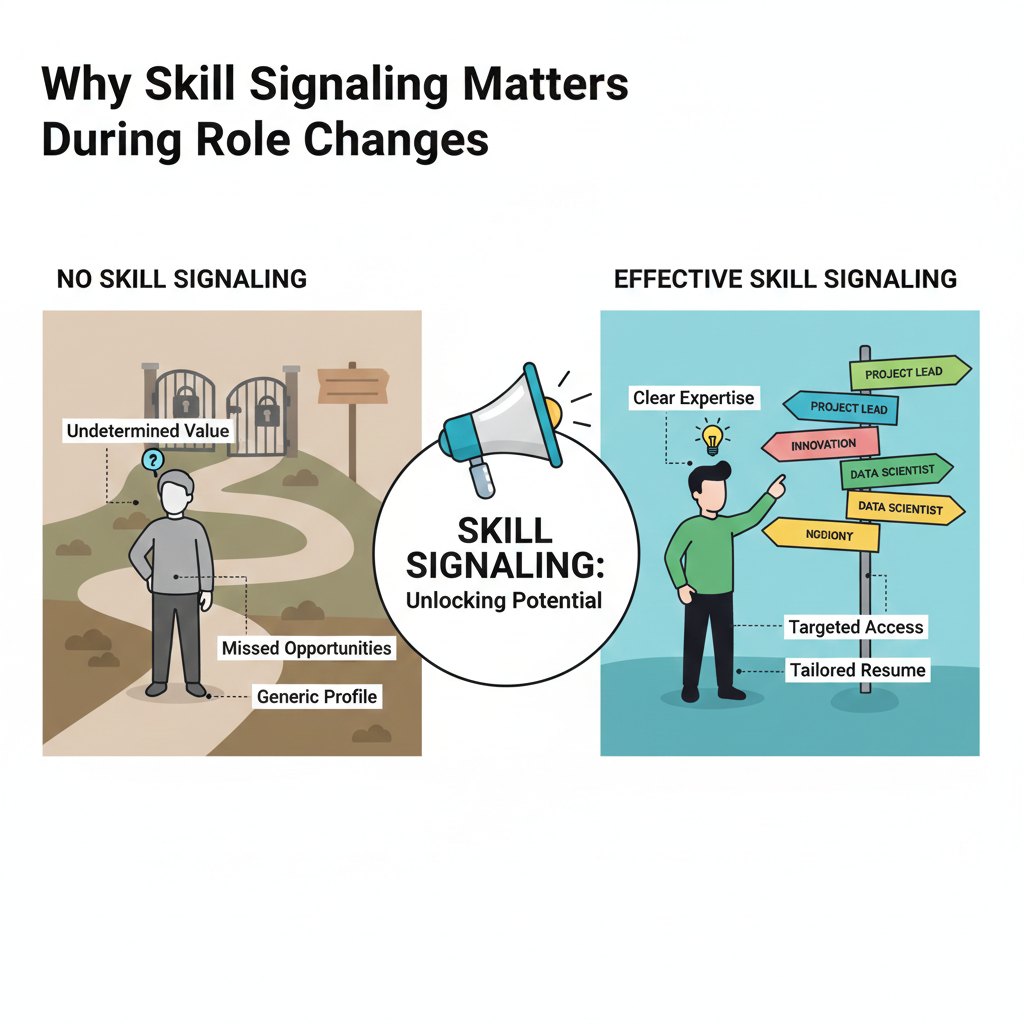
Skill signaling is the way you make your abilities visible and credible. It is not just listing skills on a resume. It is showing proof through outcomes, projects, language, and positioning.
For example, saying you “know analytics” is weak signaling. Showing a dashboard you built and the decision it influenced is strong signaling.
Signals reduce doubt. They help decision-makers quickly understand your value. During role changes, this clarity becomes essential.
Without strong signals, your new direction looks risky to employers.
Why role changes create trust gaps
When you apply within the same role type, trust is easier. Your experience matches expectations. However, role changes create uncertainty.
Employers wonder whether your past success will translate. They worry about ramp-up time and performance risk. Therefore, they look for stronger proof.
This trust gap explains why skill signaling matters during role changes more than during straight career paths. Signals replace familiarity with evidence.
The clearer your signals, the smaller the perceived risk.
Transferable skills are invisible unless you translate them
Most professionals underestimate transferable skills. They assume overlap is obvious. It is not.
Project management, stakeholder communication, analysis, and problem-solving appear in many roles. Yet recruiters only see relevance when you translate context.
You must connect past work to future value directly. Show how the same skill produced results in a different environment.
Translation turns background experience into forward-fit capability.
Recruiters scan for signals, not intentions
Candidates often explain intentions instead of evidence. They say they are passionate, motivated, or eager to switch. Unfortunately, intention is not a hiring signal.
Recruiters scan for proof markers. These include metrics, artifacts, certifications, and applied projects. Signals answer the question: can this person perform here?
That is why skill signaling matters during role changes more than career goals or enthusiasm. Proof beats intention every time.
Strong signals shorten evaluation time and increase shortlist chances.
How portfolios and projects strengthen signals
Projects create visible credibility. They demonstrate applied skill instead of theoretical knowledge. Even small projects can carry strong signaling power.
A mock campaign, sample analysis, automation script, or case study works well. These artifacts show thinking process and execution ability.
Portfolios are especially powerful for role changers. They create evidence where job history does not yet match.
Practical proof reduces employer hesitation.
Language framing changes perception
The way you describe your past work affects how transferable it appears. Task-based language weakens signals. Outcome-based language strengthens them.
Instead of describing duties, describe impact. Focus on decisions influenced, systems improved, or revenue affected.
Framing also means using the vocabulary of your target role. When your language matches the new domain, perception shifts faster.
Better framing is a core part of why skill signaling matters during role changes.
Certifications and credentials as trust accelerators
Credentials act as third-party validation. They do not replace experience, but they strengthen signals. They show commitment and baseline knowledge.
During role changes, credentials reduce perceived risk. They show structured preparation instead of casual interest.
However, credentials work best when paired with applied work. Proof plus validation creates stronger signaling than either alone.
Think of certifications as signal amplifiers, not substitutes.
Internal role changes also require signaling
Many people think signaling only matters for external switches. That is incorrect. Internal role changes require signaling too.
Managers must believe you can handle new responsibilities. They look for readiness signals before approving transitions.
Cross-team projects, stretch assignments, and visible problem-solving create these signals internally. Quiet preparation builds internal mobility.
The same principle applies everywhere. Visibility creates opportunity.
Common skill signaling mistakes during transitions
One common mistake is overloading resumes with skill lists. Quantity does not equal credibility. Specific proof matters more.
Another mistake is hiding relevant crossover work. Candidates often underplay side projects or hybrid responsibilities.
Some also rely too heavily on job titles. Titles rarely communicate transferable depth alone. Signals must show capability beyond labels.
Avoiding these mistakes improves transition success significantly.
Building a personal signal strategy
Skill signaling should be intentional. Start by identifying the top skills your target role values. Then gather proof from past work that demonstrates them.
Next, create visible artifacts if proof is missing. Build small projects, publish insights, or complete guided case work.
Finally, align your resume, portfolio, and profile language with your new direction. Consistency strengthens signals across platforms.
This structured approach makes role change positioning far more effective.
Conclusion
Career transitions succeed when employers see proof, not just potential. That is exactly why skill signaling matters during role changes in competitive hiring markets.
Clear signals reduce risk, increase trust, and speed up decisions. They translate your past into future relevance. Without them, even strong candidates remain overlooked.
Build visible proof, frame your impact clearly, and align your signals with your target role. Then explore new opportunities using the best job tool built to match evolving skills with the right roles.
Find Your Dream Job Today – Explore Endless Career Opportunities and Secure Your Next Role with Best Job Tool.






Comments
Be the first to leave a comment.