

Introduction
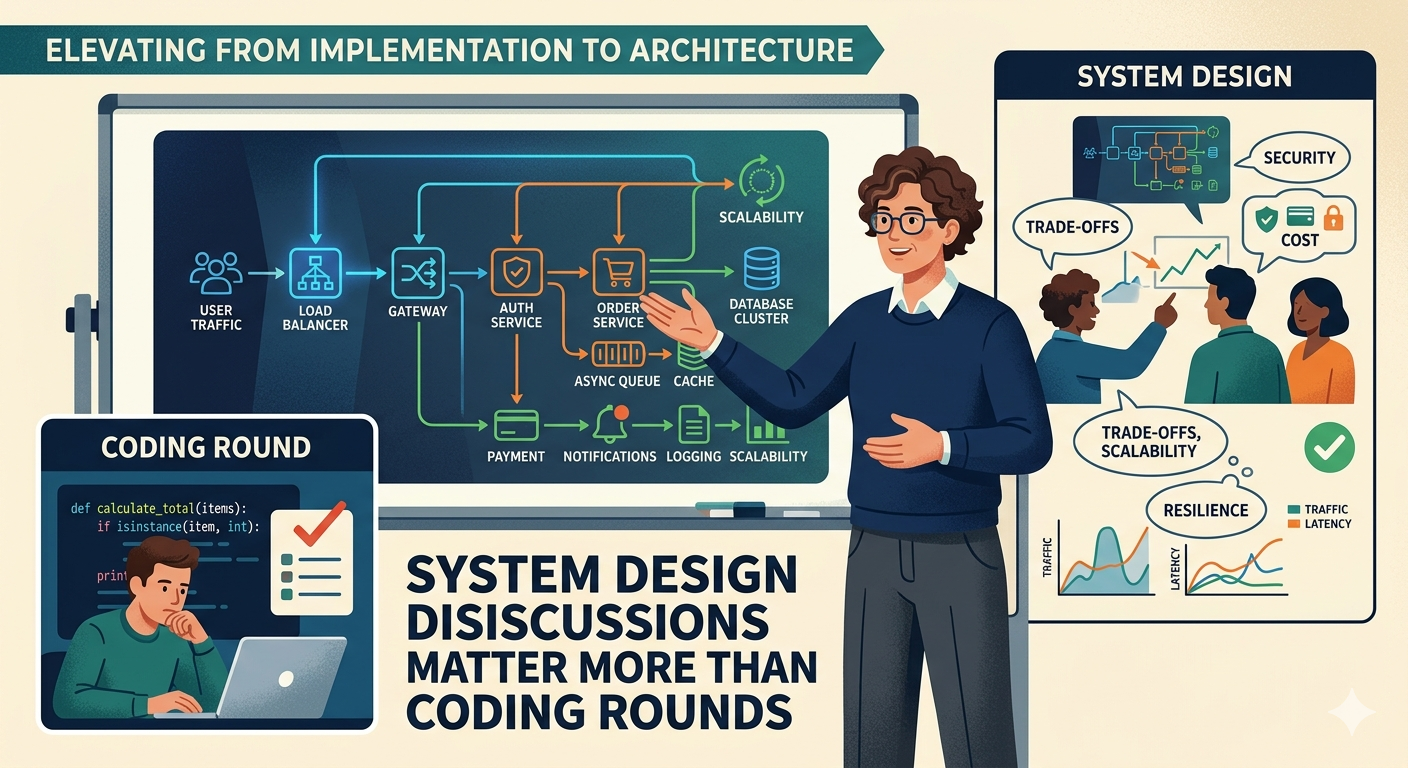
Coding rounds have long been a standard part of technical interviews. They test problem-solving ability, logic, and familiarity with programming concepts. However, as roles become more complex, companies increasingly rely on system design discussions to evaluate candidates. These discussions go beyond writing code and focus on how engineers think about building scalable and reliable systems. This shift explains exactly why system design discussions matter more than coding rounds in modern engineering hiring.
Employers want professionals who can design solutions that work in real-world environments. While coding shows execution ability, system design reveals how candidates handle complexity, scale, and long-term decisions.
System design reflects real-world responsibilities
In actual engineering roles, developers rarely solve isolated algorithmic problems. Instead, they design systems that handle users, data, and performance challenges.
System design discussions simulate real job scenarios. Candidates explain how they would build applications, manage data flow, and ensure system stability.
This practical relevance makes design discussions more valuable than theoretical coding exercises.
Scalability becomes a key evaluation factor
Modern applications must support large user bases and increasing data volumes. System design interviews allow candidates to demonstrate how they would scale systems effectively.
They may discuss load balancing, caching, database optimization, and distributed architecture. These considerations are critical in production environments.
Scalability thinking reflects advanced technical maturity.
Trade-off analysis shows deeper understanding
System design involves making decisions between competing factors such as performance, cost, complexity, and maintainability.
Interviewers evaluate how candidates analyze these trade-offs and justify their choices. There is rarely a perfect solution, so decision-making becomes more important than correctness.
This ability demonstrates real engineering judgment.
Architectural thinking influences long-term impact
Coding rounds focus on solving immediate problems. In contrast, system design discussions reveal how candidates think about long-term system architecture.
Candidates must consider modular design, service interactions, and future expansion. These decisions influence how systems evolve over time.
Architectural thinking is essential for senior and mid-level roles.
Communication and clarity are tested
System design interviews require candidates to explain complex ideas clearly. They must describe architecture, components, and workflows in a structured way.
Interviewers assess how well candidates communicate their ideas and respond to questions. Clear communication is critical in team environments where engineers collaborate on large systems.
Strong communication improves evaluation outcomes.
Handling ambiguity reflects real-world readiness
Unlike coding problems, system design questions are often open-ended. Candidates must define assumptions, clarify requirements, and choose an approach.
Interviewers observe how candidates handle this ambiguity. Those who structure their thinking and ask relevant questions demonstrate readiness for real-world challenges.
Handling uncertainty is a key professional skill.
Cross-functional awareness becomes visible
System design discussions often involve considerations beyond coding, such as security, data storage, user experience, and operational reliability.
Candidates who include these factors show broader awareness of how systems interact with different teams and business goals.
Cross-functional thinking increases professional value.
Performance and reliability considerations
System design requires planning for system performance and failure handling. Candidates must consider latency, uptime, redundancy, and monitoring.
Interviewers evaluate whether candidates can design systems that remain stable under stress and recover from failures effectively.
Reliability planning demonstrates advanced technical capability.
Leadership potential is easier to assess
System design discussions reveal leadership qualities. Candidates must guide the conversation, justify decisions, and respond to feedback confidently.
These skills indicate whether a candidate can take ownership of projects and influence team direction.
Leadership potential becomes more visible than in coding rounds.
Conclusion
Coding rounds remain important for assessing fundamental skills, but they do not capture the full scope of real engineering work. That is precisely why system design discussions matter more than coding rounds in modern hiring processes.
Employers prioritize candidates who can design scalable systems, evaluate trade-offs, communicate clearly, and handle complex real-world challenges. By developing strong system design skills, engineers can improve their interview performance and position themselves for higher-level roles and long-term career growth.
Find Your Dream Job Today – Explore Endless Career Opportunities and Secure Your Next Role with Best Job Tool.






Comments
Be the first to leave a comment.