

Introduction: Career Paths in Game Design and Interactive Narrative
The gaming industry is one of the most prominent and exciting spheres these days. The development of video games is now so sophisticated that games are no longer just a form of entertainment.
These days, video games are a triple combination of narrative, technology, and art. The gaming industry provides a wide range of job opportunities for those interested in pursuing Career Paths in Game Design and Interactive Narrative.
Career Paths in Game Design and Interactive Narrative
1. Understanding Game Design Essay
Game design can be defined as a process of coming up with a game’s rules, elements, and components. Designers should be able to control how the game will operate, what challenges it will offer, what rewards it will provide, and what imagery and narratives it will use to drive the gameplay. Game designers should also understand what players will do while interacting with the game in order for the experience to be valuable and rewarding.
A professional game designer is a person who is able to address both creative and systemic problems and come up with appropriate solutions. Such a person should be able to communicate effectively with coders, artists, writers, sound designers, and producers. In addition, a designer should know the audience’s expectations and be aware of the technical limitations of a game platform.
2. Careers in Game Design
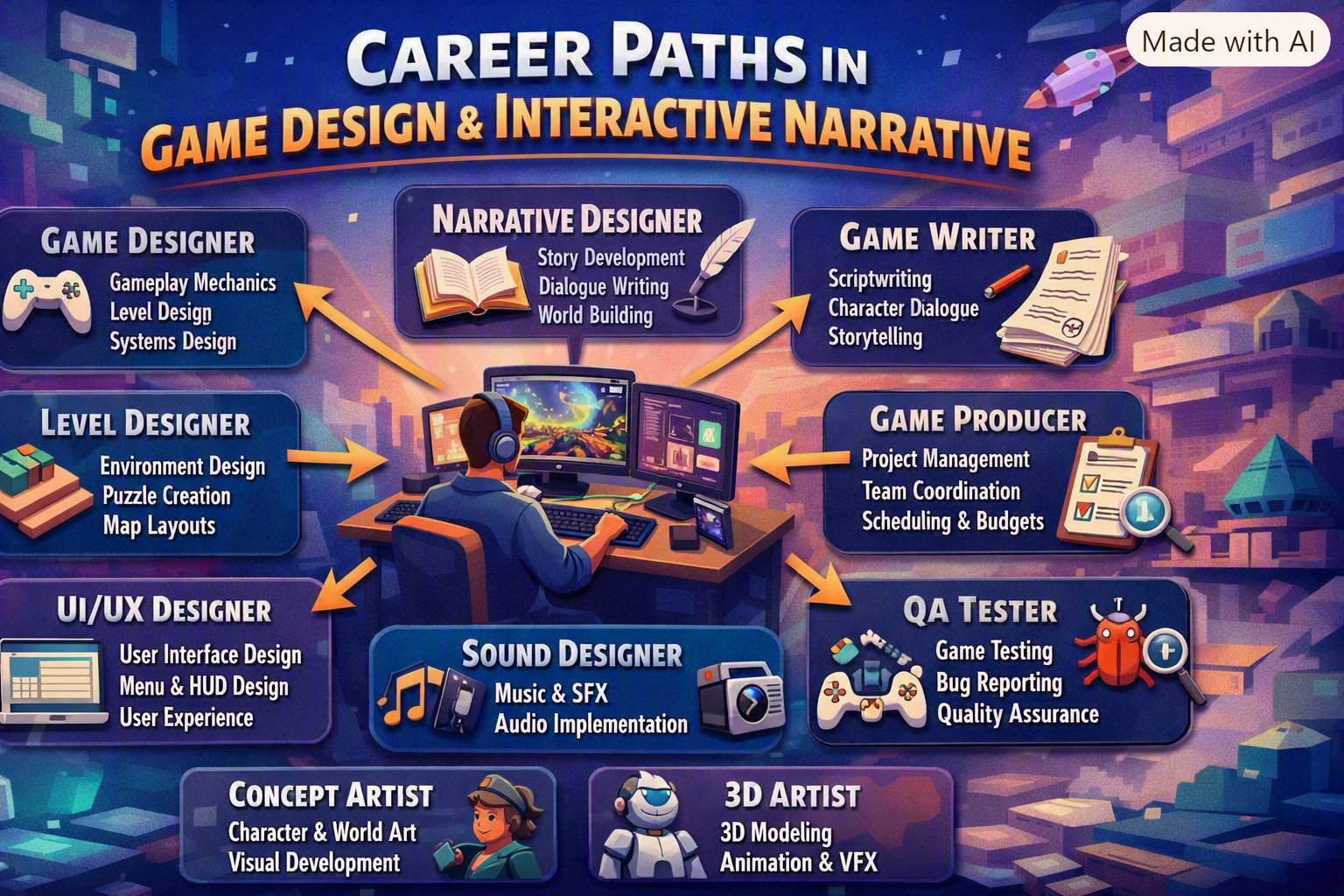
The game design career includes a number of positions and roles. First, a game designer is the person who comes up with rules, mechanics, and challenges of the game. Then, there are level designers who work on specific levels of a game, including maps, missions, or puzzles.
Finally, there are systems designers who work on game systems, storylines, characters, and progression. Additionally, a producer is a person that coordinates designers, coders, artists, and other participants in game creation. Producers set deadlines, define the project’s scope, and manage budgets while also bringing together different teams and elements to create a game.
3. Interactive Narrative as a Career Alternative
Interactive narrative is another emerging field in the gaming world. Unlike conventional narratives, an interactive one permits a player to make decisions that can, in turn, shape the story’s outcome. This format also allows gamers to determine who to interact with, how to act, and what to do.
Those interested in writing can consider being a narrative designer, a game writer, or an interactive fiction writer. For instance, narrative designers usually have traditional writing skills and must be able to learn how the game works. They also develop dialogues, story progressions, quests, characters, and other narrative elements.
4. Essential Skills
Anyone interested in a career in gaming should have strong communication skills, be a proficient writer and storyteller, be creative and innovative, think critically and logically, and be a quick learner. Finally, one must also be confident in one’s abilities. To be a narrative designer, one needs to understand how to design characters and story progression, create captivating dialogues, develop game treatments and outlines, and utilize tools to design games.
5. Portfolio and Experience
It is essential to develop a portfolio to land a job in the gaming industry. Some narrative designers acquire experience through their studies. Therefore, students can develop their portfolios by creating games or writing samples. This way, they can demonstrate their competencies and abilities in the actual projects.
Acquiring experience through such programs can help one gain practical skills and eventually secure a position in the company. Individuals can also build their portfolio by participating in game jams, contributing to independent games, or writing interactive stories.
6. Education
Students interested in working in the gaming industry should consider enrolling in programs related to game design, computer science, or graphic design. However, it is important to note that experience may be more important than formal education. Therefore, students can build their portfolios while studying at a college or university.
This will enable them to gain experience and acquire new skills and competencies. For instance, those interested in attending a game design programs should study narrative design, level design, character design, animation, and other related disciplines.
Conclusion: Career Paths in Game Design and Interactive Narrative
Game design and interactive narrative offer a variety of career opportunities for individuals with different skill sets and interests. One can choose a career path in game design, interactive fiction, character design, world-building, or production management, among others.
With the necessary creative and technical skills, practical experience, and a compelling portfolio, it will be possible to have a successful career in the gaming industry. Thus, it will be interesting for students and professionals to consider a career in the gaming industry.
“A career in game design and interactive narrative can combine creativity, storytelling, technology, and problem-solving. Explore roles, build a strong portfolio, develop relevant skills, and turn your passion for interactive experiences into a rewarding career with Best Job Tool.”






Comments
Be the first to leave a comment.