

Healthcare is one of the world’s largest and most complex industries, requiring professionals who can manage operations, coordinate teams, control costs, improve patient experiences, and maintain efficient systems. While doctors, nurses, and clinical specialists remain central to healthcare delivery, hospitals and healthcare organizations also depend heavily on professionals working behind the scenes.Hospital
Healthcare operations and hospital administration offer diverse career paths for people interested in management, business processes, analytics, finance, technology, human resources, and service delivery. These careers can be particularly attractive to professionals who want to combine business skills with meaningful organizational impact.
The field is also evolving. Digital healthcare platforms, electronic health records, telehealth, data analytics, and remote administrative teams are changing how healthcare organizations operate. For professionals considering this career direction, understanding the available roles, required skills, remote-work possibilities, and financial considerations is essential.
1. Understand the Difference Between Healthcare Operations and Hospital Administration
Healthcare operations focuses on how healthcare services are delivered efficiently. Hospital administration is broader and often involves managing departments, people, budgets, compliance, and organizational strategy.
Although the responsibilities overlap, professionals can specialize according to their interests and experience.
Common healthcare operations responsibilities include:
- Managing patient-flow processes
- Improving appointment scheduling
- Coordinating support services
- Monitoring operational KPIs
- Managing resources
- Improving workflow efficiency
- Supporting quality initiatives
- Coordinating administrative teams
Hospital administration may involve:
- Department management
- Budget planning
- Staff coordination
- Policy implementation
- Regulatory compliance
- Vendor management
- Strategic planning
- Patient-service improvement
Understanding these differences can help job seekers select an appropriate career path rather than applying randomly to healthcare management positions.
2. Explore Entry-Level Healthcare Operations Roles
Professionals entering the field do not necessarily need to start in senior administration. Several entry-level and early-career roles provide exposure to healthcare processes and organizational management.
Potential positions include:
- Healthcare operations coordinator
- Hospital administrative assistant
- Patient services coordinator
- Medical office manager
- Healthcare project coordinator
- Scheduling coordinator
- Revenue-cycle associate
- Healthcare data analyst
- Quality improvement coordinator
- Healthcare business analyst
These roles can provide practical experience with healthcare workflows, documentation, patient services, financial processes, and organizational systems.
A useful strategy is to select one operational area and build expertise around it.
For example, someone interested in analytics could focus on healthcare reporting, KPIs, Excel, SQL, and dashboard development. Someone interested in management could focus on project coordination, process improvement, communication, and team management.
Specialization can make your profile more competitive than presenting yourself as a general healthcare professional without a defined skill set.
3. Build the Skills Needed for Healthcare Administration
Healthcare administration requires a combination of business, operational, and communication skills. Your exact requirements will depend on the role and organization, but several capabilities are broadly valuable.
Business and Financial Skills
Healthcare administrators frequently work with budgets, costs, resource allocation, and performance targets. Basic financial literacy can help you understand how operational decisions affect an organization.
Data and Analytics
Healthcare organizations generate large amounts of operational data. Professionals who can interpret data can contribute to better decisions.
Useful skills include:
- Excel
- Data visualization
- KPI reporting
- SQL
- Dashboard development
- Basic statistics
- Process analysis Hospital
Communication and Leadership
Administrators coordinate across clinical and non-clinical teams. Clear communication is essential when implementing policies, resolving operational problems, or managing competing priorities.
Process Improvement
Knowledge of Lean, Six Sigma, workflow mapping, and root-cause analysis can be valuable for improving healthcare operations.
For example, if patients experience long waiting times, an operations professional can map the patient journey, identify bottlenecks, analyze available data, and recommend process changes.Hospital
The goal is to connect every skill to a measurable organizational outcome.
4. Consider Remote and Hybrid Healthcare Operations Careers
Not every healthcare administration role can be performed remotely. Positions involving direct patient interaction, physical facility management, or on-site operations generally require a physical presence.
However, several administrative and analytical Hospital responsibilities can be performed remotely or through hybrid arrangements.
Potential remote-friendly areas include:
- Healthcare data analysis
- Revenue-cycle operations
- Scheduling management
- Healthcare project management
- Documentation
- Reporting and analytics
- Quality management
- Virtual care operations
- Administrative support
- Healthcare technology implementation
Remote healthcare operations require excellent organization because teams may be distributed across locations.
Professionals working remotely should establish clear processes for communication, documentation, deadlines, and performance tracking.
A practical remote-work system can include:
- Maintain a centralized task tracker.
- Define measurable weekly objectives.
- Document decisions and process changes.
- Use dashboards to monitor operational performance.
- Schedule focused time for analysis.
- Communicate risks before they become urgent.
For professionals looking for international and remote opportunities, best job tool, a global job platform, can be used to explore roles across different markets and identify positions aligned with specific career preferences.
5. Use Travel Testing to Evaluate International Healthcare Careers
Healthcare systems differ considerably between countries. Before pursuing an international healthcare administration career, professionals should research how hospitals operate in their target market.
Travel testing can provide useful real-world insight Hospital without immediately committing to relocation.
A short professional trip can help you evaluate:
- Local healthcare infrastructure
- Business environment
- Professional networking opportunities
- Living costs
- Transportation
- Internet connectivity
- Availability of relevant roles
- Local working culture
- Demand for healthcare management skills
During the trip, focus on gathering professional information rather than simply visiting tourist destinations.
You can attend industry events, research healthcare organizations, connect with professionals, and explore potential employers.
For remote workers, travel testing can also determine whether working across different time zones is practical.
Before traveling, establish a budget and specific objectives. Calculate accommodation, transportation, food, workspace, connectivity, and other expenses. This prevents career exploration from becoming an uncontrolled financial commitment.
6. Create a Career Progression Plan in Healthcare Operations
Healthcare administration offers multiple advancement routes. Your career path will depend on your education, experience, specialization, and organization.
A potential operations-focused progression could look like:
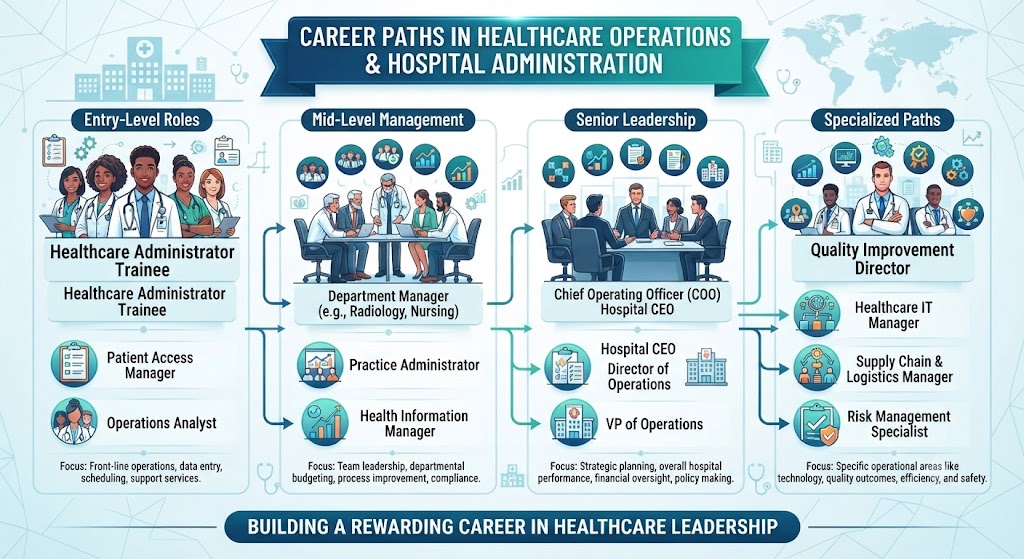
Healthcare Operations Coordinator → Operations Specialist → Operations Manager → Senior Operations Manager → Director of Operations
An administration-focused path might be:
Administrative Coordinator → Department Administrator → Hospital Administrator → Senior Administrator → Executive Leadership
Professionals with strong analytical capabilities may follow another route:
Healthcare Data Analyst → Senior Analyst → Healthcare Business Analyst → Analytics Manager → Healthcare Strategy Leader
There is no single correct path. The important factor is deliberately developing capabilities that qualify you for the next level.
At every stage, track measurable accomplishments.
Instead of writing:
Managed hospital operations.
Document outcomes such as:
Improved appointment scheduling workflow and reduced administrative delays by implementing a standardized tracking process.
Specific achievements are easier for recruiters and hiring managers to evaluate.
Professionals should also regularly compare their current skills with job descriptions for their target positions. This reveals which qualifications are actually required and prevents unnecessary training.
7. Plan Your Education, Productivity, and Finances
Education can strengthen a healthcare administration career, but professionals should choose qualifications strategically.
Depending on the role and country, relevant educational backgrounds may include healthcare administration, business administration, public health, management, finance, operations, or health informatics.
Additional certifications or specialized training can strengthen a profile when they directly support your target role.
Before investing in a course, ask:
- Is this skill requested in current job postings?
- Will it help me qualify for my target role?
- Can I demonstrate the skill through a project?
- Is the cost justified by potential career value?
- Does the qualification have relevance in my target country?
Productivity is equally important. Healthcare operations can involve multiple departments, deadlines, and high-priority requests. Use structured planning rather than relying on memory.
A practical weekly system can include:
- Three major priorities
- Recurring operational responsibilities
- Project deadlines
- Performance metrics
- Pending decisions
- Stakeholder follow-ups
Financial planning should also be part of career development.
Before changing roles, moving cities, or traveling internationally, calculate:
- Training expenses
- Travel costs
- Relocation expenses
- Emergency savings
- Equipment costs
- Accommodation
- Transportation
- Taxes and other obligations
Maintaining an emergency fund provides greater flexibility when pursuing a new career opportunity.
For international job searches, best job tool can help professionals identify global opportunities while they compare roles, locations, and remote-work possibilities.
Conclusion: Build a Specialized Healthcare Operations Career
Healthcare operations and hospital administration provide diverse career opportunities for professionals who understand business processes, data, people management, and service delivery.
The most effective approach is to choose a specific direction rather than attempting to master every part of healthcare administration at once. Start with a practical role, develop analytical and operational skills, document measurable achievements, and gradually move toward positions with greater responsibility.
Remote and hybrid opportunities can expand career possibilities, particularly in analytics, project management, revenue-cycle operations, quality management, and healthcare technology. At the same time, travel testing can help professionals evaluate international opportunities before committing to relocation.
Financial planning should remain part of the strategy. Education, certifications, travel, and relocation can require significant investment, so each decision should be connected to a clear career objective.
Ultimately, a successful career in healthcare operations is built through continuous improvement, measurable results, and specialized expertise. Professionals who combine operational knowledge with technology, analytics, communication, and financial awareness can position themselves for sustainable growth across the evolving healthcare industry.






Comments
Be the first to leave a comment.