

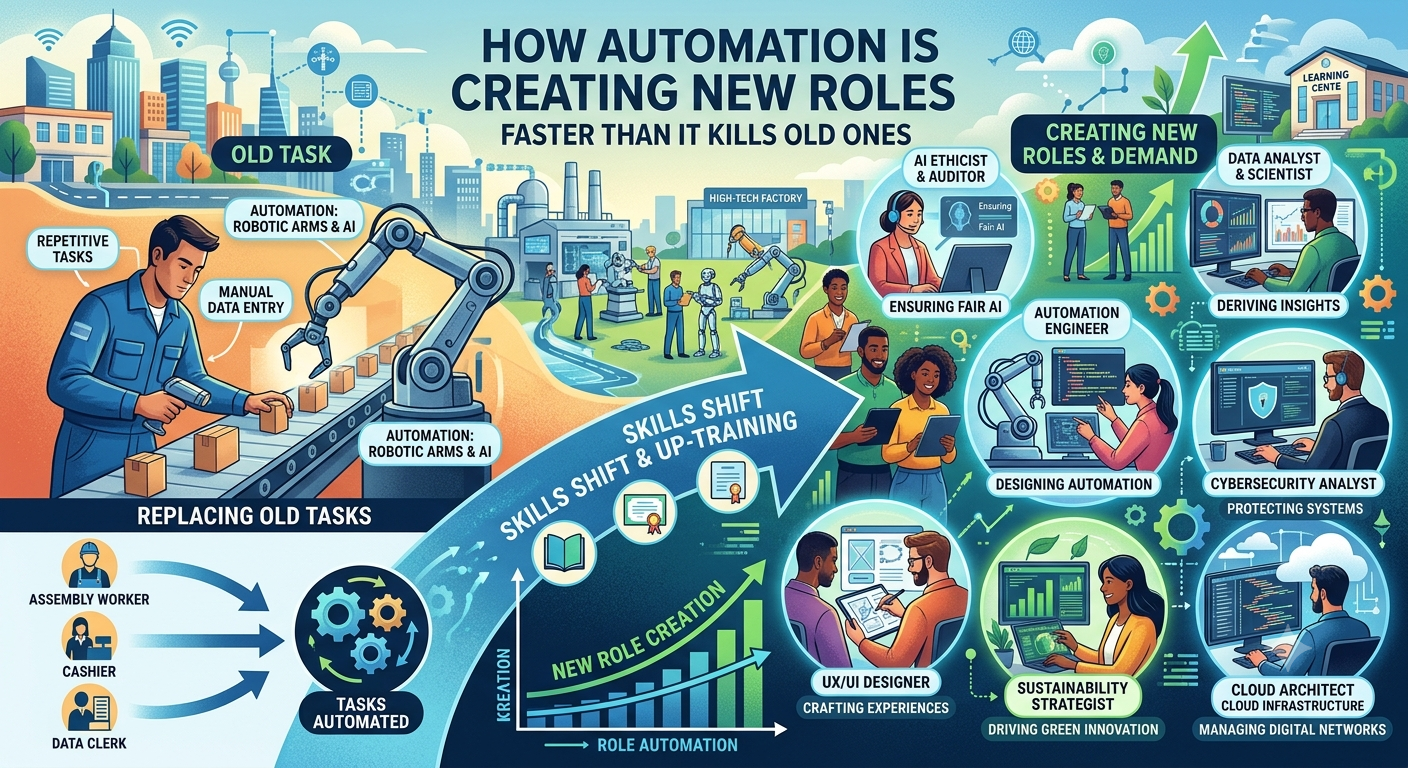
Introduction: Automation Is Creating New Roles
Automation has introduced a new era in the functioning of businesses, communication, and the work environment. Through the use of robots, artificial intelligence, and automated software programs, the companies are prioritizing the replacement of all repetitive and tedious tasks with automatic and digital ones. However, despite the possible threat to jobs, automation is creating new opportunities for workers.
How Automation Is Creating New Roles Faster Than It Kills Old Ones is a fascinating issue in the modern economy. The jobs eliminated due to the introduction of advanced technologies are often different and do not coincide with those affected by automation.
How Automation Is Creating New Roles Faster Than It Kills Old Ones?
1. Automation Processes Transform All Jobs Into Some Other Jobs
The first effect of automation that deserves consideration is the alteration of the employees’ work. Technology is replacing all the mundane aspects of jobs, but each profession must remain alive. For example, chatbots are answering frequently asked questions, but specialists are needed to solve unique, complex, and challenging problems.
From the given perspective, automation rarely completely replaces a human worker; instead, it transforms the job function. The majority of routine elements are eliminated while more unique and necessary aspects remain.
2. New Technologies Require People to Operate and Manage Them
The second interesting point to consider is that the introduction of new technologies and processes requires people to fill new professional roles. Every new technology needs to be managed, maintained, monitored, and modified. Thus, the increasing number of artificial intelligence innovations calls for more specialists in related fields.
As a consequence, workers not only fill in the positions lost due to automationbut also pursue different job opportunities and enhance their skills. In combination with the reduced mental burden and better work/life balance, new career options are powerful motivators for business owners when they consider implementing automation technologies.
3. Human Qualities and Abilities Remained Valuable Under the Influence of Technology
The third fact worth discussing is that automation eliminates routine activities, leaving more time for creative, social, and managerial activities. Since machines can calculate, organize, monitor, and optimize processes, human qualities valued in employers become even more attractive. Those with outstanding leadership skills, effective negotiating techniques, and high emotional intelligence, critical thinking, and excellent interpersonal communication will be active contestants in the future job market.
For instance, researchers note that while the marketing field is highly automatized nowadays, still human interaction and creativityare vital for building brand awareness and maintaining customer loyalty. Similarly, technology helps managers in many routine tasks, including making reports, analyzing data, and organizing schedules. However, those with outstanding managerial talent and the ability to multi-task will remain in demand.
4. Knowledge of Automation Can Improve the Professional Growth Rate
The increased role of automated processes in the functioning of the economy and business demands a closer consideration of the changes in the job market. Since automation processes call for more technologically advanced workers in specific fields and fewer in others, people need to remain aware of the necessary transformations. Moreover, the constant influx of new concepts, technologies, and processes promotes the relevance of continuous learning throughout life.
Thus, individuals can preparefor the impending changes by expanding their knowledge and skill set in their chosen fields by taking online courses, earning certifications, attending workshops, and studying similar subjects. It is essential to realize that one does not strive to become an expert in technology. Instead, understanding automation’s influence on one’s industry and learning how to use it to one’s professional advantage would be a more achievable and rewarding goal.
5. Businesses Create Jobs for Employees to Handle Automation
The fourth effect of automation under review demonstrates that companies are more willing to invest in new technologies. The latter often requires the assistance of specialists to ensure that the former operate correctly. Those with updated technical skills and knowledge can provide support services, train colleagues, or be responsible for ongoing development in this area.
Such professional opportunities as automation consultant or manager, artificial intelligence designer and director, automation trainer and instructor, and similar positions are the result of the need for employees who know how to utilize technology to their advantage.
6. Automation Helps Organizations Become More Productive and Expand Their Operations
Another effect of automation that might be noted is that due to the increased efficiency, businesses expand their operations. As a result, organizations need more employees to fill higher-level positions or specialize in unique subjects. Therefore, while automation may eliminate some types of jobs, the specialization it requires often creates a shortage of skilled workers.
A firm in high demand due to its products or services’ quality can benefit from a strong team of managers, sellers, analysts, marketers, researchers, and other specialists. Under the influence of automation, these employees have more value than ever. As a consequence, the higher overall productivity of businesses can lead to an increase in demand for people for various kinds of jobs.
7. Education and Career Development Will Become More Important
An insight into automation’s impact on the job market is valuable for the understanding of multiple factors associated with it. For example, firms can promote the transition to digitalization and automation with the introduction of special training or educational programs for their employees. The state, universities, and enterprises can implement special modules in the educational process. Additionally, it is vital to provide workers with more opportunities to obtain training, learning the necessary technological aspects.
Conclusion: Automation
How Automation Is Creating New Roles Faster Than It Kills Old Ones reflects an intriguing aspect of the modern economy, namely the constant transformation of professions and the overall job market.
Despite the threat that automation poses to many businesses, it is evident that its implementation provides more potential for jobs than less. The people who will be the most successful in this environment will be the ones who maintain a constant desire to learn something new and expand their qualifications.
As automation continues to reshape the workplace, staying ahead means developing the right skills and finding roles that match your strengths. Use Best Job Tools to explore relevant opportunities, simplify your job search, and take the next step toward your career goals.






Comments
Be the first to leave a comment.