

Introduction
One of the biggest challenges freshers face during a job search is the lack of professional experience. Many candidates have the education, enthusiasm, and willingness to learn, but struggle to convince employers that they can perform the job. This is where “proof of skill” becomes important.
Proof of skill refers to tangible evidence that demonstrates your abilities. Instead of simply listing skills on a resume, you show recruiters examples of what you can actually do. In today’s competitive job market, employers increasingly value practical demonstrations of skills over theoretical knowledge alone.
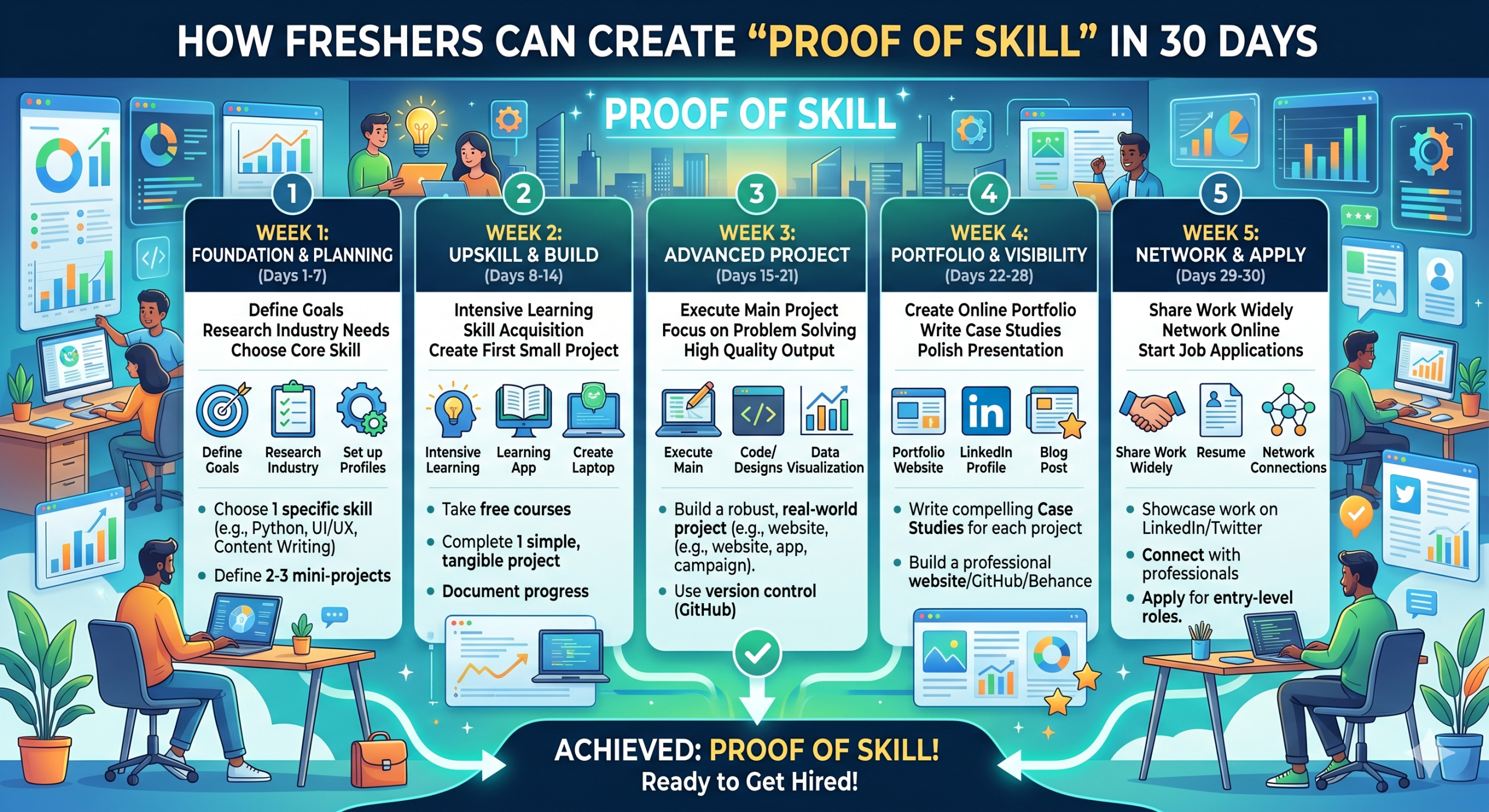
The good news is that you do not need years of experience to build credibility. With a focused plan, freshers can create meaningful proof of skill within 30 days. Whether you are interested in marketing, customer support, operations, design, data analysis, content writing, or technology, a structured approach can help you build a portfolio that attracts employers.
Understanding What Employers Mean by Proof of Skill
Recruiters often receive hundreds of applications from candidates with similar educational backgrounds. What helps one candidate stand out is evidence of practical capability.
Examples of proof of skill include:
- Portfolio projects
- Case studies
- Certifications
- Writing samples
- Process improvement proposals
- Data analysis reports
- Personal websites
- Mock business projects
- Video demonstrations
These assets show employers how you think, solve problems, and apply knowledge in real situations.
Week 1: Choose One Skill and Define a Goal
Many freshers make the mistake of trying to learn multiple skills at once. Instead, focus on one marketable skill and build evidence around it.
Examples include:
- Content writing
- Social media marketing
- Customer support
- Graphic design
- Data analysis
- Operations management
- Digital marketing
- Project coordination
Once you choose a skill, define a clear goal.
For example:
- Create three content writing samples.
- Build a customer support portfolio.
- Develop a social media campaign.
- Analyze a public dataset.
A focused objective creates direction and makes progress easier to measure.
Week 1: Learn the Fundamentals Quickly
Before creating projects, spend time understanding the basics.
Use resources such as:
- Online courses
- Industry blogs
- Professional webinars
- YouTube tutorials
- Industry reports
Focus on learning practical concepts rather than consuming endless information.
Create notes on:
- Key terminology
- Industry best practices
- Common tools
- Employer expectations
- Real-world applications
The goal is not to become an expert immediately but to develop enough knowledge to begin creating projects.
Week 2: Build Your First Practical Project
Projects are one of the strongest forms of proof of skill because they demonstrate application rather than theory.
Choose a project that reflects the type of work employers expect.
Examples:
For Content Writers
Create:
- Blog articles
- Website copy
- Product descriptions
- LinkedIn posts
For Digital Marketers
Develop:
- Social media campaigns
- Content calendars
- Marketing strategies
- Audience research reports
For Customer Support Candidates
Create:
- Help center articles
- Customer response templates
- Support workflow documentation
For Operations Candidates
Build:
- Process improvement proposals
- Workflow diagrams
- Standard operating procedures
The project does not need to be perfect. It simply needs to demonstrate your understanding and ability to execute.
Week 2: Document Your Process
Employers often care about how you approach problems as much as the final result.
For every project, document:
- The objective
- The challenge
- Your approach
- Tools used
- Lessons learned
- Final outcome
This documentation can later become a case study for your portfolio.
Case studies help recruiters understand your thought process and problem-solving abilities.
Week 3: Create Multiple Portfolio Pieces
One project is helpful, but several related projects create stronger credibility.
Aim to complete:
- 3–5 small projects
- 2 detailed case studies
- 1 professional presentation
Examples:
A marketing candidate might create:
- A content strategy
- A social media plan
- A competitor analysis
- A campaign proposal
A customer support candidate might create:
- A support knowledge base
- Email response templates
- Customer onboarding documentation
The goal is to demonstrate consistency and versatility.
Week 3: Earn a Relevant Certification
Certifications can complement portfolio projects and provide additional validation.
Choose certifications that are:
- Industry recognized
- Skill focused
- Relevant to target roles
- Practical rather than purely theoretical
Popular areas include:
- Digital marketing
- Data analytics
- Customer service
- Project management
- Business operations
- Content marketing
Certifications alone will not guarantee interviews, but they strengthen your professional profile when paired with real projects.
Week 4: Build an Online Presence
Once you have projects and certifications, make them visible.
Create a professional online presence through:
Share:
- Project highlights
- Learning experiences
- Case studies
- Industry insights
Portfolio Website
Include:
- About section
- Skills overview
- Project examples
- Contact information
Digital Portfolio
A simple PDF portfolio can also be effective.
Organize it with:
- Introduction
- Projects
- Results
- Certifications
- Career objectives
Visibility increases the chances of recruiters discovering your work.
Showcase Results Instead of Responsibilities
One common mistake freshers make is focusing on activities rather than outcomes.
Instead of writing:
- Created a social media campaign.
Write:
- Developed a 30-day social media campaign targeting audience growth and engagement.
Instead of:
- Designed a customer support guide.
Write:
- Created a customer support knowledge base to improve issue resolution efficiency.
Outcome-focused descriptions sound more professional and impactful.
Ask for Feedback and Improve
Professional growth happens faster when you seek feedback.
Share your projects with:
- Mentors
- Professors
- Industry professionals
- Career coaches
- Online communities
Ask questions such as:
- What could be improved?
- Is the project realistic?
- Would this impress a recruiter?
- What skills are missing?
Constructive feedback helps refine your portfolio and improve future projects.
Common Mistakes Freshers Should Avoid
Many candidates delay progress because they focus on learning instead of creating.
Avoid these mistakes:
- Waiting until you feel fully prepared
- Building projects without documentation
- Creating too many unrelated projects
- Ignoring feedback
- Failing to showcase work publicly
- Relying only on certifications
Employers are often more impressed by practical projects than by a long list of completed courses.
Conclusion
Creating proof of skill does not require years of experience. In just 30 days, freshers can build a portfolio of projects, case studies, certifications, and professional content that demonstrates real capability. By focusing on one skill, creating practical work, documenting results, and sharing achievements online, candidates can significantly improve their job prospects.
The most successful job seekers are not always those with the most experience, but those who can clearly show what they are capable of doing. By following a structured 30-day plan and consistently building evidence of your abilities, you can stand out in a competitive market and approach employers with greater confidence. When it is time to apply for opportunities, best job tool can help you connect with employers looking for candidates who demonstrate initiative, practical skills, and career readiness.






Comments
Be the first to leave a comment.