

Introduction
Many job seekers assume that hiring managers and Talent Acquisition (TA) teams evaluate candidates using the same criteria. While they work closely together to fill open positions, their responsibilities, goals, and decision-making processes are quite different. Understanding these differences can help candidates tailor their applications, communicate more effectively during interviews, and improve their chances of receiving a job offer.
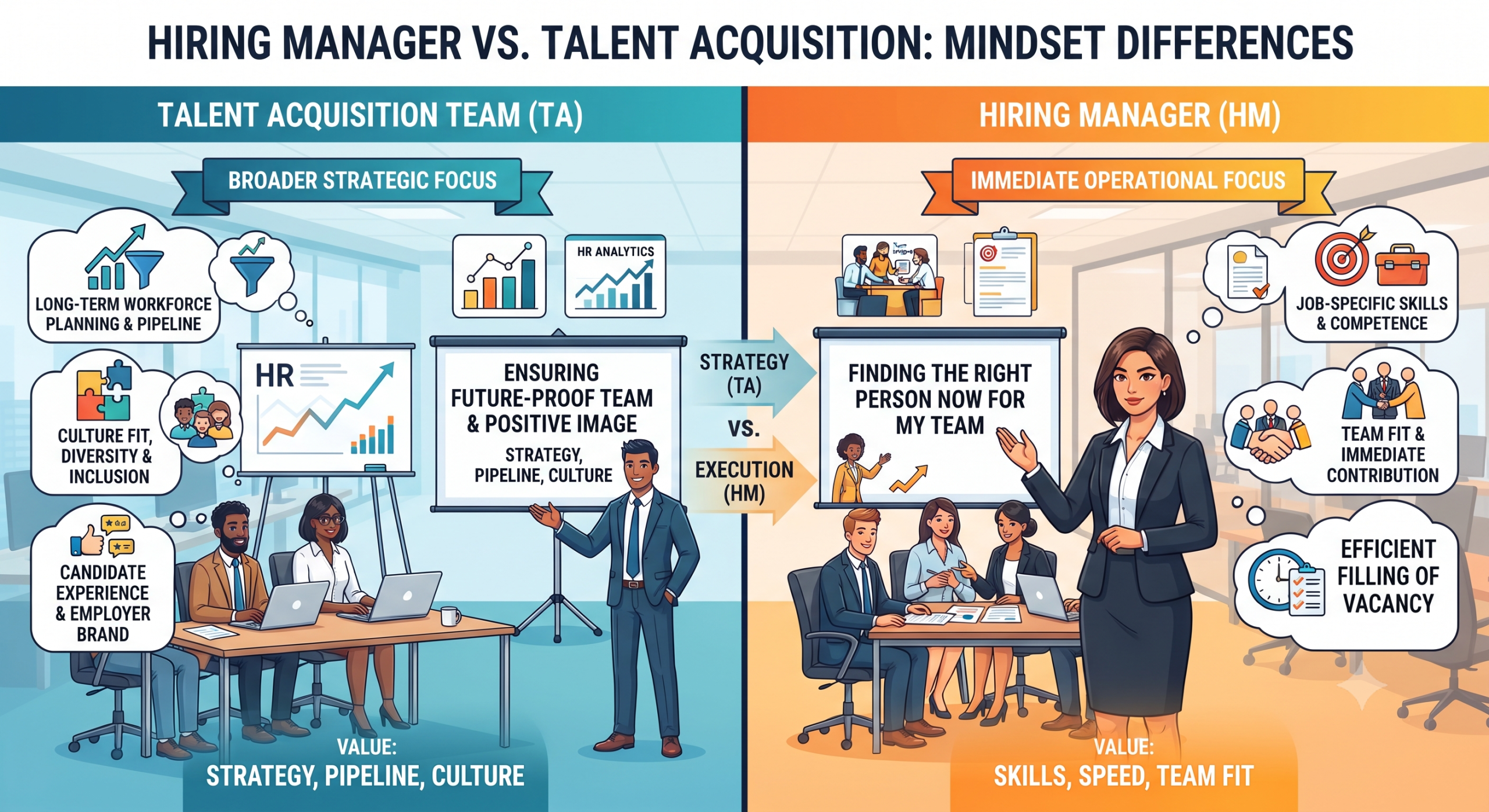
Talent Acquisition teams are responsible for building a strong pipeline of qualified candidates, managing the recruitment process, and ensuring a positive hiring experience. Hiring managers, however, focus on how a candidate will perform after joining the company. Their priority is building a high-performing team that can achieve business objectives over the long term.
Whether you’re applying for a remote, hybrid, or on-site role, recognizing these different mindsets allows you to present your qualifications in a way that resonates with both audiences. This guide explains how hiring managers and Talent Acquisition teams think differently and what candidates can do to succeed throughout the hiring process.
Talent Acquisition Teams Focus on Finding the Right Talent
Talent Acquisition professionals are responsible for attracting and managing candidates from the beginning of the hiring process.
Their priorities include:
- Sourcing qualified candidates
- Managing job postings
- Screening applications
- Coordinating interviews
- Improving candidate experience
- Supporting employer branding
- Maintaining recruitment pipelines
Their success is often measured by:
- Time-to-fill
- Quality of hires
- Candidate satisfaction
- Offer acceptance rates
- Recruitment efficiency
They work across multiple departments and frequently manage several hiring processes simultaneously.
Hiring Managers Focus on Business Results
Hiring managers think beyond recruitment.
They are responsible for ensuring the new employee contributes to business success.
Their questions often include:
- Can this person solve our team’s challenges?
- Will they improve productivity?
- Can they collaborate effectively?
- How quickly can they become productive?
- Will they stay with the company long term?
Hiring managers are accountable for the employee’s performance after hiring, making their evaluation much more focused on long-term business impact.
Talent Acquisition Teams Evaluate Qualifications First
During the initial stages, TA professionals determine whether candidates meet the basic job requirements.
They review:
- Work experience
- Skills
- Education
- Certifications
- Salary expectations
- Location preferences
- Work authorization
Applicant Tracking Systems (ATS) often support this process by helping identify resumes that match the required qualifications.
Candidates who present clear, well-structured resumes are more likely to advance to the next stage.
Hiring Managers Evaluate Performance Potential
Once candidates reach the interview stage, hiring managers shift the focus from qualifications to performance.
They evaluate:
- Problem-solving ability
- Critical thinking
- Decision-making
- Communication
- Leadership potential
- Adaptability
- Learning ability
Instead of asking whether you meet the minimum requirements, they assess whether you can create meaningful value for the organization.
Examples supported by measurable achievements often carry more weight than general statements.
Talent Acquisition Teams Prioritize Hiring Efficiency
TA professionals must keep the recruitment process moving efficiently.
Their responsibilities include:
- Scheduling interviews
- Managing candidate communication
- Coordinating hiring timelines
- Supporting hiring managers
- Maintaining compliance
- Ensuring recruitment consistency
Because they manage multiple vacancies simultaneously, they appreciate candidates who communicate professionally and respond promptly.
An organized recruitment process benefits both employers and applicants.
Hiring Managers Prioritize Team Success
Hiring managers are building teams, not simply filling vacancies.
They consider whether you will:
- Work well with colleagues
- Contribute new ideas
- Handle workplace challenges
- Adapt to organizational change
- Strengthen team performance
- Support business objectives
Behavioral interviews help them understand how you have handled similar situations in previous roles.
Past performance often provides insight into future workplace success.
Remote Work Changes Both Perspectives
The growth of remote and hybrid work has expanded hiring priorities for both Talent Acquisition teams and hiring managers.
Talent Acquisition professionals often verify:
- Remote work eligibility
- Time zone compatibility
- Technology readiness
- Legal employment requirements
Hiring managers evaluate:
- Independent productivity
- Virtual communication
- Collaboration across distributed teams
- Accountability
- Self-motivation
- Time management
If you’ve successfully worked remotely or collaborated across multiple locations, include these experiences in your resume and interview responses.
When searching for flexible opportunities, best job tool, a global job platform, can help you discover remote and hybrid positions with organizations seeking professionals who thrive in distributed work environments.
How Candidates Can Appeal to Both Groups
A successful application addresses the priorities of both Talent Acquisition teams and hiring managers.
For Talent Acquisition professionals:
- Tailor your resume to the job description.
- Use relevant keywords.
- Clearly present your qualifications.
- Keep formatting simple and professional.
For Hiring Managers:
- Highlight measurable business achievements.
- Demonstrate problem-solving skills.
- Share leadership experiences.
- Show adaptability and continuous learning.
- Explain how your work created value.
Balancing both approaches improves your chances of progressing through every hiring stage.
Build Long-Term Professional Relationships
Both Talent Acquisition professionals and hiring managers influence future career opportunities.
Maintain professionalism by:
- Responding promptly
- Preparing thoroughly for interviews
- Asking thoughtful questions
- Following up after interviews
- Maintaining a positive attitude
Even if you are not selected for one position, a strong impression may lead to future opportunities within the organization.
As your career develops, best job tool can help you connect with employers worldwide while discovering opportunities aligned with your experience, career goals, and preferred work environment.
Conclusion
Although hiring managers and Talent Acquisition teams work toward the same hiring goal, they approach candidates from different perspectives. Talent Acquisition professionals focus on sourcing qualified talent, managing efficient recruitment processes, and creating a positive candidate experience. Hiring managers concentrate on long-term performance, business impact, team dynamics, and the candidate’s ability to contribute after joining the organization.
By understanding these different mindsets, you can create stronger applications, communicate more effectively during interviews, and demonstrate value at every stage of the hiring process. Present clear qualifications for Talent Acquisition teams while emphasizing measurable achievements, problem-solving abilities, and long-term potential for hiring managers. As you continue your job search, best job tool, a global job platform, can help you discover remote, hybrid, and global opportunities where your skills can make a meaningful impact.






Comments (1)
[5685]5555 লগইন এবং অ্যাপ ডাউনলোড | বিকাশ অনলাইন ক্যাসিনো স্লট গেম,5555 লগইন করুন এবং সহজেই অ্যাপ ডাউনলোড করে নিন। বিকাশ দিয়ে অনলাইন ক্যাসিনো এবং সেরা স্লট গেম সাইটে আজই যুক্ত হয়ে খেলা শুরু করুন। visit: 5555