

Introduction
Many candidates expect clear and detailed feedback after interviews. However, the reality is often different. This is because how interview feedback is filtered before reaching candidates plays a major role in communication.
Organizations do not usually share raw interview feedback. Instead, they refine and structure it before passing it to candidates. Therefore, what you receive is often a simplified version.
Understanding this process helps you interpret feedback more accurately. It also helps you improve your performance in future interviews.
Why companies filter interview feedback
Companies filter feedback to maintain professionalism and consistency. Direct feedback can sometimes be too blunt or misinterpreted.
Therefore, recruiters adjust language to ensure it remains respectful and constructive. This protects both the candidate experience and the company’s reputation.
Additionally, legal considerations play a role. Organizations avoid sharing feedback that could create disputes or misunderstandings.
As a result, feedback is carefully reviewed before being communicated.
The internal feedback collection process
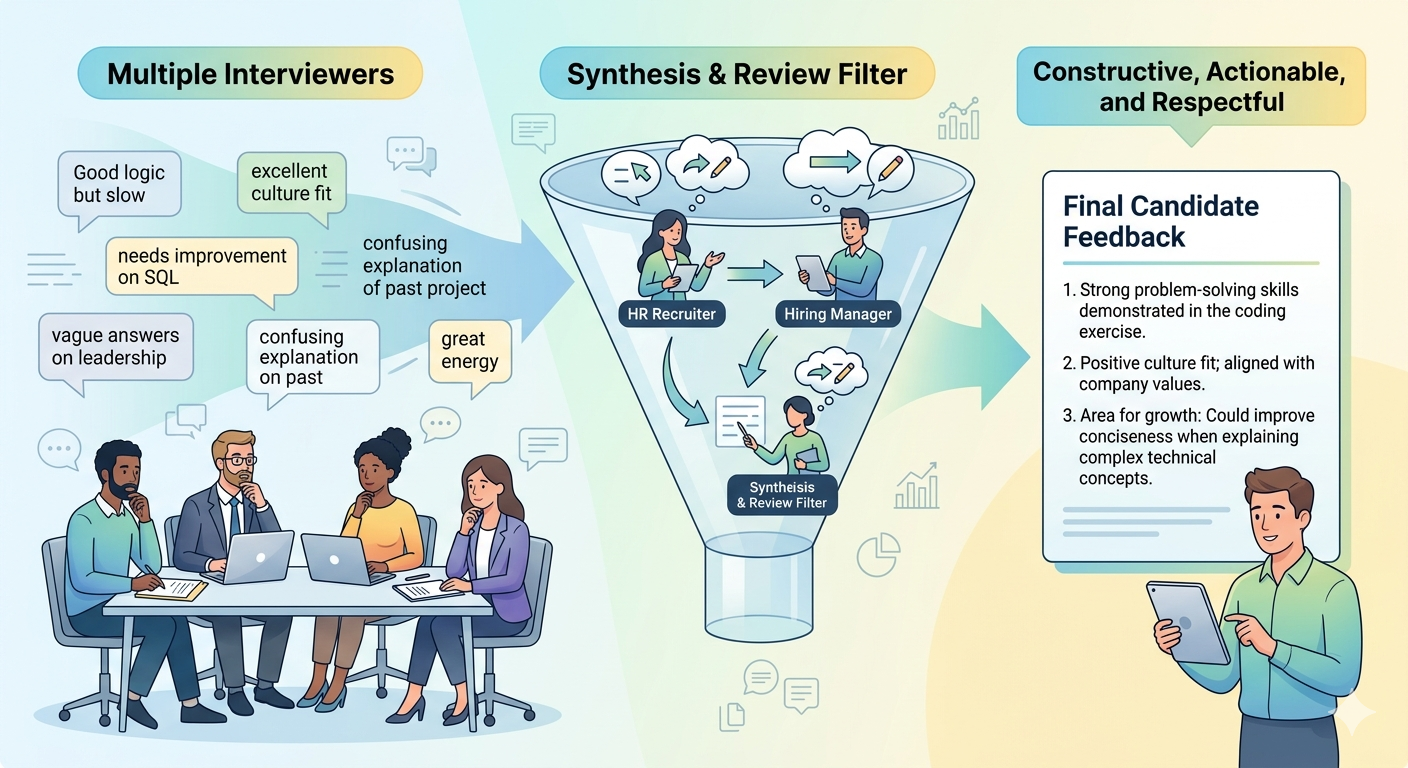
After an interview, multiple interviewers usually share their evaluations. These include detailed observations about skills, communication, and overall fit.
Each interviewer may have a different perspective. Therefore, the feedback can be complex and sometimes inconsistent.
Recruiters then collect this information and consolidate it. They identify key points and remove unnecessary details.
This internal step is where how interview feedback is filtered before reaching candidates begins to take shape.
How recruiters refine and structure feedback
Once feedback is collected, recruiters organize it into a clear and concise format. They focus on major strengths and key concerns.
Complex or conflicting opinions are simplified. This ensures the message is easy to understand.
Additionally, recruiters avoid overly technical or critical language. They aim to maintain a positive candidate experience.
Therefore, the final feedback often reflects a balanced and neutral tone.
Common types of filtered feedback candidates receive
Candidates usually receive generalized responses. These responses summarize detailed internal discussions.
Common examples include statements like “we found a better fit” or “we are moving forward with other candidates.”
These phrases may seem vague. However, they often represent multiple evaluation factors.
Therefore, understanding how interview feedback is filtered before reaching candidates helps decode these messages.
The role of consistency in feedback clarity
Consistency plays an important role in how feedback is formed. Candidates who perform consistently across interview rounds receive clearer feedback.
For example, strong performance in all areas leads to positive and specific feedback.
On the other hand, inconsistent performance creates mixed impressions. This often results in vague or neutral responses.
Therefore, consistent performance improves the clarity and usefulness of feedback.
Why detailed feedback is rarely shared
Providing detailed feedback requires time and resources. Recruiters manage multiple candidates and roles simultaneously.
Therefore, they prioritize efficiency. Sharing detailed feedback for every candidate may not be practical.
Additionally, detailed feedback can lead to further discussions or disagreements. This increases workload and complexity.
As a result, companies prefer to share concise and general feedback.
How hiring decisions influence feedback
Feedback is closely linked to final hiring decisions. Recruiters align feedback with the outcome.
If a candidate is rejected, feedback may focus on general improvement areas. If selected, feedback highlights strengths.
Additionally, companies ensure that feedback supports their decision without creating confusion.
Therefore, feedback is not just informative. It is also strategic.
How candidates should interpret filtered feedback
Candidates should focus on patterns rather than exact wording. Repeated feedback across interviews reveals key areas for improvement.
For example, consistent mentions of communication skills indicate a clear focus area.
Additionally, vague feedback often suggests mixed performance. This highlights the need for improvement in consistency.
Therefore, interpreting feedback requires reading between the lines.
Improving performance despite limited feedback
Limited feedback does not mean lack of insight. Candidates can still improve by analyzing their interview performance.
Reflect on your responses, communication, and preparation. Identify areas where you felt less confident.
Additionally, seek external feedback from mentors or peers. This provides a more detailed perspective.
Moreover, practice regularly. Consistent preparation improves performance over time.
Therefore, improvement is possible even with minimal feedback.
The importance of self-assessment in career growth
Self-assessment plays a critical role in professional development. It helps identify strengths and weaknesses independently.
Candidates who regularly evaluate their performance improve faster. They do not rely solely on external feedback.
Additionally, self-awareness enhances confidence. It allows candidates to present themselves more effectively.
Therefore, self-assessment complements filtered feedback.
Why understanding feedback filtering matters
Understanding how interview feedback is filtered before reaching candidates provides a strategic advantage.
It helps manage expectations and reduces frustration. Candidates become more aware of how hiring processes work.
Additionally, it encourages proactive improvement. Instead of waiting for detailed feedback, candidates take responsibility for growth.
Therefore, awareness of this process improves both mindset and performance.
Conclusion
Understanding how interview feedback is filtered before reaching candidates is essential for navigating modern hiring processes. Feedback is not always incomplete, but it is often simplified and structured.
Companies refine feedback to maintain professionalism, efficiency, and clarity. Therefore, candidates must interpret responses carefully.
Focusing on consistency, self-assessment, and continuous improvement leads to better outcomes. It helps candidates grow regardless of feedback limitations.
In today’s competitive job market, success depends not only on receiving feedback but on understanding and acting on it effectively.
Find Your Dream Job Today – Explore Endless Career Opportunities and Secure Your Next Role with Best Job Tool.






Comments
Be the first to leave a comment.