

Introduction
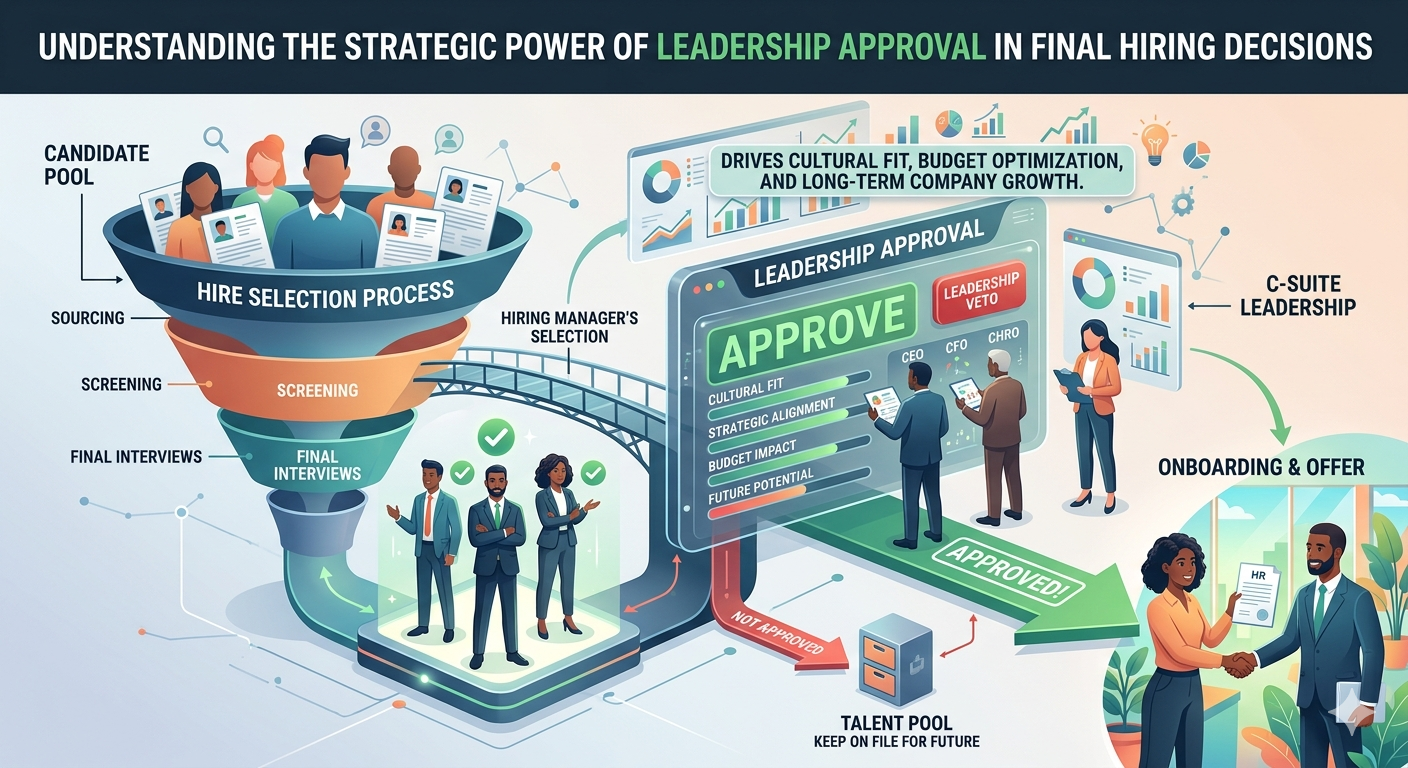
Most candidates assume that once they clear interviews with recruiters and hiring managers, the job offer will follow quickly. However, in many organizations, especially growing companies and enterprises, the final decision often depends on leadership approval. Senior leaders review hiring decisions to ensure alignment with business goals, budgets, and long-term strategy. This explains exactly how leadership approval impacts final hiring decisions in modern hiring processes.
Leadership involvement adds an extra layer of evaluation. It ensures that hiring decisions support not just immediate team needs but also broader organizational priorities.
Leadership ensures alignment with business goals
First, leaders evaluate whether the candidate aligns with the company’s strategic direction. They consider how the role contributes to long-term growth, product development, or operational efficiency.
Even if a candidate performs well technically, leadership may delay or reconsider the decision if the role itself does not align with current priorities.
Strategic alignment influences final approval.
Budget and resource validation
Hiring decisions also depend on budget availability. Leaders review whether the company has the financial capacity to support the role.
They may evaluate salary expectations, team expansion plans, and cost implications. In some cases, even strong candidates face delays due to budget constraints.
Financial validation plays a key role in approval decisions.
Risk assessment before final approval
Leadership evaluates the potential risks associated with hiring a candidate. These risks may include cultural misalignment, role fit, or long-term retention concerns.
Senior leaders often prefer candidates who reduce uncertainty and integrate smoothly into the organization. They focus on long-term impact rather than short-term performance.
Risk-aware decisions protect organizational stability.
Consistency across hiring standards
Large organizations maintain standardized hiring practices to ensure fairness and quality. Leadership approval helps maintain consistency across teams and departments.
Leaders review whether the candidate meets company-wide standards, not just team-specific expectations. This ensures that hiring quality remains uniform across the organization.
Consistency strengthens hiring processes.
Cross-team impact considerations
Some roles affect multiple teams or departments. Leadership evaluates how a candidate’s role will interact with other teams and whether it supports broader collaboration.
They may consider how the hire influences workflows, dependencies, and team structure. Candidates who align well with cross-team requirements are more likely to receive approval.
Broader impact influences decision-making.
Cultural and leadership alignment
Leadership often focuses heavily on cultural fit. They assess whether the candidate aligns with company values, leadership style, and team dynamics.
Candidates who demonstrate adaptability, communication, and alignment with organizational culture are more likely to receive approval.
Cultural fit becomes a deciding factor at this stage.
Long-term growth potential
Leaders think beyond immediate role requirements. They evaluate whether the candidate has the potential to grow within the organization.
Candidates who show learning ability, leadership qualities, and adaptability are seen as long-term assets. This potential can influence final hiring decisions positively.
Growth potential increases hiring confidence.
Final validation of interview feedback
Leadership reviews feedback from different interview rounds. They analyze strengths, weaknesses, and overall performance.
If feedback is consistent and positive, approval becomes easier. However, mixed feedback may lead to further discussions or delays.
Final validation ensures informed decision-making.
Decision delays and candidate experience
Leadership approval can sometimes delay the hiring process. Candidates may experience waiting periods even after completing all interview rounds.
While this may seem frustrating, it reflects the organization’s effort to make careful and strategic decisions.
Understanding this process helps candidates manage expectations.
Conclusion
Hiring decisions involve more than technical evaluation and interview performance. That is precisely how leadership approval impacts final hiring decisions across modern organizations.
Leaders ensure alignment with business goals, validate budgets, assess risks, and evaluate long-term potential before approving hires. While this process may add time, it helps organizations make more strategic and sustainable hiring choices. Candidates who align with both team needs and organizational vision are more likely to receive final approval and succeed in their roles.
Find Your Dream Job Today – Explore Endless Career Opportunities and Secure Your Next Role with Best Job Tool.






Comments
Be the first to leave a comment.