

Introduction
In today’s professional world, accountability is one of the most important qualities employers look for. Skills can be taught. Experience can be gained. But accountability is a mindset. It shows how a person takes responsibility for their actions, decisions, and results.
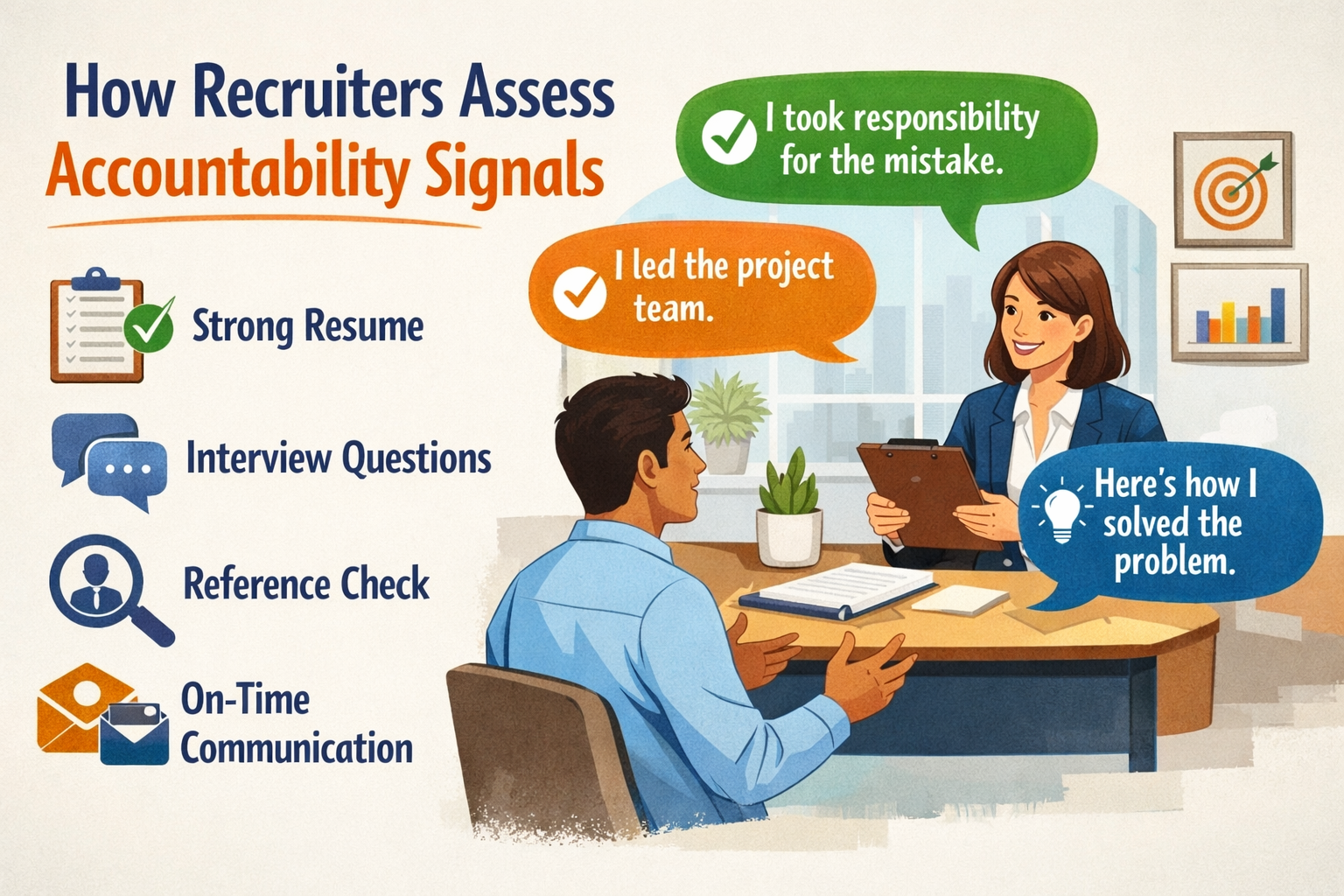
Recruiters do not always directly ask, “Are you accountable?” Instead, they look for signals. These signals appear in resumes, interviews, communication style, body language, and even small behaviors.
In this article, we will understand how recruiters assess accountability signals and why it matters so much in hiring decisions.
What Does Accountability Mean?
Accountability means:
- Taking responsibility for your work
- Accepting mistakes without blaming others
- Delivering what you promise
- Owning both success and failure
- Being reliable and dependable
A person who is accountable does not run away from problems. They face them and try to solve them.
Recruiters value accountability because companies want employees who can be trusted.
Why Accountability Is Important in the Workplace?
Before understanding how recruiters assess accountability, let us understand why it is important.
1. Builds Trust
Managers trust employees who take ownership. Trust reduces micromanagement.
2. Improves Team Performance
When team members are accountable, work becomes smooth. There is less conflict and blame.
3. Increases Productivity
Accountable people focus on results. They complete tasks on time.
4. Shows Leadership Potential
Leaders must take responsibility. Accountability is a key leadership quality.
Because of these reasons, recruiters carefully observe accountability signals during hiring.
How Recruiters Assess Accountability Signals?
1. Accountability Signals in the Resume
Your resume is the first place where recruiters look for signs of accountability.
A. Use of Ownership Language
Recruiters notice how you describe your work.
For example:
❌ “Worked on marketing campaigns.”
✅ “Led marketing campaigns that increased engagement by 30%.”
The second sentence shows ownership and measurable results.
B. Results-Oriented Statements
Accountable candidates mention outcomes.
Instead of writing:
- “Handled customer service.”
Write:
- “Resolved 95% of customer complaints within 24 hours.”
Numbers show responsibility and results.
C. Consistent Career Growth
Frequent job changes without clear reasons may create doubt. Recruiters may wonder if the candidate avoids responsibility.
Steady growth or increasing responsibilities show accountability.
2. Accountability Signals in Cover Letters
Your cover letter shows your mindset.
Recruiters look for:
- Clarity
- Honesty
- Confidence
- Responsibility
If you mention past challenges and how you solved them, it shows maturity.
Example:
“In my previous role, I missed a deadline during my first month. I learned to plan better and improved my time management system.”
This shows learning and ownership.
3. Behavioral Interview Questions
Recruiters often use behavioral questions to test accountability.
They may ask:
- “Tell me about a time you made a mistake.”
- “Describe a situation where you failed.”
- “How do you handle missed deadlines?”
- “What happens when a team project goes wrong?”
4. How You Talk About Mistakes
This is one of the biggest accountability signals.
There are two types of answers:
Non-Accountable Answer
“The project failed because my teammate did not complete his part.”
This answer shows blame.
Accountable Answer
“The project faced delays because we did not coordinate properly. I should have followed up earlier. After that, I created a tracking sheet to avoid future delays.”
This shows ownership and improvement.
Recruiters notice this difference immediately.
5. Body Language and Tone
Accountability is not only about words. It is also about behavior.
Recruiters observe:
- Eye contact
- Calm tone
- Clear communication
- Confidence
If a candidate becomes defensive or aggressive when asked about mistakes, it can be a red flag.
Calm and thoughtful responses show emotional maturity.
6. Consistency Between Resume and Interview
If your resume says you led a team, but in the interview you say “We did everything together,” it creates confusion.
Recruiters check consistency.
They may ask detailed questions to see if you truly owned the work.
Accountable candidates can clearly explain:
- Their role
- Their contribution
- The result
7. Accountability in Communication Style
Recruiters also assess how you communicate before and after the interview.
For example:
- Do you respond to emails on time?
- Do you arrive on time for interviews?
- Do you inform them if you are running late?
These small actions show professionalism.
Being punctual is a strong accountability signal.
8. Handling Difficult Situations
Recruiters want to know how you act under pressure.
They may ask:
- “What if your manager criticizes your work?”
- “What if you disagree with your team?”
An accountable person says:
“I would listen carefully, understand the feedback, and improve.”
A defensive person says:
“I usually do not make mistakes.”
Recruiters prefer candidates who accept feedback.
9. Ownership of Team Results
Sometimes recruiters test how you talk about team success.
If you only say:
“I achieved everything.”
It may sound selfish.
If you only say:
“My team did everything.”
It may sound like you are hiding.
A balanced answer shows accountability:
“I led the project planning, and my team worked hard to execute it. Together we achieved 20% growth.”
This shows both leadership and teamwork.
10. Reference Checks
Recruiters often contact previous managers.
They ask questions like:
- Was this person reliable?
- Did they complete tasks on time?
- How did they handle mistakes?
- Were they dependable?
If your manager says you avoided responsibility, it affects hiring decisions.
11. Accountability in Problem-Solving
Recruiters also give case studies or scenario questions.
For example:
“What will you do if a client is unhappy?”
An accountable answer:
“I will first understand the problem, apologize if needed, and find a solution.”
Recruiters check whether you focus on solving or blaming.
12. Meeting Deadlines During Hiring Process
Even during the hiring process, recruiters test accountability.
For example:
- Submitting assignments on time
- Following instructions carefully
- Sending required documents
If a candidate misses deadlines without explanation, it shows low accountability.
13. Growth Mindset
Accountability is connected to growth mindset.
A growth mindset means:
- Accepting weaknesses
- Learning from failure
- Improving continuously
Recruiters prefer candidates who say:
“I learned from that experience and improved.”
Instead of:
“That was not my fault.”
14. Emotional Control
Emotional stability is another accountability signal.
When recruiters ask tough questions, they observe:
- Do you stay calm?
- Do you react emotionally?
Calm candidates appear more responsible and mature.
15. Accountability in Leadership Roles
For senior roles, accountability becomes even more important.
Recruiters look for:
- Decision-making ability
- Ownership of business outcomes
- Crisis management skills
- Team accountability
Leaders must protect their team and take responsibility.
16. Digital Footprint and Professional Behavior
Sometimes recruiters check:
- LinkedIn profile
- Public posts
- Online behavior
If someone publicly blames companies or speaks negatively about previous employers, it can show poor accountability.
Professional behavior online also matters.
Conclusion
Recruiters do not assess accountability through one question. They observe it throughout the hiring process.
They look at:
- Resume language
- Behavioral answers
- Body language
- Communication style
- Reference feedback
- Professional behavior
Accountability signals appear in small actions and honest words.
In the end, recruiters hire people they can trust. Skills can be trained. Experience can grow. But accountability shows character.
If you want to stand out as a candidate, focus not only on what you achieved but also on how you owned your journey.
Because true professionalism begins with responsibility.






Comments
Be the first to leave a comment.