

Introduction
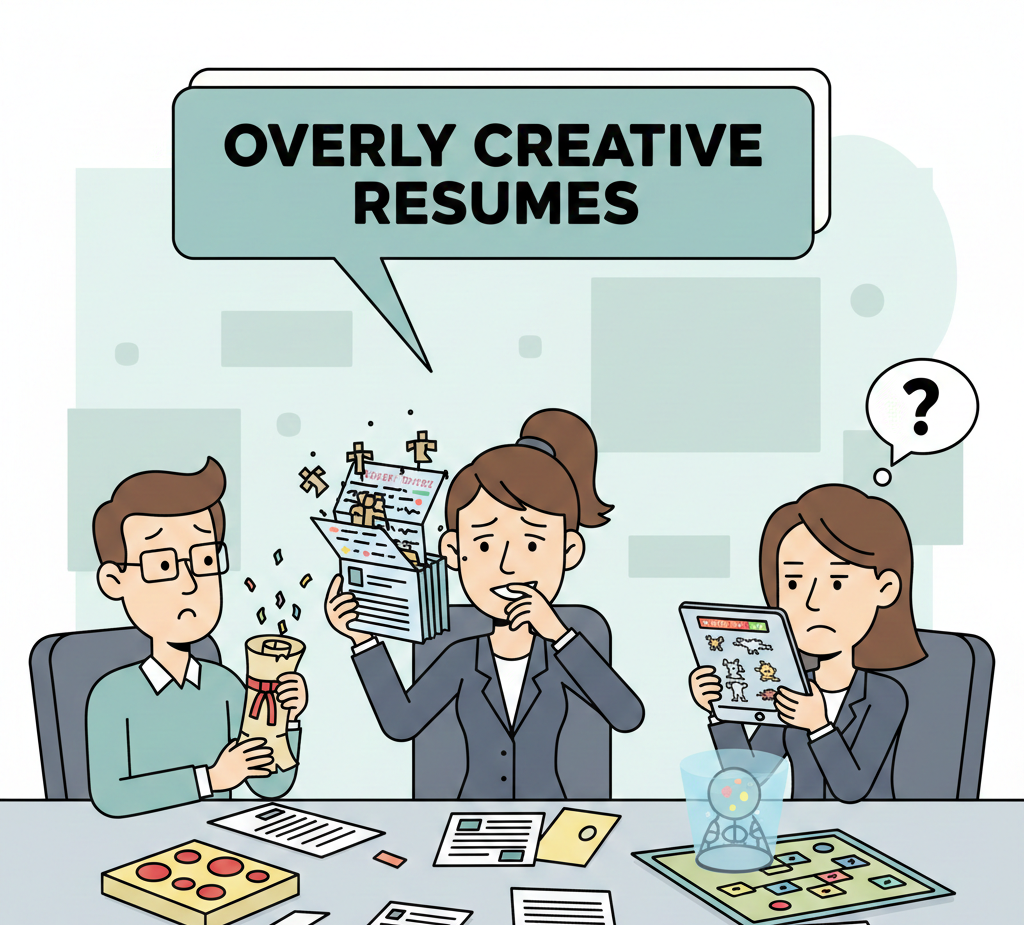
Creative resumes are often seen as a way to stand out in competitive job markets. Candidates use bold colors, graphics, unique layouts, and unconventional formats to capture attention. While creativity can be useful in certain roles, it does not always produce the intended result. In many cases, it creates friction during screening. That is exactly how recruiters react to overly creative resumes in real hiring scenarios.
Recruiters operate under time pressure and structured evaluation processes. When a resume prioritizes design over clarity, it can slow down comprehension and reduce shortlisting chances, even if the candidate is qualified.
Recruiters prioritize readability over design
The primary goal of a resume is communication, not visual entertainment. Recruiters need to extract key information quickly, such as skills, experience, and achievements.
Overly creative resumes often disrupt this flow with complex layouts, unusual fonts, or excessive visuals. When readability decreases, recruiters may move on to simpler resumes that are easier to scan.
Clarity consistently outperforms creativity in high-volume screening.
Complex formats increase screening time
Recruiters typically spend only a few seconds on the initial resume scan. A standard structure allows them to find important details instantly.
Creative formats with icons, columns, or non-linear layouts require additional effort to interpret. Under high application volume, recruiters rarely invest extra time decoding design-heavy resumes.
Efficiency strongly influences how recruiters react to overly creative resumes.
Applicant Tracking Systems struggle with creative layouts
Many organizations use Applicant Tracking Systems to filter resumes before human review. Overly creative resumes with graphics, tables, or text embedded in images may not be parsed correctly.
Important keywords, job titles, or skills can be missed during automated screening. As a result, a creative resume may get filtered out despite strong qualifications.
Technical compatibility is a major factor in resume evaluation.
Creativity can signal role misalignment
In roles that prioritize structure, analysis, or operations, highly creative resumes may unintentionally signal poor role alignment.
Recruiters may question whether the candidate understands industry expectations. For non-design roles, simplicity often reflects professionalism and awareness of hiring norms.
Context matters when using creative presentation styles.
Visual overload reduces key message retention
Excessive design elements can overshadow important achievements and experience. Recruiters may remember the design but miss the substance.
A resume should highlight impact and relevance, not distract from them. When visuals dominate content, the core value proposition becomes less clear.
Substance must remain the central focus.
Creative resumes work better in specific industries
Design, marketing, branding, and creative fields may appreciate visually unique resumes. In such industries, creativity can showcase relevant skills directly.
However, even in creative roles, clarity and structure remain essential. A creative resume that lacks organization can still reduce evaluation effectiveness.
Balanced creativity is more effective than excessive design.
Recruiters may perceive creativity as compensation
In some cases, overly creative resumes may be interpreted as an attempt to compensate for weaker experience.
If design overshadows content depth, recruiters may focus more critically on qualifications. This perception can unintentionally reduce credibility during screening.
Strong content should always support creative presentation.
Standard resumes enable faster comparison
Recruiters often compare multiple resumes side by side. Standardized formats make comparison easier and more efficient.
Creative resumes disrupt this comparison process because information appears in unfamiliar sections or formats. This slows decision-making and may reduce shortlist chances.
Consistency supports faster evaluation.
Professional tone matters more than visual uniqueness
Recruiters value professionalism, clarity, and alignment more than visual distinctiveness. A clean, well-structured resume signals seriousness and attention to detail.
Overly playful or experimental designs may appear less formal, especially in corporate environments. This perception influences shortlisting decisions subtly but significantly.
Tone alignment is crucial in resume presentation.
Balanced creativity enhances rather than harms
Creativity is not inherently negative. Subtle design elements such as clean typography, consistent spacing, and minimal color use can improve readability.
The problem arises when creativity compromises clarity or structure. A balanced approach maintains professionalism while allowing slight visual differentiation.
Strategic creativity supports rather than distracts from content.
Conclusion
Overly creative resumes can attract attention, but attention alone does not guarantee shortlisting. That is precisely how recruiters react to overly creative resumes when clarity, structure, and relevance are compromised.
Recruiters prioritize readability, efficiency, and content alignment over visual complexity. A clean and focused resume communicates value more effectively than an overly designed one. To create resumes that balance clarity, professionalism, and role alignment, use the best job tool to optimize applications, track opportunities, and present your profile strategically.
Find Your Dream Job Today – Explore Endless Career Opportunities and Secure Your Next Role with Best Job Tool.






Comments
Be the first to leave a comment.