

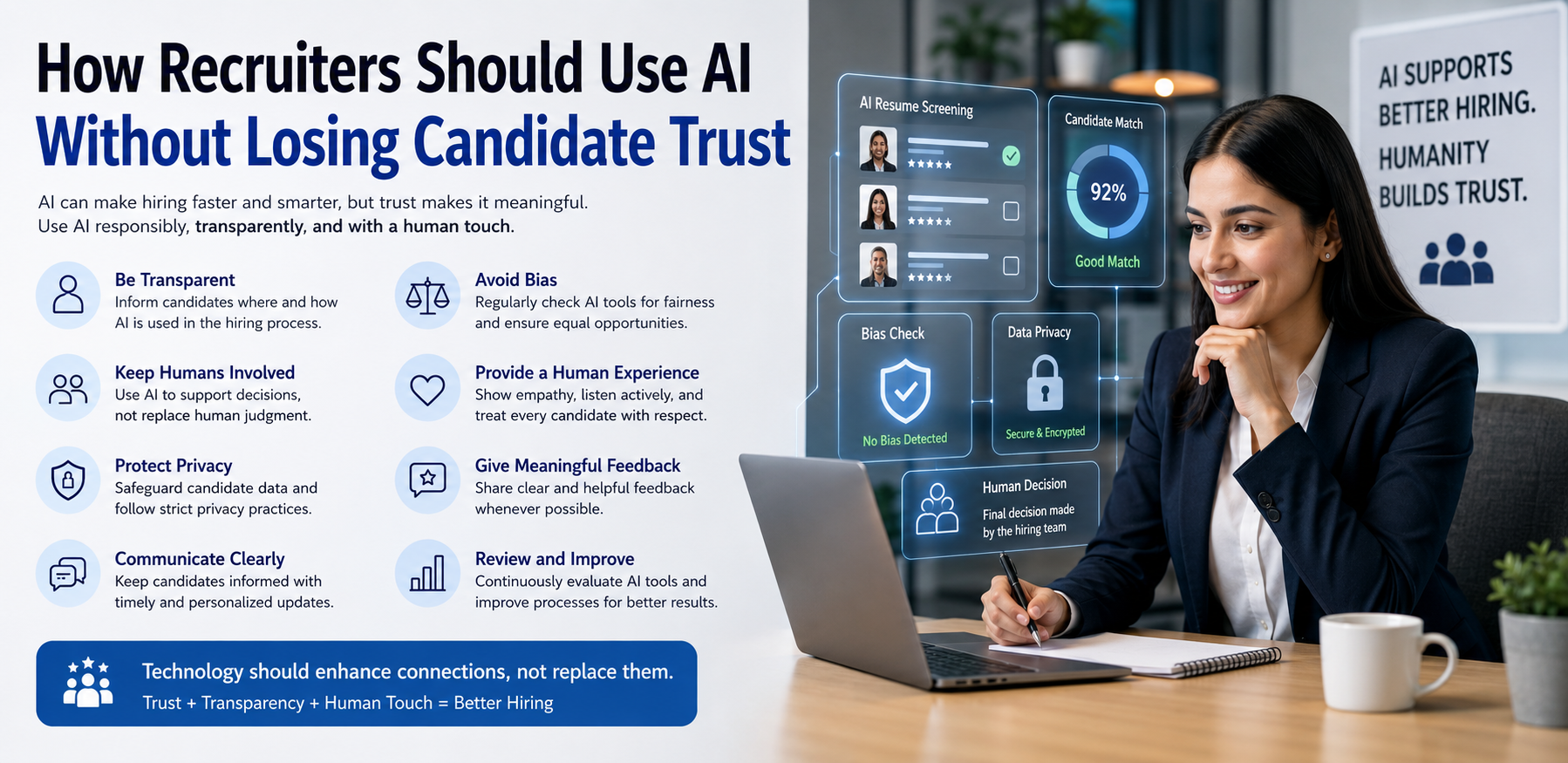
Introduction: Recruiters Should Use AI
Artificial Intelligence is changing the hiring process very quickly. Today many companies use AI tools to screen resumes, schedule interviews, analyze candidate data, and improve recruitment speed. AI can save time and help recruiters manage large numbers of applications more effectively. But even though AI is becoming common in hiring, one important thing should never be ignored — candidate trust.
Candidates want fair treatment, honest communication, and human connection during the hiring process. If recruiters use AI in the wrong way, candidates may feel ignored, confused, or unfairly judged. This can damage the company’s reputation and reduce the quality of hiring.
AI should support recruiters, not replace human understanding. Recruiters who use AI carefully and ethically can improve hiring while still building strong relationships with candidates.
In this article, we will discuss how recruiters should use AI without losing candidate trust.
Why AI Is Becoming Popular in Recruitment?
Recruitment can be a long and difficult process. Recruiters often receive hundreds or even thousands of applications for one job role. Managing all these applications manually takes a lot of time.
AI helps recruiters by automating repetitive tasks such as:
- Resume screening
- Candidate matching
- Interview scheduling
- Skill assessment
- Chat support for candidates
- Predicting hiring success
AI tools can quickly identify candidates whose skills match the job requirements. This helps recruiters focus more on interviews and decision-making instead of spending all day reviewing resumes.
Many companies also use AI because it improves efficiency and reduces hiring costs.
However, faster hiring does not always mean better hiring. If recruiters depend too much on AI, they may create a negative experience for candidates.
How Recruiters Should Use AI Without Losing Candidate Trust?
1. Use AI as a Support Tool, Not a Replacement
One of the biggest mistakes recruiters make is depending completely on AI.
AI is good at handling repetitive tasks and analyzing data quickly. But AI cannot fully understand human emotions, personality, motivation, creativity, or cultural fit.
Recruiters should use AI to assist decision-making, not replace human judgment.
For example:
- AI can shortlist candidates based on skills and experience.
- But recruiters should still personally review important applications.
- AI can schedule interviews automatically.
- But recruiters should communicate personally during key stages.
Candidates still want to feel that a real person is evaluating them.
Human involvement helps candidates feel respected and valued.
2. Be Transparent About AI Usage
Transparency is one of the best ways to build candidate trust.
If a company uses AI during hiring, candidates should know about it. Recruiters should clearly explain:
- Where AI is being used
- Why AI is being used
- How candidate data is processed
- Whether humans are involved in decisions
When recruiters hide AI usage, candidates may feel uncomfortable if they later discover it.
For example, if an AI tool is analyzing video interviews or screening resumes, candidates should be informed in advance.
Transparency creates honesty in the recruitment process.
A simple explanation like this can help:
“We use AI tools to support resume screening and scheduling, but final hiring decisions are made by recruiters.”
This reassurance helps candidates feel more confident.
3. Avoid Over-Automation
Automation can improve efficiency, but too much automation can make recruitment feel cold and impersonal.
Candidates do not want to interact only with bots and automated emails. They still want human communication.
Some recruiters make the mistake of automating every step, including:
- Rejection emails
- Interview communication
- Candidate support
- Follow-ups
This can make candidates feel like they are talking to a machine instead of a company.
Recruiters should maintain a balance between automation and personal interaction.
For example:
- Use automated scheduling tools to save time.
- But personally connect with candidates before interviews.
- Use AI chatbots for basic questions.
- But provide human support for important concerns.
Human communication creates a better candidate experience.
4. Make Sure AI Does Not Create Bias
Bias in hiring is a serious issue.
Many people believe AI is always unbiased, but this is not completely true. AI systems learn from existing data. If the data contains bias, the AI may also make biased decisions.
For example:
- AI may prefer candidates from certain colleges.
- AI may reject candidates because of career gaps.
- AI may unintentionally favor specific genders or backgrounds.
This can create unfair hiring practices.
Recruiters should regularly check AI systems for fairness and accuracy.
Some important steps include:
- Reviewing hiring results regularly
- Testing AI tools for bias
- Using diverse training data
- Keeping human oversight in decisions
Recruiters should never blindly trust AI recommendations.
Fair hiring increases candidate trust and protects company reputation.
5. Protect Candidate Privacy
AI tools often collect and process large amounts of candidate data.
This may include:
- Personal details
- Resume information
- Interview recordings
- Assessment results
- Behavioral analysis
Candidates want assurance that their information is safe.
Recruiters should use secure systems and follow privacy regulations carefully.
Important practices include:
- Collect only necessary data
- Explain how data will be used
- Store candidate data securely
- Avoid sharing data unnecessarily
- Delete outdated information when required
If candidates feel their data is unsafe, they may lose trust in the company.
Privacy protection is an important part of ethical recruitment.
6. Give Candidates a Human Experience
Even when AI is involved, candidates should still feel respected and understood.
Recruitment is not only about skills and qualifications. It is also about emotions, confidence, and career goals.
Candidates often remember how recruiters treated them during the hiring process.
Recruiters can create a human experience by:
- Listening carefully during interviews
- Giving personalized responses
- Showing empathy and respect
- Providing feedback when possible
- Answering candidate questions honestly
AI cannot replace emotional intelligence.
A positive human experience helps companies attract better talent.
7. Recruiters Should Use AI to Improve Communication, Not Reduce It
AI can actually improve communication when used correctly.
For example, AI tools can:
- Send interview reminders
- Update application status quickly
- Answer simple candidate questions
- Reduce response delays
This helps candidates stay informed during the hiring process.
Many candidates lose trust when companies stop responding after applications or interviews.
AI can help recruiters maintain consistent communication.
But communication should still feel natural and respectful.
Recruiters should avoid robotic or overly generic messages.
Candidates appreciate personalized communication because it shows effort and professionalism.
Conclusion: Recruiters Should Use AI
AI is transforming recruitment and helping companies hire faster and more efficiently. It can reduce repetitive work, improve organization, and support better hiring decisions. But recruiters should never forget the human side of recruitment.
Candidate trust is extremely important. If AI is used without transparency, fairness, or human interaction, candidates may feel disconnected and lose confidence in the hiring process.
Recruiters should use AI as a support tool instead of depending on it completely. They should maintain honest communication, protect candidate privacy, avoid bias, and continue providing a human experience.
Technology can improve recruitment, but trust is built through fairness, empathy, and respect.
The future of successful hiring is not only about smart AI tools. It is about using those tools responsibly while keeping people at the center of recruitment.






Comments
Be the first to leave a comment.