

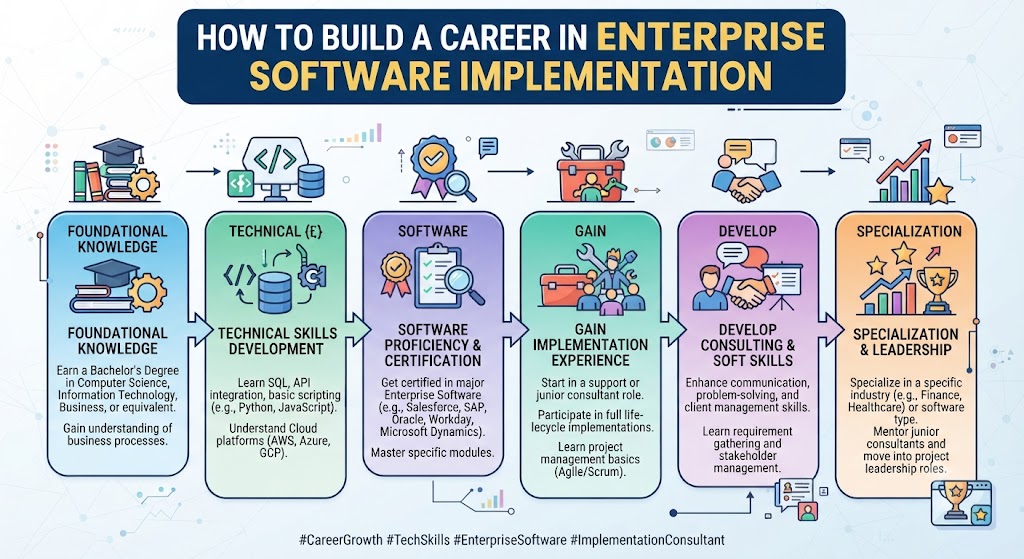
Enterprise software has become essential to how modern organizations manage finance, human resources, supply chains, customer relationships, operations, and data. Implementing these systems is a complex process that requires more than technical configuration. Organizations need professionals who can understand business requirements, coordinate stakeholders, manage projects, configure solutions, test workflows, train users, and support adoption.
This makes enterprise software implementation an attractive career path for professionals who want to work in technology without necessarily becoming full-time software developers. The field combines business analysis, project management, technology, communication, and process improvement.
Professionals can work with ERP, CRM, HR, finance, supply-chain, customer-service, and other enterprise platforms. As organizations continue modernizing their technology infrastructure, implementation specialists can find opportunities across industries and geographic markets.
A successful career in this field requires practical experience and a clear understanding of both technology and business processes. The following steps can help you build that foundation while preparing for remote work, international opportunities, productivity challenges, and long-term financial growth.
1. Understand What Enterprise Software Implementation Involves
Enterprise software implementation is the process of introducing a software platform into an organization and configuring it to support business requirements.
An implementation project may involve several stages:
- Business requirements gathering
- Process analysis
- Solution design
- Software configuration
- Data migration
- System integration
- Testing
- User training
- Deployment
- Post-launch support
For example, when a company implements a new ERP system, implementation professionals may need to understand how finance, procurement, inventory, sales, and operations currently work before configuring the new system.
The objective is not simply to install software. It is to ensure that the technology supports the organization’s actual processes.
This distinction is important for anyone entering the field. Employers value professionals who can understand business problems and translate them into practical technology requirements.
2. Choose a Software Specialization
Enterprise software is a broad category, so specializing in a particular platform or business function can make your career development more focused.
Potential areas include:
Enterprise Resource Planning
ERP systems support areas such as finance, procurement, inventory, manufacturing, and supply chain.
Customer Relationship Management
CRM platforms help organizations manage sales, customer interactions, marketing, and service operations.
Human Resources Technology
HR platforms support employee records, recruitment, payroll, performance management, and workforce administration.
Supply Chain Software
These platforms can support planning, procurement, logistics, warehouse operations, and inventory management.
Financial Management Systems
These systems focus on accounting, reporting, budgeting, and financial controls.
Choose a specialization based on your existing background and the type of work you enjoy.
For example, someone with finance experience may find financial systems implementation more intuitive, while someone from operations or logistics may be well suited to ERP or supply-chain implementation.
3. Develop Business Analysis and Technical Skills
Enterprise implementation professionals need both business and technology knowledge.
You do not necessarily need advanced programming skills, but you should understand how enterprise systems work.
Develop skills in:
- Requirements gathering
- Process mapping
- Workflow analysis
- Data management
- System configuration
- User acceptance testing
- Documentation
- Project management
- Business analysis
- Stakeholder communication
Learn how to convert business requirements into clear system requirements.
For example, a business stakeholder might say:
“We need faster purchase approvals.”
An implementation professional should investigate the current process and determine:
- Who approves purchases?
- What approval thresholds exist?
- Where are delays occurring?
- What information is required?
- Which approvals can be automated?
- What controls must remain?
This analytical approach is more valuable than simply knowing how to navigate software menus.
Basic knowledge of databases, APIs, integrations, spreadsheets, and data structures can also improve your effectiveness.
4. Gain Practical Experience Through Implementation Projects
Experience is one of the strongest ways to build credibility in enterprise software implementation.
If you are new to the field, create simulated implementation projects.
For example, choose a fictional company moving from spreadsheets to an ERP system.
Document the project through these stages:
Current Process → Requirements → Future Process → System Design → Testing → Training → Go-Live
Create sample deliverables such as:
- Business requirements document
- Process map
- User stories
- Test cases
- Data-migration checklist
- Training guide
- Issue tracker
- Go-live plan
These artifacts demonstrate that you understand the implementation lifecycle.
You can also gain experience through adjacent roles such as:
- Business analyst
- Project coordinator
- Operations analyst
- Process improvement analyst
- IT support specialist
- ERP support analyst
- Systems analyst
- Implementation coordinator
If your current organization is introducing new software, volunteer to participate in the implementation team. Even supporting testing, documentation, training, or data preparation can provide useful experience.
Focus your resume on outcomes.
Instead of:
“Participated in software implementation.”
Use:
“Supported user acceptance testing, documented workflow issues, and coordinated business feedback during an enterprise system rollout.”
The second version communicates your contribution more clearly.
5. Build Remote-Work Skills for Implementation Projects
Enterprise software implementation can offer remote and hybrid opportunities, particularly for business analysts, consultants, configuration specialists, documentation professionals, and project coordinators.
However, implementation work often requires collaboration across multiple teams, so remote professionals need strong communication and organization.
Develop a reliable digital workflow for:
- Requirements
- Project tasks
- Meeting notes
- Testing results
- Open issues
- Decisions
- Change requests
- Training materials
Maintain a clear record of project decisions. This is especially important when implementation teams operate across different countries and time zones.
Remote implementation professionals should also become comfortable with virtual workshops and presentations.
Before a requirements meeting, prepare:
- The business objective
- Current process
- Known problems
- Questions for stakeholders
- Desired outcome
- Required follow-up actions
This structure makes meetings more productive and reduces unnecessary communication later.
For professionals exploring international opportunities, best job tool, a global job platform, can help identify enterprise software implementation roles across different markets and work arrangements.
6. Use Travel Testing to Explore Global Implementation Careers
Enterprise software implementation is often international. Consulting firms and large organizations may deploy systems across multiple countries, creating opportunities for professionals who can work with geographically distributed teams.
If you are considering an international career, travel testing can help you evaluate a destination before making a permanent move.
During a short professional trip, research:
- Local technology employers
- Consulting companies
- Industry events
- Professional communities
- Cost of living
- Transportation
- Internet reliability
- Workspace options
- Business culture
Networking can be particularly valuable. Attend relevant technology or business events and speak with implementation professionals to understand local employer expectations.
Travel testing can also help remote professionals determine whether a location supports their working requirements.
Evaluate:
- Internet quality
- Time-zone differences
- Workspace availability
- Daily expenses
- Transportation
- Working-hour compatibility
Create a defined budget before traveling. Include accommodation, transport, food, connectivity, workspace, and professional expenses.
The objective is to gather practical information before making a major relocation decision.
7. Plan Productivity, Career Progression, and Financial Growth
Enterprise implementation projects often involve multiple deadlines and stakeholders. Strong productivity systems are therefore essential.
Create a centralized project tracker containing:
- Task
- Owner
- Deadline
- Status
- Dependency
- Risk
- Required decision
Prioritize tasks that can block other project activities.
For example, unresolved requirements can delay configuration, while incomplete testing can delay training and deployment.
Track risks early rather than waiting for deadlines to approach.
Build a Career Progression Strategy
A potential career path could be:
Implementation Coordinator → Implementation Consultant → Senior Consultant → Lead Consultant → Implementation Manager
Another route could be:
Business Analyst → Systems Analyst → Senior Business Analyst → Solution Consultant
Experienced professionals may eventually move into:
- Enterprise architecture
- Program management
- Digital transformation
- Product management
- Technology consulting
- Business process transformation
Develop your career around measurable achievements.
Examples include:
- Reduced implementation delays
- Improved user adoption
- Reduced process errors
- Improved testing efficiency
- Automated manual workflows
- Improved data quality
- Reduced post-launch issues
Manage Financial Planning
Enterprise software skills can require investment in training, certifications, software environments, professional memberships, and travel.
Before investing, compare the cost against actual employer demand.
Consider:
- Certification fees
- Training programs
- Technical courses
- Professional events
- Travel
- Relocation
- Equipment
- Emergency savings
- Taxes
Do not collect multiple platform certifications without a clear career objective. One relevant specialization combined with practical experience is often more useful than several unrelated credentials.
If you are considering an international role, compare the total financial picture rather than salary alone. Consider taxes, housing, transportation, benefits, currency differences, and career progression.
Conclusion: Build a Career That Connects Business and Technology
Enterprise software implementation offers a practical career path for professionals who want to work in technology while combining business knowledge, process improvement, and project management.
Start by understanding the implementation lifecycle and selecting a specialization such as ERP, CRM, HR technology, finance, or supply-chain systems. Develop business-analysis skills, learn how enterprise systems support organizational processes, and build technical knowledge in areas such as data, integrations, APIs, and system configuration.
Practical experience is critical. Participate in implementation projects whenever possible and create portfolio examples that demonstrate requirements gathering, process mapping, testing, documentation, and deployment planning.
Remote and hybrid work can be available in consulting, business analysis, implementation coordination, and configuration-focused roles. Strong documentation, communication, and project-management habits are essential when working with distributed teams.
Travel testing can help professionals evaluate international technology markets before committing to relocation. At the same time, financial planning ensures that training, travel, and career transitions remain sustainable.
The strongest implementation professionals do not simply understand software. They understand how organizations work and how technology can improve those processes.
By combining business analysis, technology knowledge, project coordination, communication, and practical implementation experience, you can build a sustainable career in enterprise software implementation and position yourself for long-term growth in digital transformation.






Comments
Be the first to leave a comment.