

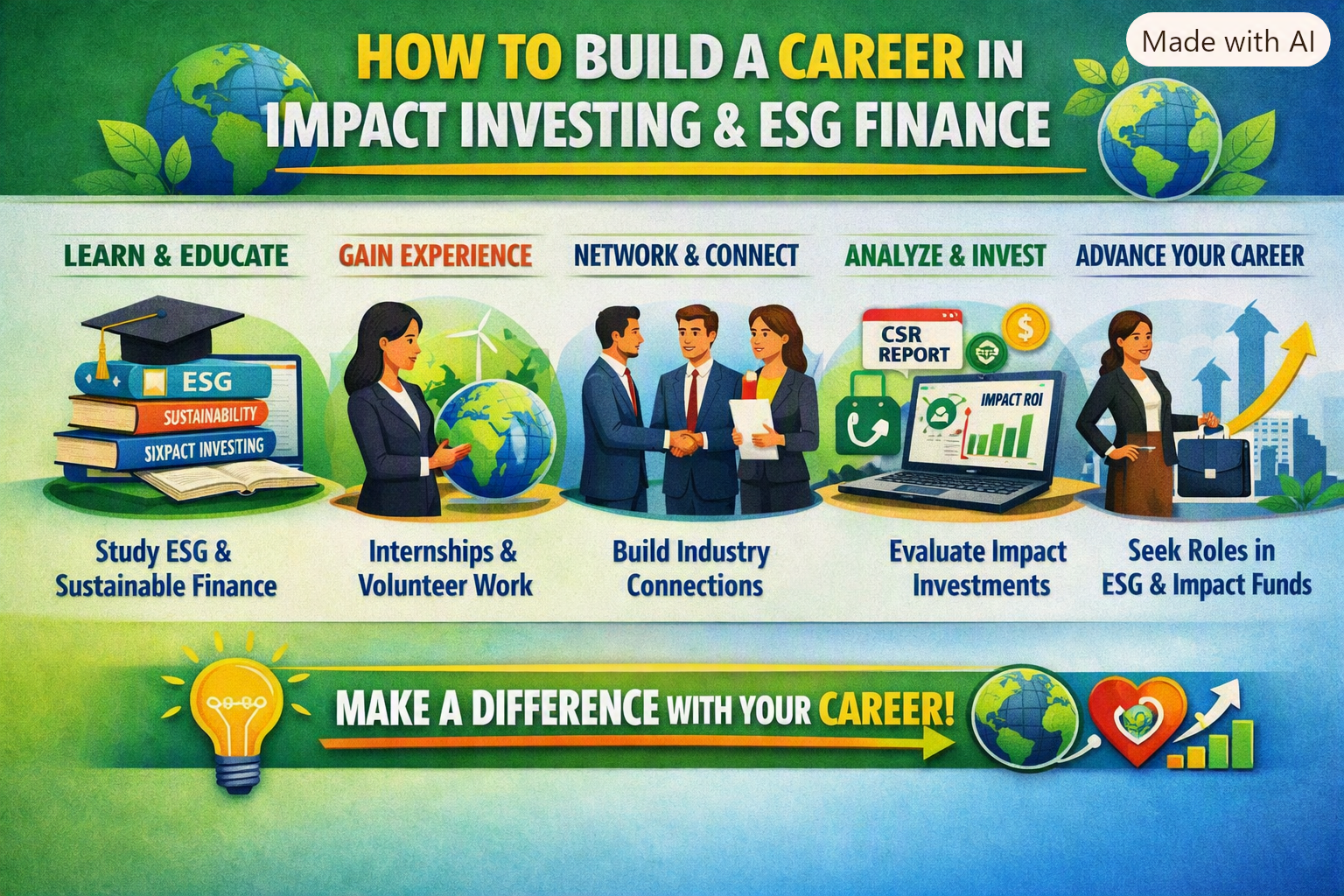
Introduction: Impact Investing and ESG Finance
The financial world is evolving, and companies and investors are looking for ways to make money while also focusing on how businesses affect people, society, and the environment. This demand is creating new career opportunities in fields such as impact investing and ESG finance. These areas are ideal for professionals looking to make a difference while also pursuing a career in finance.
How to Build a Career in Impact Investing and ESG Finance ?
1. Understand Impact Investing and ESG Finance
One must understand the difference between impact investing and ESG finance before starting the journey of pursuing a career in either area.
In general, impact investing refers to investing in companies, funds, and projects that are intended to improve society and the environment while also providing financial gains. ESG stands for environmental, social, and governance, and ESG finance integrates social and environmental concerns into mainstream finance.
Both fields integrate traditional finance and focus on doing good.
2. Build a Solid Finance Foundation
Having a strong foundation in finance is crucial for a career in ESG or impact investing. A person must be well-versed with the finance fundamentals, such as financial statements, valuation, investment analysis, risk management, portfolio management, and markets.
Students considering a career in ESG or impact investing should consider studying finance, economics, accounting, business, or mathematics in college. One does not need to pursue a finance major to build a career in these areas. People with various academic backgrounds, such as engineers, environmental science students, economists, consultants, and businesspeople, can invest in this space.
One can invest in online courses and books to learn finance fundamentals if they do not have a strong finance background.
3. Learn About ESG and Sustainability
Having a solid foundation in finance is not enough; one must also have a firm grasp of ESG and sustainability. The concepts of climate change, clean energy, social responsibility, corporate governance, and sustainable finance are essential to comprehend.
One should also be familiar with ESG terms and know how firms report on ESG factors. Reading through ESG and company reports can be helpful in gaining a deeper understanding of the ESG landscape.
4. Develop Analytical Skills
Impact and ESG finance involve a lot of research and analysis. Employers are looking for analytical thinkers who can go through a stack of data and pull out relevant investment ideas. It is essential to highlight quantitative skills, particularly data analysis skills in Excel, financial modeling skills, and data visualization tools, such as Power BI and SQL. Having some coding experience can also be beneficial.
One should also learn how to analyze companies, compare and contrast similar companies, study industries, and identify investment risks and ideas. Analytical skills allow one to highlight the pros and cons of different investment opportunities and highlight which options have the potential to gain financially and fulfill ESG goals.
5. Create Practical Projects
One of the best ways to highlight ESG or impact finance expertise is to build a strong portfolio. A person can add projects that showcase their ability to make informed ESG and impact investment decisions, even without years of finance experience. For instance, a person can complete an ESG analysis project of their choice and present their findings.
They can go through a company’s website and analyze its ESG practices and performance, including governance, employee-friendly policies, climate change initiatives, and financial performance. They could also create a mock impact investment portfolio that includes stocks, companies, and funds that fit the ESG investment criteria.
6. Consider Getting Certified
Having the necessary certifications is also crucial in this space. It is critical to identify the best ESG finance certifications that one can pursue, depending on their interests and long-term goals. Certifications will make it easier to switch careers from another space to ESG or impact investing. However, one must not overlook the need to gain practical knowledge when preparing for certification exams.
They should also research the cost of the best ESG finance certifications and weigh their needs and budget. One should only go for the ESG finance certification that offers value and aligns with their long-term needs.
Conclusion
Building a career in impact investing and ESG finance requires a combination of financial expertise, sustainability knowledge, analytical skills, and a genuine understanding of social and environmental challenges. By gaining relevant qualifications, developing practical experience, staying informed about evolving ESG standards, and building a strong professional network, aspiring professionals can position themselves for opportunities in this growing field.
Ready to build a meaningful career in impact investing and ESG finance? Turn your interest in sustainable finance into practical skills and career opportunities. Explore Best Job Tool to discover relevant roles, connect with employers, and take the next step toward a career that combines financial expertise with positive social and environmental impact.






Comments
Be the first to leave a comment.