

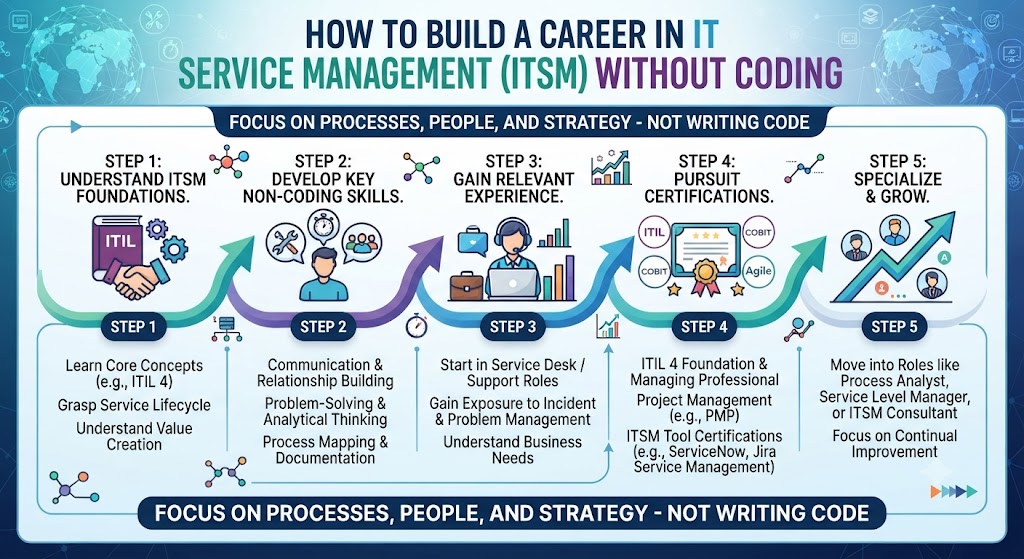
Information technology is often associated with software development, programming, and engineering. However, the technology industry also depends on professionals who manage services, processes, incidents, customers, vendors, and business operations. IT Service Management (ITSM) is one of the strongest career areas for professionals who want to work in technology without becoming software developers. Coding
ITSM focuses on designing, delivering, managing, and continuously improving IT services so that they support business requirements. Professionals in this field help organizations maintain reliable technology services, resolve issues efficiently, manage changes, and improve user experiences.
A coding background can be useful in some IT roles, but it is not a universal requirement for IT service management. Strong communication, process management, analytical thinking, documentation, customer service, and problem-solving skills can be equally important.
For professionals considering a career transition, ITSM can provide opportunities in service desk management, incident management, change management, problem management, service delivery, IT operations coordination, and IT governance. Many of these roles can also offer hybrid or remote work opportunities.
1. Understand What IT Service Management Actually Involves
IT Service Management is about managing IT services throughout their lifecycle and ensuring they deliver consistent value to users and the organization.
Instead of developing software, an ITSM professional may focus on questions such as:
- How should an IT incident be handled?
- Why does the same technical problem keep occurring?
- How should a system change be approved?
- How quickly should an issue be resolved?
- Are IT services meeting agreed performance targets?
- How can users receive better support?
Common ITSM processes include:
- Incident management
- Problem management
- Change management
- Service request management
- Knowledge management
- Service-level management
- Configuration management
- IT asset management
For example, if employees repeatedly lose access to an internal application, an ITSM professional may track incidents, identify patterns, coordinate technical teams, monitor resolution times, and help investigate the underlying problem.
The focus is on managing the service and process rather than writing the application code.
2. Explore ITSM Career Paths That Do Not Require Coding
There are several ITSM roles where coding is not the primary requirement.
IT Service Desk Analyst
Service desk professionals help users resolve technical issues and manage service requests. Strong communication and troubleshooting skills are particularly important.
Incident Manager
Incident managers coordinate responses to significant IT disruptions. Their role involves communication, prioritization, escalation, and coordination between technical teams.
Problem Manager
Problem managers investigate recurring incidents and coordinate efforts to Coding identify and address underlying causes.
Change Manager
Change managers help organizations introduce technology changes in a controlled way while minimizing operational risk.
Service Delivery Manager
Service delivery managers oversee service performance and relationships between IT teams, business stakeholders, and customers.
ITSM Process Analyst
Process analysts evaluate existing workflows, identify inefficiencies, document processes, and recommend improvements.
IT Service Management Consultant
Experienced professionals can move into consulting, helping organizations design or improve their ITSM frameworks and processes.
These roles demonstrate that there are multiple ways to build a technology career without becoming a programmer.
3. Build the Core Skills Employers Value
The absence of coding experience does not mean an ITSM career is easy. You need a strong professional skill set.
Communication
ITSM professionals often act as a bridge between technical specialists and business users.
You must be able to translate technical issues into clear business language.
Process Management
Learn how workflows operate and how they can be improved.
You should understand:
- Process mapping
- Standard operating procedures
- Escalation workflows
- Service-level agreements
- Key performance indicators
- Continuous improvement
Problem-Solving
ITSM involves more than responding to individual Coding incidents. Professionals must recognize patterns and help prevent recurring issues.
Documentation
Clear documentation is critical. Create concise records of incidents, changes, procedures, known errors, and resolutions.
Data Analysis
You do not need advanced programming to analyze Coding service-management data.
Start with Excel and learn how to evaluate:
- Incident volumes
- Resolution times
- SLA compliance
- Recurring issues
- Service availability
- Customer satisfaction
- Backlog trends
Learning Power BI can further strengthen your ability to create service-performance dashboards.
4. Learn ITSM Frameworks and Tools
Understanding recognized ITSM frameworks can make your profile more credible.
ITIL is one of the most widely recognized approaches to IT service management. Learning its principles can help you understand concepts such as service value, incident management, change enablement, problem management, and continual improvement.
You should also become familiar with service-management platforms.
Depending on the employer, you may encounter tools such as:
- ServiceNow
- Jira Service Management
- BMC Helix
- Freshservice
- ManageEngine ServiceDesk Plus
You do not need to learn every platform.
Choose one widely used platform and understand how tickets, workflows, approvals, knowledge articles, SLAs, and reporting work.
The goal is to understand service-management processes rather than simply learning where to click inside a software application.
5. Build Experience Through Practical Projects
If you are transitioning from another field, practical projects can help demonstrate your understanding of ITSM.
Create a simulated service-desk environment.
For example, build a dataset containing:
- Incident ID
- Category
- Priority
- Assigned team
- Creation date
- Resolution date
- SLA target
- Resolution status
- User satisfaction
Analyze the data and identify:
- Which categories generate the most incidents?
- Which issues take the longest to resolve?
- Which teams have the largest backlog?
- Where are SLA breaches occurring?
- Which incidents appear repeatedly?
Then create a dashboard and recommend process improvements.
You can also document a sample incident-management process:
Incident Reported → Categorization → Prioritization → Assignment → Investigation → Resolution → Closure → Review
These projects can demonstrate your understanding even if you have not previously held an ITSM job.
Look for relevant experience in adjacent positions such as:
- Customer support
- Operations coordination
- Business operations
- Help desk support
- Process management
- Quality assurance
- Project coordination
- Administrative technology support
Skills from these roles can transfer into ITSM when presented correctly.
6. Target Remote and International ITSM Opportunities
ITSM can offer strong remote and hybrid possibilities because many service-management responsibilities are digital.
Potentially remote-friendly roles include:
- ITSM analyst
- Incident manager
- Change manager
- Problem manager
- Service delivery analyst
- Service desk analyst
- IT process analyst
- ITSM consultant
However, some organizations require on-site support, particularly for hardware, infrastructure, or physical facilities.
If remote work is a priority, target positions focused on service processes, coordination, reporting, governance, and digital support.
Develop habits that make remote service management effective:
- Keep detailed documentation.
- Maintain clear escalation procedures.
- Track SLA deadlines.
- Communicate status updates consistently.
- Record decisions.
- Use centralized ticketing systems.
- Schedule regular service reviews.
Working internationally may also require comfort with multiple time zones. If your role supports global users, you may need to coordinate handoffs between regional teams.
For professionals exploring global opportunities, BestJobTool, a global job platform, can help identify ITSM and technology operations roles across different markets.
7. Plan Your Productivity, Career Growth, Travel Testing, and Finances
ITSM professionals frequently handle multiple incidents, meetings, reports, and improvement projects. Productivity depends on prioritizing issues correctly.
Start with impact and urgency.
For example:
High impact + high urgency: Major service outage affecting a large number of users.
High impact + lower urgency: Recurring problem requiring root-cause investigation.
Lower impact + high volume: Routine service requests that may benefit from automation or self-service.
Low impact: Minor administrative tasks.
This prioritization prevents important service issues from being buried under routine requests.
Build a Career Progression Plan
A potential career path could be:
Service Desk Analyst → Senior Service Desk Analyst → Incident/Problem Manager → ITSM Manager
Another route could be:
ITSM Analyst → ITSM Process Specialist → Service Management Consultant → ITSM Lead
Professionals can also move into:
- Service delivery
- IT governance
- IT operations
- IT project management
- Vendor management
- Technology risk
- Business operations
Build your career around measurable outcomes.
Examples include:
- Improved SLA compliance
- Reduced incident resolution time
- Reduced recurring incidents
- Improved customer satisfaction
- Reduced ticket backlog
- Improved change success rates
Use Travel Testing for International Career Decisions
If you are considering working internationally, do not immediately assume relocation is necessary.
Use travel testing to evaluate potential destinations.
During a short visit, assess:
- Cost of living
- Internet reliability
- Workspace availability
- Professional networking opportunities
- Local technology communities
- Transportation
- Time-zone compatibility
You can also attend technology or IT service-management events to understand local demand.
For remote professionals, testing a destination while maintaining normal work responsibilities can reveal whether the location supports your productivity.
Manage Your Finances
Career transitions require financial planning.
Before investing in courses, certifications, travel, or relocation, calculate:
- Certification costs
- Training expenses
- Travel
- Equipment
- Emergency savings
- Accommodation
- Transportation
- Taxes
- Relocation costs
Do not pursue certifications simply because they appear on other professionals’ profiles. Prioritize qualifications that align with the roles you actually want.
Conclusion: Build a Technology Career Through Service Management
You do not need to become a programmer to build a successful career in technology. IT Service Management provides multiple opportunities for professionals who are strong in communication, organization, process improvement, analysis, and problem-solving.
Start by understanding core ITSM processes such as incident, problem, change, service request, and service-level management. Then build practical skills in documentation, data analysis, process mapping, and service reporting.
Learning an ITSM framework such as ITIL and gaining familiarity with platforms such as ServiceNow or Jira Service Management can strengthen your profile. Practical projects can demonstrate your abilities even when you are transitioning from another career.
Remote and international opportunities can further expand your options, particularly in service management, analytics, process management, and consulting. Travel testing can help you evaluate potential destinations before making a major relocation decision.
Finally, treat career development as a long-term investment. Choose training based on employer requirements, maintain financial flexibility, and focus on measurable improvements rather than collecting qualifications without practical application.
A strong ITSM professional does not need to write software code every day. The real value comes from keeping technology services reliable, organized, measurable, and aligned with business needs.






Comments
Be the first to leave a comment.