

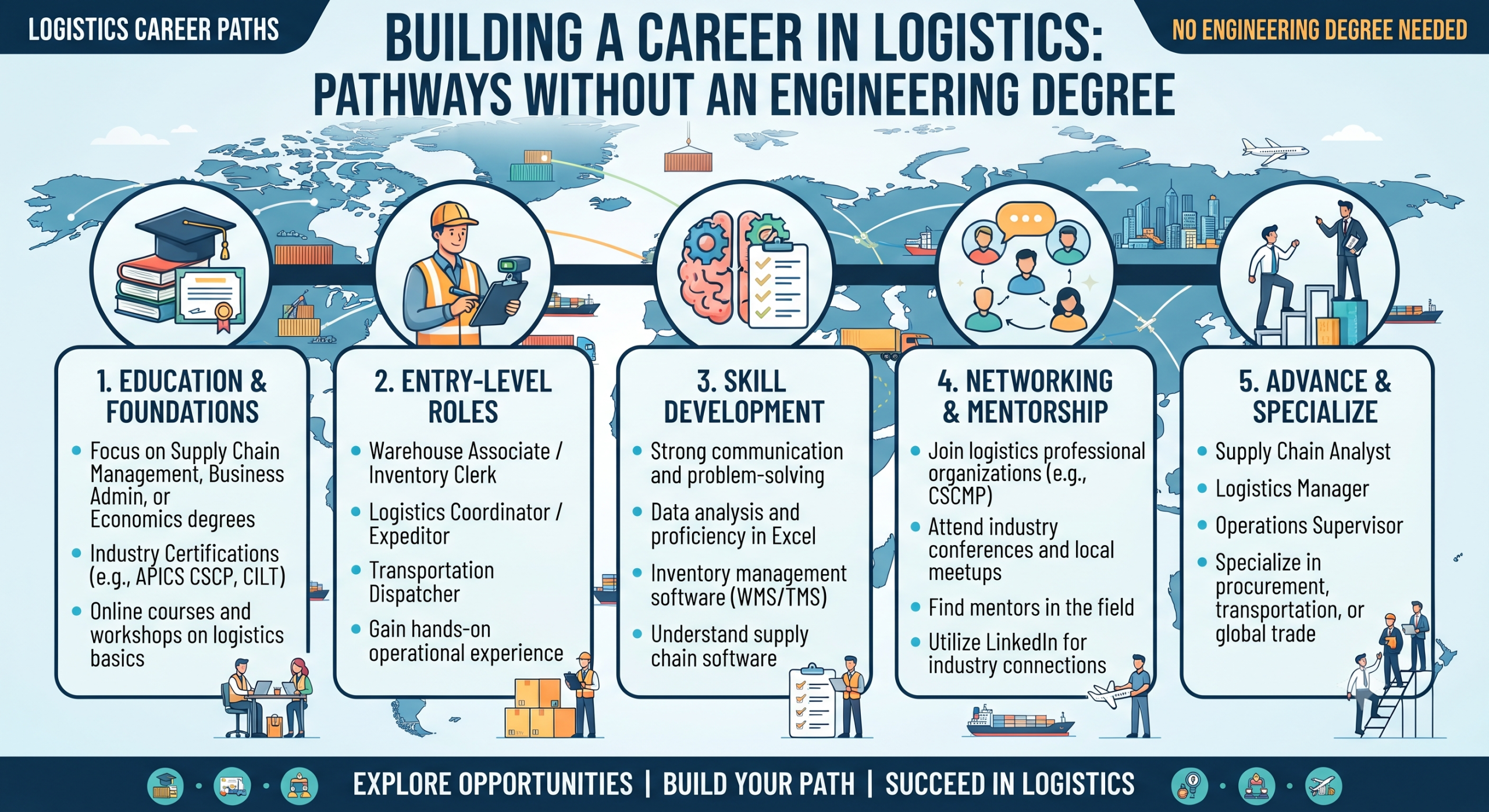
The logistics industry is often associated with engineering, supply chain management, and technical degrees. However, modern logistics is a much broader field. Companies need professionals who can coordinate operations, manage documentation, communicate with suppliers and customers, analyze data, monitor shipments, solve problems, and improve processes.
This means an engineering degree is not a mandatory requirement for building a successful logistics career. Graduates from business, commerce, management, economics, arts, and other disciplines can enter the industry by developing relevant skills and gaining practical experience.
The growth of e-commerce, international trade, third-party logistics, digital freight platforms, and remote operations has also created new opportunities. Professionals can now work in areas such as logistics coordination, freight operations, procurement support, customer operations, inventory management, documentation, and supply chain analytics.
The key is to focus less on the degree you do not have and more on the skills you can demonstrate.
1. Understand the Logistics Career Paths Available Without Engineering
Logistics is not a single job function. It includes several interconnected areas, and many of them do not require an engineering background.
Entry-level and mid-level opportunities can include:
- Logistics Coordinator
- Supply Chain Coordinator
- Operations Executive
- Freight Coordinator
- Transportation Coordinator
- Inventory Coordinator
- Procurement Assistant
- Import and Export Executive
- Warehouse Operations Coordinator
- Order Management Specialist
- Customer Operations Executive
- Supply Chain Analyst
- Logistics Documentation Specialist
The best starting point depends on your existing education and transferable skills.
For example, someone with a commerce background may transition into procurement, inventory, or financial operations. A management graduate may be suited to logistics coordination or operations management. Someone with strong communication skills may perform well in customer operations or freight coordination.
Instead of applying randomly, select one career path and identify the skills employers repeatedly request for that role.
2. Build the Core Skills Employers Actually Need
A logistics career depends heavily on practical skills. Employers need people who can keep operations organized, communicate accurately, and respond quickly when plans change.
Start with these foundational skills:
Excel and Data Management
Excel remains valuable for logistics professionals. Learn how to work with:
- Sorting and filtering
- Pivot tables
- VLOOKUP or XLOOKUP
- Conditional formatting
- Basic formulas
- Data validation
- Shipment and inventory tracking
- Simple dashboards
You do not need to become a data scientist. You need to become comfortable turning operational information into useful decisions.
Logistics Fundamentals
Understand concepts such as:
- Inventory management
- Transportation modes
- Warehousing
- Order fulfillment
- Freight forwarding
- Lead time
- Safety stock
- Purchase orders
- Delivery schedules
- Incoterms
- Import and export documentation
These fundamentals help you communicate confidently during interviews and on the job.
Communication and Coordination
Logistics involves multiple parties. A coordinator may communicate with suppliers, transport companies, warehouse teams, customers, and internal departments.
Clear communication can prevent costly mistakes. Learn how to write concise professional emails, follow up systematically, document issues, and communicate delays without creating confusion.
3. Gain Experience Before You Feel Fully Qualified
One of the biggest mistakes career changers make is waiting until they meet every requirement before applying.
Job descriptions often describe an ideal candidate rather than a minimum requirement. If you understand the fundamentals and can demonstrate relevant skills, start applying.
Create practical projects that demonstrate your capabilities. For example, you could build a simple shipment tracking spreadsheet containing:
- Shipment ID
- Supplier
- Destination
- Dispatch date
- Expected delivery date
- Actual delivery date
- Delay status
- Transportation cost
- Delivery status
Then analyze the data and identify delays or cost patterns.
You can also create a basic inventory dashboard or develop a mock logistics plan for an e-commerce business.
These projects give you something concrete to discuss during interviews.
Internships, apprenticeships, freelance assignments, temporary operations roles, and entry-level positions can also provide valuable experience. The objective is to accumulate evidence that you can perform logistics-related work.
4. Use Remote Work and Digital Tools to Expand Your Opportunities
Not every logistics role can be performed remotely. Warehouse supervision, physical inventory management, and transportation operations often require on-site presence.
However, several logistics-related responsibilities can engineering, be performed remotely or through hybrid arrangements.
These include:
- Shipment coordination
- Order management
- Documentation
- Customer operations
- Procurement support
- Vendor communication
- Data reporting
- Supply chain analysis
- Freight administration
Remote logistics work requires strong digital organization. Learn to work effectively with spreadsheets, project management platforms, communication tools, cloud documents, and logistics management systems.
Productivity becomes particularly important when working across different time zones. Create a daily operating system rather than relying on memory.
A practical remote-work routine can include:
- Review pending shipments at the beginning of the day.
- Identify delayed or high-priority orders.
- Respond to urgent communication first.
- Update tracking records immediately after receiving information.
- Schedule follow-ups instead of keeping them in your head.
- Review unresolved tasks before ending the workday.
If you are searching for international remote opportunities, use a global job platform such as best job tool to explore roles beyond your immediate local market. The objective should be to identify positions where your logistics skills can be applied across regions.
5. Test Travel and International Work Before Making Major Decisions
Logistics is naturally connected to international business. Professionals may eventually work with overseas suppliers, freight companies, customers, ports, warehouses, or multinational teams.
However, international mobility should be tested strategically rather than treated as an automatic career requirement.
If you are considering working abroad or becoming a location-flexible professional, start with a short travel test.
For example, spend a limited period working remotely from another city or country, where your employment arrangement allows it. Test whether you can maintain productivity while dealing with different time zones, connectivity, accommodation costs, and daily routines.
Before travelling, evaluate:
- Internet reliability
- Time-zone compatibility
- Accommodation costs
- Local transportation
- Work-hour requirements engineering,
- Employer policies
- Travel insurance
- Emergency funds
- Tax and visa considerations
A short trial can reveal whether international or location-independent work actually suits you.
Travel can also strengthen your understanding of logistics. Visiting airports, ports, industrial areas, warehouses, or major commercial hubs can provide practical insight into how goods move through different systems.
The goal is not to travel simply for the appearance of international experience. The goal is to understand how geography, infrastructure, regulations, and transportation affect supply chains.
6. Manage Productivity and Finances as Your Career Develops
A logistics career can become demanding because operational problems rarely follow a predictable schedule. Delays, supplier issues, missed deliveries, documentation errors, and customer escalations can require immediate attention.
Developing productivity habits early can help you manage pressure.
Use a simple priority system:
Maintain a single task-tracking system rather than keeping separate lists across notebooks, messages, and applications.
Financial planning is equally important, particularly if you are changing careers or considering remote international work.
Build an emergency fund before making a major career transition. Avoid assuming that a higher salary automatically means better financial stability.
Consider:
- Monthly living expenses
- Emergency savings
- Training and certification costs
- Travel expenses
- Health and insurance costs
- Taxes
- Currency fluctuations
- Equipment for remote work
If you receive an international remote salary, calculate your actual disposable income after taxes, banking fees, insurance, and location-related expenses.
A career transition should improve your long-term financial position, not simply change your job title.
7. Build a Logistics Career Strategy That Compounds Over Time
Once you have entered logistics, avoid remaining at the same engineering, skill level for years. Build expertise progressively.
Your first objective may be learning operational fundamentals. The next could be specializing in a particular area such as procurement, freight forwarding, inventory, analytics, or international logistics.
After gaining experience, consider developing skills in:
- Power BI
- Advanced Excel
- ERP systems
- Supply chain analytics
- Procurement technology
- Transportation management systems
- Process improvement
- International trade compliance
Professional certifications can also strengthen your profile, but choose them based on your target role rather than collecting credentials without practical application.
Networking should also become part of your career strategy. Follow logistics professionals, supply chain managers, freight specialists, and recruiters on LinkedIn. Participate in relevant discussions and share practical insights from your projects or work experience.
When searching for new opportunities, focus on quality rather than application volume. Tailor your resume to each position and use relevant logistics terminology naturally.
A platform such as best job tool can also support your search for global opportunities, particularly when you are interested in remote or internationally oriented roles.
The long-term objective is to move from task execution to problem-solving. Employers increasingly value professionals who can identify inefficiencies, analyze operational information, reduce delays, control costs, and improve customer outcomes.
Conclusion
An engineering degree can be useful in certain technical logistics engineering, positions, but it is not a prerequisite for building a successful career across the wider logistics industry. The sector needs professionals with strong coordination, communication, analytical, operational, and problem-solving abilities.
The most practical approach is to choose a specific logistics career path, develop the required skills, create evidence through projects or internships, and apply for roles before you feel perfectly qualified.
Remote work can expand your options in areas such as coordination, documentation, analytics, procurement support, and customer operations. Travel testing can help you evaluate international work realistically, while productivity systems and financial planning can make career transitions more sustainable.
Ultimately, your logistics career will be shaped less by the title of your degree and more by the value you can create. Build relevant skills, demonstrate measurable results, stay adaptable, and continue learning as technology changes the industry






Comments
Be the first to leave a comment.