

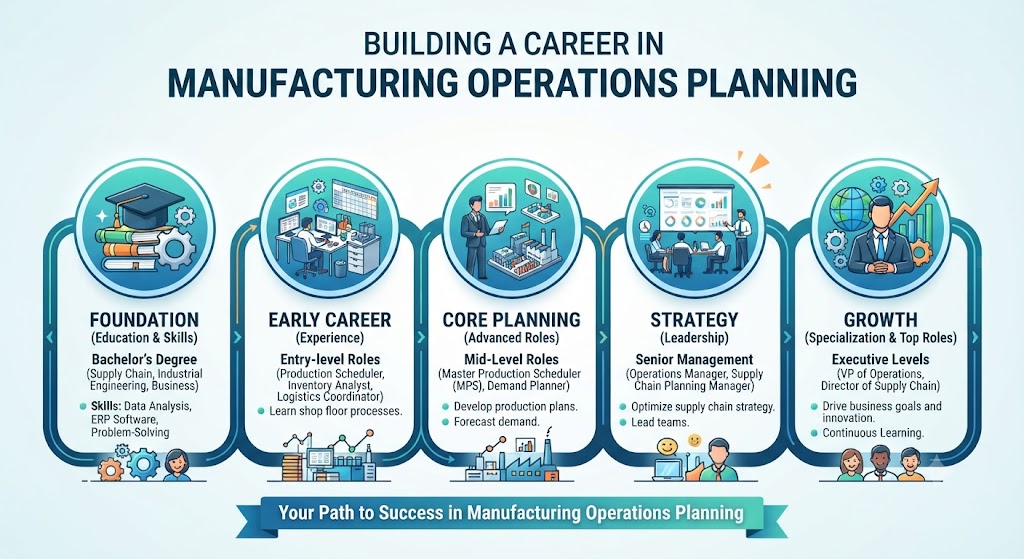
Manufacturing operations planning is essential to keeping production systems efficient, cost-effective, and responsive to customer demand. Every manufacturing organization must coordinate materials, labor, machinery, inventory, production schedules, and delivery commitments. Professionals who can manage these moving parts are increasingly valuable as manufacturers adopt automation, digital planning systems, and data-driven decision-making.
A career in manufacturing operations planning can lead to opportunities in production planning, supply planning, inventory management, demand planning, operations analytics, and supply chain leadership. It can also be a strong option for professionals transitioning from logistics, procurement, warehouse operations, business analysis, or general operations.
Building a successful career in this field requires more than understanding production schedules. Professionals need analytical skills, knowledge of manufacturing processes, familiarity with planning technology, strong communication abilities, and the capacity to make decisions when demand, supply, or production conditions change.
This guide explains how to build a career in manufacturing operations planning, with practical strategies covering skills, remote work, travel testing, productivity, career development, and financial planning.
1. Understand What Manufacturing Operations Planning Involves
Manufacturing operations planning focuses on coordinating production resources with business requirements. The objective is to ensure products are manufactured in the right quantities, at the right time, while balancing capacity, inventory, costs, and customer requirements.
A manufacturing planner may be responsible for:
- Creating production schedules
- Monitoring production capacity
- Coordinating material availability
- Reviewing demand forecasts
- Managing production priorities
- Tracking inventory requirements
- Identifying supply shortages
- Coordinating with procurement teams
- Monitoring production performance
- Communicating schedule changes
The work requires an understanding of how different departments interact.
For example, increasing production may help prevent a stockout but could create excess inventory. Delaying production may reduce inventory costs but potentially cause customer orders to be late.
An effective operations planner evaluates these trade-offs before making a recommendation.
Start by learning important concepts such as Material Requirements Planning (MRP), Master Production Scheduling (MPS), capacity planning, inventory planning, demand forecasting, and Sales and Operations Planning (S&OP).
These concepts provide the foundation for understanding how manufacturing organizations make planning decisions.
2. Develop the Core Skills Employers Value
Manufacturing operations planning requires a combination of technical, analytical, and interpersonal skills.
Production Planning Knowledge
Understand production cycles, lead times, bottlenecks, capacity constraints, work orders, and production sequencing.
Learn how changes in one part of the production process can affect downstream activities.
Inventory Management
Inventory decisions directly affect manufacturing performance.
Become familiar with:
- Safety stock
- Reorder points
- Inventory turnover
- Lead times
- Stockouts
- Excess inventory
- Material availability
- Carrying costs
The objective is not simply to maintain high inventory. It is to maintain enough inventory to support operations without unnecessarily tying up capital.
Data Analysis
Strong analytical skills can significantly improve your career prospects.
Start with Excel and develop expertise in:
- Pivot tables
- Lookup functions
- Data cleaning
- Forecasting
- Conditional formulas
- KPI reporting
- Charts and dashboards
Then consider learning SQL, Power BI, Python, or other analytical tools relevant to your target positions.
Communication
Manufacturing planners regularly interact with procurement, production, warehouse, sales, finance, and management teams.
You must be able to communicate:
- Material shortages
- Schedule changes
- Production risks
- Capacity constraints
- Customer priorities
- Expected delays
Clear communication can prevent small planning issues from becoming larger operational problems.
3. Gain Practical Experience Through Manufacturing Projects
If you are new to manufacturing planning, practical projects can help demonstrate your capabilities.
Create a simulated manufacturing environment using a spreadsheet.
Include information such as:
- Product demand
- Current inventory
- Bill of materials
- Supplier lead times
- Production capacity
- Available workforce
- Customer deadlines
- Existing production orders
Then develop a production plan for several weeks.
Analyze whether the company has sufficient materials and capacity to meet demand.
Identify:
- Potential shortages
- Bottlenecks
- Excess inventory
- Late orders
- Capacity problems
- Production conflicts
Then propose solutions.
For example, you could compare two production schedules and determine which one provides better capacity utilization while minimizing late deliveries.
Present your project as a structured case study:
Problem → Data → Analysis → Recommendation → Expected Result
This is much stronger than simply listing a course or certification on your resume.
You can also build relevant experience through adjacent roles such as:
- Operations coordinator
- Production coordinator
- Supply chain analyst
- Inventory analyst
- Procurement analyst
- Logistics coordinator
- Operations analyst
Relevant experience does not always require an exact “Manufacturing Operations Planner” job title.
4. Learn ERP and Digital Manufacturing Systems
Technology plays a central role in modern manufacturing planning. Enterprise Resource Planning (ERP) systems connect information across production, inventory, procurement, sales, and finance.
Depending on the organization, you may encounter platforms such as SAP, Oracle, Microsoft Dynamics, or other ERP systems.
Rather than trying to learn every platform, focus on understanding the underlying planning processes.
Understand how information flows:
Demand → Production Planning → Material Requirements → Procurement → Manufacturing → Inventory → Distribution
You should also become familiar with:
- MRP systems
- Manufacturing Execution Systems
- Warehouse Management Systems
- Demand forecasting
- Production scheduling
- Capacity planning
- Inventory optimization
- Supply planning
Digital skills become more valuable when combined with operational understanding.
Knowing how to enter information into an ERP system is useful, but understanding what the information means and how it affects production decisions is far more valuable.
5. Identify Remote and Hybrid Career Opportunities
Manufacturing is fundamentally connected to physical facilities, so many production-focused positions require on-site work. However, several planning and analytical responsibilities can be performed remotely or through hybrid arrangements.
Potentially remote-friendly areas include:
- Supply planning
- Production planning analysis
- Demand planning
- Inventory analysis
- Procurement analytics
- Supply-chain reporting
- Operations analytics
- ERP support
- Process improvement
If remote work is important to you, target roles where the primary responsibilities involve planning, analysis, reporting, systems, or strategy rather than direct factory supervision.
Build a remote-ready skill set around:
- Excel
- Power BI
- SQL
- ERP systems
- Data visualization
- Forecasting
- Process documentation
- Digital collaboration
Remote operations professionals must also be highly organized. When teams are working across locations, unclear communication can quickly create planning errors.
Maintain clear documentation of assumptions, schedule changes, decisions, deadlines, and responsibilities.
For professionals searching for international opportunities, best job tool, a global job platform, can help explore positions across different markets and identify opportunities that match remote or location-flexible career preferences.
6. Use Travel Testing to Explore Global Manufacturing Markets
Manufacturing is a global industry, with major production centers distributed across North America, Europe, and Asia. However, the availability of jobs, cost of living, industrial infrastructure, and business culture varies significantly between locations.
If you are considering an international manufacturing career, travel testing can provide useful information before committing to relocation.
During a short visit to a potential target market, research:
- Industrial zones
- Manufacturing clusters
- Transportation infrastructure
- Logistics networks
- Local employment conditions
- Professional communities
- Cost of living
- Business culture
Use the trip to connect with professionals, attend industry events where possible, and research companies operating in the region.
For remote professionals, travel testing can also determine whether a location is practical for working with international teams.
Evaluate:
- Internet reliability
- Workspace availability
- Time-zone differences
- Transportation
- Daily expenses
- Working-hour requirements
Create a defined budget before traveling. Include accommodation, transportation, meals, workspace, connectivity, and professional expenses.
The objective is to make an informed career decision rather than treating travel as a substitute for career planning.
7. Improve Productivity, Career Progression, and Financial Planning
Manufacturing planners often deal with changing priorities, urgent material shortages, production disruptions, and shifting customer requirements. A structured productivity system helps maintain control.
Start each day by identifying the highest-impact issues.
Prioritize:
- Production-stopping material shortages
- Customer-critical orders
- Major capacity constraints
- Supply disruptions
- Inventory risks
- Routine administrative tasks
Use dashboards and automated reporting wherever possible. If you repeatedly spend hours preparing the same production report, determine whether the process can be automated.
Track KPIs such as:
- Schedule adherence
- Production output
- Capacity utilization
- Inventory turnover
- Forecast accuracy
- On-time delivery
- Production downtime
- Backlog
These metrics help you identify problems before they become major operational failures.
Plan Your Career Progression
A possible career path is:
Production Coordinator → Production Planner → Senior Production Planner → Planning Manager → Operations Planning Manager
Another path could be:
Operations Analyst → Supply Chain Analyst → Supply Planning Specialist → Supply Chain Manager
You can also move toward demand planning, procurement, operations strategy, inventory management, or supply-chain analytics.
Focus on building capabilities that prepare you for the next level rather than collecting unrelated qualifications.
Manage Your Finances
Career development may involve expenses for training, certifications, travel, equipment, or relocation.
Before making a major investment, calculate:
- Education and certification costs
- Travel expenses
- Relocation costs
- Emergency savings
- Equipment requirements
- Accommodation
- Transportation
- Taxes
- Currency fluctuations
Do not evaluate a job based solely on salary. Consider career progression, industry exposure, skill development, work flexibility, and long-term earning potential.
Conclusion: Build a Career Around Planning and Operational Intelligence
Manufacturing operations planning is a strong career option for professionals who enjoy working with data, solving operational problems, and coordinating complex business processes. As manufacturers adopt digital systems and increasingly data-driven planning methods, professionals who combine operational knowledge with analytical capabilities can create valuable career opportunities.
Start by learning production planning, capacity management, inventory control, demand forecasting, and MRP fundamentals. Strengthen these skills with Excel, SQL, Power BI, ERP knowledge, and practical projects.
If you lack direct manufacturing experience, use adjacent operations or supply-chain roles to build relevant knowledge. Create portfolio projects that demonstrate how you can analyze production problems and recommend measurable improvements.
Remote and hybrid opportunities are more common in planning, analytics, reporting, and strategy-focused positions than in hands-on production roles. Travel testing can help you evaluate international manufacturing markets before making a costly relocation decision.
Finally, combine career planning with financial discipline. Choose education based on actual employer requirements, maintain emergency savings, and evaluate opportunities based on both immediate compensation and long-term professional development.
A successful manufacturing operations planner does more than create schedules. The role requires understanding demand, capacity, inventory, technology, and business priorities—and using that knowledge to make better operational decisions.
With the right combination of technical skills, analytical thinking, practical experience, and strategic career planning, you can build a sustainable career in manufacturing operations planning.






Comments
Be the first to leave a comment.