

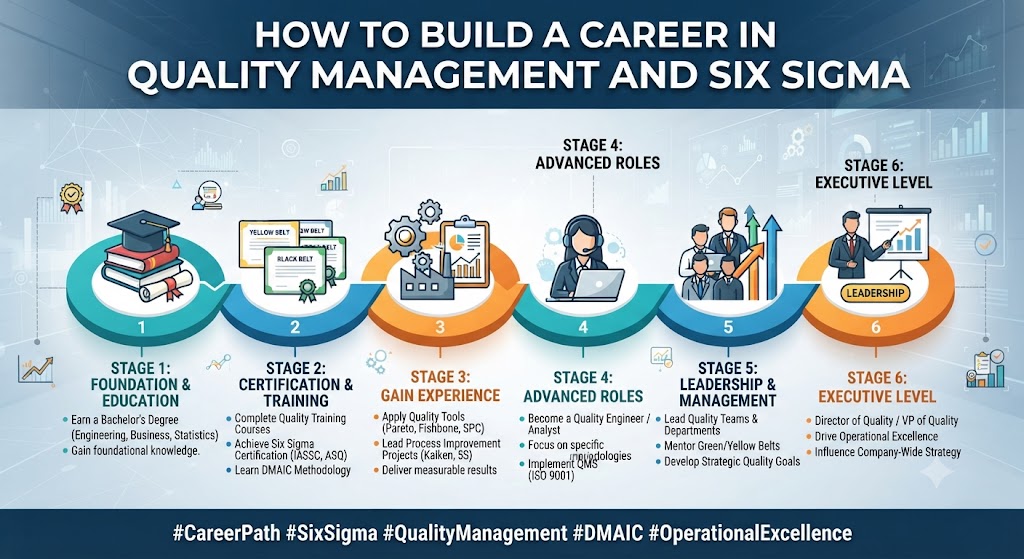
Quality management has become a strategic function rather than a purely operational responsibility. Companies across manufacturing, healthcare, logistics, technology, automotive, pharmaceuticals, retail, and professional services rely on quality systems to reduce errors, control costs, improve customer satisfaction, and maintain consistent performance.
This has created career opportunities for professionals who understand process improvement, data analysis, compliance, and operational efficiency. Six Sigma, in particular, provides a structured approach for identifying process problems, reducing variation, and improving measurable business outcomes.
A career in quality management and Six Sigma can suit professionals from engineering, operations, supply chain, production, customer service, business analysis, and other backgrounds. The transition does not always require a highly specialized degree. What matters is the ability to understand processes, analyze problems, work with stakeholders, and demonstrate measurable improvements.
For professionals planning this career path, it is also important to consider remote and hybrid opportunities, productivity systems, travel testing before relocation, and financial planning during professional development. A structured approach can turn quality and process-improvement skills into a sustainable long-term career.
1. Understand the Career Opportunities in Quality Management and Six Sigma
Quality management covers a wide range of responsibilities. Some professionals focus on quality control, while others work on quality assurance, continuous improvement, compliance, auditing, or process optimization.
Common career options include:
- Quality Analyst
- Quality Assurance Specialist
- Quality Engineer
- Quality Management Specialist
- Process Improvement Analyst
- Continuous Improvement Specialist
- Six Sigma Analyst
- Lean Six Sigma Consultant
- Quality Auditor
- Supplier Quality Specialist
- Operational Excellence Manager
- Quality Manager
The right starting point depends on your current experience.
For example, an operations professional may transition into quality assurance or process improvement because they already understand workflows and performance metrics. A supply-chain professional may move into supplier quality or operational excellence. A business analyst may use data-analysis skills to enter process improvement.
Over time, professionals can progress from analytical and specialist roles into management, consulting, or operational excellence leadership.
The important point is to choose a specialization instead of trying to master every aspect of quality management at once.
2. Build a Strong Foundation in Six Sigma and Quality Principles
Six Sigma is fundamentally about improving processes by reducing variation and defects. One of its most commonly used frameworks is DMAIC:
- Define: Clearly identify the problem and business objective.
- Measure: Collect reliable data about current performance.
- Analyze: Identify the root causes of the problem.
- Improve: Develop and implement solutions.
- Control: Establish systems to sustain improvements.
Understanding this methodology gives professionals a structured way to approach business problems.
You should also become familiar with quality concepts such as:
- Root-cause analysis
- Pareto analysis
- Fishbone diagrams
- Process mapping
- Control charts
- Failure Mode and Effects Analysis (FMEA)
- Statistical process control
- Corrective and preventive actions
- Standard operating procedures
- Continuous improvement
Do not focus only on memorizing terminology. Employers value professionals who can apply these methods to real situations.
For example, instead of simply explaining what a Pareto chart is, be prepared to demonstrate how it could identify the small number of causes responsible for most customer complaints.
3. Choose the Right Skills and Certification Path
Professional certifications can strengthen credibility, particularly when you are entering quality management without extensive direct experience.
Depending on your career level and objectives, you may explore introductory, intermediate, or advanced Six Sigma training. Common levels include Yellow Belt, Green Belt, and Black Belt.
A practical progression is:
Beginner: Learn quality fundamentals, process mapping, basic statistics, and DMAIC.
Intermediate: Develop Green Belt-level capabilities and complete improvement projects using real data.
Advanced: Build expertise in complex improvement initiatives, leadership, statistical analysis, and cross-functional transformation.
Certification should not become the only goal. A certificate may demonstrate that you understand a methodology, but employers also want evidence that you can use it.
Build practical projects alongside your training. For example, analyze a fictional customer-support process and identify sources of delays, errors, or repeated work. Then document your proposed improvements and the metrics you would use to measure success.
This combination of certification and practical application creates a stronger professional profile.
4. Develop Data, Technology, and Problem-Solving Skills
Modern quality management increasingly depends on data. Professionals need to identify patterns, measure performance, and determine whether process changes are actually producing improvements.
Excel is an essential starting point. Learn to work with:
- Pivot tables
- Data validation
- Lookup functions
- Statistical calculations
- Charts and dashboards
- Trend analysis
Power BI or similar business intelligence tools can help professionals present quality metrics to management.
SQL is another valuable skill, particularly in organizations where quality information is stored in large databases.
You should also understand basic statistics, including averages, standard deviation, distributions, correlation, sampling, and process variation.
Technology skills can be particularly valuable for remote quality and process-improvement positions. Professionals may analyze digital workflows, monitor dashboards, conduct virtual process reviews, and collaborate with teams across locations.
The objective is not to become a software developer. It is to become a quality professional who can use technology to make better decisions.
5. Create Practical Experience and Build a Professional Portfolio
Experience is one of the biggest differentiators in quality careers. If you are new to the field, you can begin building evidence of your capabilities through projects within your current role.
Look for recurring problems such as:
- High error rates
- Customer complaints
- Delayed processing
- Rework
- Excessive approvals
- Inconsistent documentation
- Supplier issues
- Repeated operational failures
Select one problem and document the improvement process.
For example:
Problem: Customer requests are taking too long to process.
Measure: Average processing time is 48 hours.
Analyze: Data shows that requests are delayed because of duplicate verification steps.
Improve: Standardize the verification process and remove unnecessary duplication.
Control: Introduce a dashboard and monthly performance review.
Even if the project is relatively small, it demonstrates structured problem-solving.
Maintain a portfolio containing case studies, process maps, dashboards, improvement reports, and measurable outcomes. Never include confidential employer information.
When applying for jobs, translate your projects into results. Statements such as “participated in quality improvement” are weaker than evidence showing that you reduced processing time, lowered errors, improved compliance, or increased productivity.
6. Explore Remote Work, International Opportunities, and Travel Testing
Quality management has traditionally involved significant on-site work, particularly in manufacturing and production environments. However, many quality-related functions can now be performed remotely or through hybrid arrangements.
Remote-friendly areas may include:
- Quality documentation
- Process analysis
- Business process improvement
- Quality systems administration
- Data analysis
- Compliance coordination
- Supplier performance analysis
- Quality reporting
- Continuous improvement consulting
Manufacturing inspection and laboratory-based roles naturally require physical presence, so professionals should distinguish between quality roles that can be performed remotely and those that cannot.
Remote professionals should establish structured routines to maintain productivity. Schedule focused analysis periods, document process changes carefully, and maintain regular communication with stakeholders.
A global job platform such as best job tool can help professionals explore remote and international vacancies while comparing job requirements, locations, and employment models.
For professionals considering relocation, travel testing can reduce the risk of making an immediate long-term commitment. Spend a limited period in a potential destination while evaluating internet connectivity, workspace availability, transportation, living costs, and compatibility with work schedules.
Before working from another country, confirm employer policies and applicable immigration, tax, and employment requirements.
7. Plan Your Career Growth and Finances Strategically
A long-term career in quality management requires both professional development and financial planning.
Start by identifying your desired five-year direction. You might aim to become a Quality Manager, Lean Six Sigma Consultant, Operational Excellence Leader, or Process Improvement Specialist.
Then work backward and identify the skills required for that position.
A practical career plan can include:
- Build foundational quality knowledge.
- Complete relevant Six Sigma training.
- Develop analytical and statistical skills.
- Lead at least one measurable improvement project.
- Learn quality management systems relevant to your industry.
- Improve presentation and stakeholder-management skills.
- Build a portfolio of successful projects.
- Apply for progressively more specialized positions.
Financial planning is equally important. Certification programs, professional courses, travel testing, equipment, and relocation can create significant expenses.
Before investing in training, compare the cost against the potential career benefit. Avoid collecting multiple certifications without developing practical experience.
If you are considering leaving your current job, calculate your essential expenses and maintain an appropriate emergency reserve. When comparing international opportunities, consider taxes, benefits, insurance, currency exchange rates, relocation expenses, and long-term career progression rather than focusing only on the advertised salary.
Using best job tool to compare remote and international opportunities can support a broader job-search strategy, but each offer should still be evaluated based on its complete professional and financial value.
Conclusion
Building a career in quality management and Six Sigma is a practical option for professionals interested in process improvement, analytical problem-solving, and operational excellence. The field offers opportunities across multiple industries and career levels, from quality analysts and process improvement specialists to senior quality managers and consultants.
The most effective approach is to combine methodology with practical experience. Learn DMAIC, understand quality tools, develop data-analysis capabilities, and apply these skills to real operational problems. Certifications can strengthen your profile, but measurable improvement projects provide stronger evidence of professional capability.
Remote work is increasingly relevant for quality-related functions involving analytics, documentation, systems, and consulting. International opportunities can also expand career possibilities, while travel testing can help professionals evaluate potential destinations before committing to relocation.
Finally, treat career development as a financial decision as well as a professional one. Budget for training, maintain financial stability during transitions, and compare opportunities based on total compensation and long-term growth.
Quality management and Six Sigma are ultimately about creating better, more reliable processes. Professionals who can combine that mindset with data skills, technology, communication, and measurable business results can build a resilient and valuable career in quality and continuous improvement.






Comments
Be the first to leave a comment.