

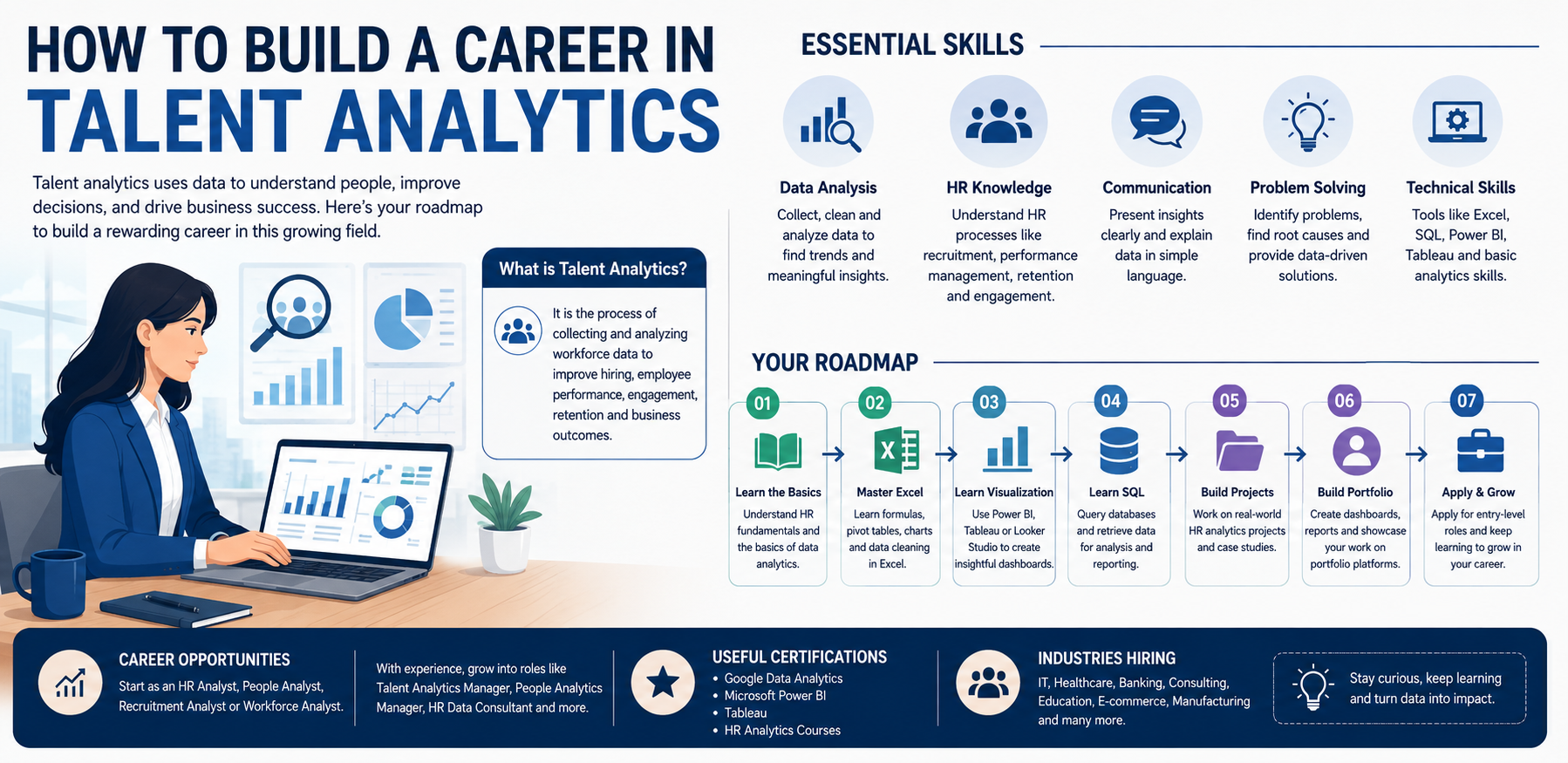
Introduction: Career in Talent Analytics
The way companies hire and manage employees is changing very fast. Today, many organizations use data to make better decisions about recruitment, employee performance, retention, and workplace culture. This is where talent analytics becomes important.
Talent analytics is one of the fastest-growing career fields in Human Resources (HR). Companies want professionals who can understand employee data and use it to improve hiring and workforce management. If you enjoy working with data, solving problems, and understanding people, then talent analytics can be a great career option for you.
In this article, you will learn what talent analytics is and how you can build a successful career in talent analytics.
What Is Talent Analytics?
Talent analytics is the process of collecting and analyzing employee-related data to improve business decisions. It helps companies understand employee behavior, hiring trends, productivity, engagement, and retention.
Talent analytics professionals use data to answer questions like:
- Why are employees leaving the company?
- Which hiring sources bring the best candidates?
- What skills are missing in the workforce?
- Which employees are likely to become future leaders?
- How can employee performance be improved?
Instead of making decisions based only on assumptions, companies use data-driven insights to make smarter workforce decisions.
How to Start a Career in Talent Analytics?
Step 1: Learn the Basics of HR and Analytics
Start by understanding how HR works and how data analysis is used in business.
You can learn:
- HR fundamentals
- Recruitment processes
- Employee lifecycle
- Basic data analysis
Many free and paid online courses are available for beginners.
Step 2: Improve Excel Skills
Excel is widely used in HR analytics and reporting.
Learn:
- Formulas
- Pivot tables
- Charts
- Data cleaning
- Data visualization
Excel is often the first tool companies expect you to know.
Step 3: Learn Data Visualization Tools
Data visualization helps present employee data clearly.
Popular tools include:
- Power BI
- Tableau
- Google Looker Studio
These tools help create dashboards and reports that support business decisions.
Step 4: Learn Basic SQL
SQL helps you work with large amounts of employee data stored in databases.
You can learn:
- How to retrieve data
- Filter records
- Analyze employee information
- Create reports
Basic SQL knowledge can make you more competitive in the job market.
Step 5: Build Small Projects
Practical projects help you gain experience and build confidence.
You can create projects like:
- Employee turnover analysis
- Recruitment dashboard
- Diversity hiring report
- Employee engagement analysis
Projects also help strengthen your portfolio.
Step 6: Create a Portfolio
A portfolio shows your skills and practical work to employers.
Your portfolio can include:
- Dashboards
- HR analytics reports
- Data visualizations
- Case studies
- Research projects
You can upload your work on platforms like GitHub, LinkedIn, or a personal website.
Step 7: Apply for Entry-Level Roles
Once you build basic skills, you can apply for beginner roles such as:
- HR Analyst
- People Analyst
- Recruitment Analyst
- Workforce Analyst
- HR Operations Analyst
These roles help you gain practical industry experience.
Conclusion: Career in Talent Analytics
Talent analytics is a modern and fast-growing career field that combines HR knowledge with data analysis. It helps companies make smarter decisions about hiring, employee engagement, and workforce planning.
If you enjoy working with data and solving problems, this field can offer excellent career opportunities. You do not need to master everything at once. Start by learning basic HR concepts, Excel, and data analysis tools. Build small projects, create a portfolio, and continue improving your skills step by step.
With consistent learning and practical experience, you can build a successful career in talent analytics and become an important part of modern business decision-making.






Comments
Be the first to leave a comment.