

Introduction: Talent Acquisition Strategy
Hiring the right people plays a critical role in the development of any successful business. Regardless of a company’s products, technology, and business strategies, a team of qualified and motivated professionals is essential for sustainable growth. However, an efficient talent acquisition process is often overlooked by business owners and managers.
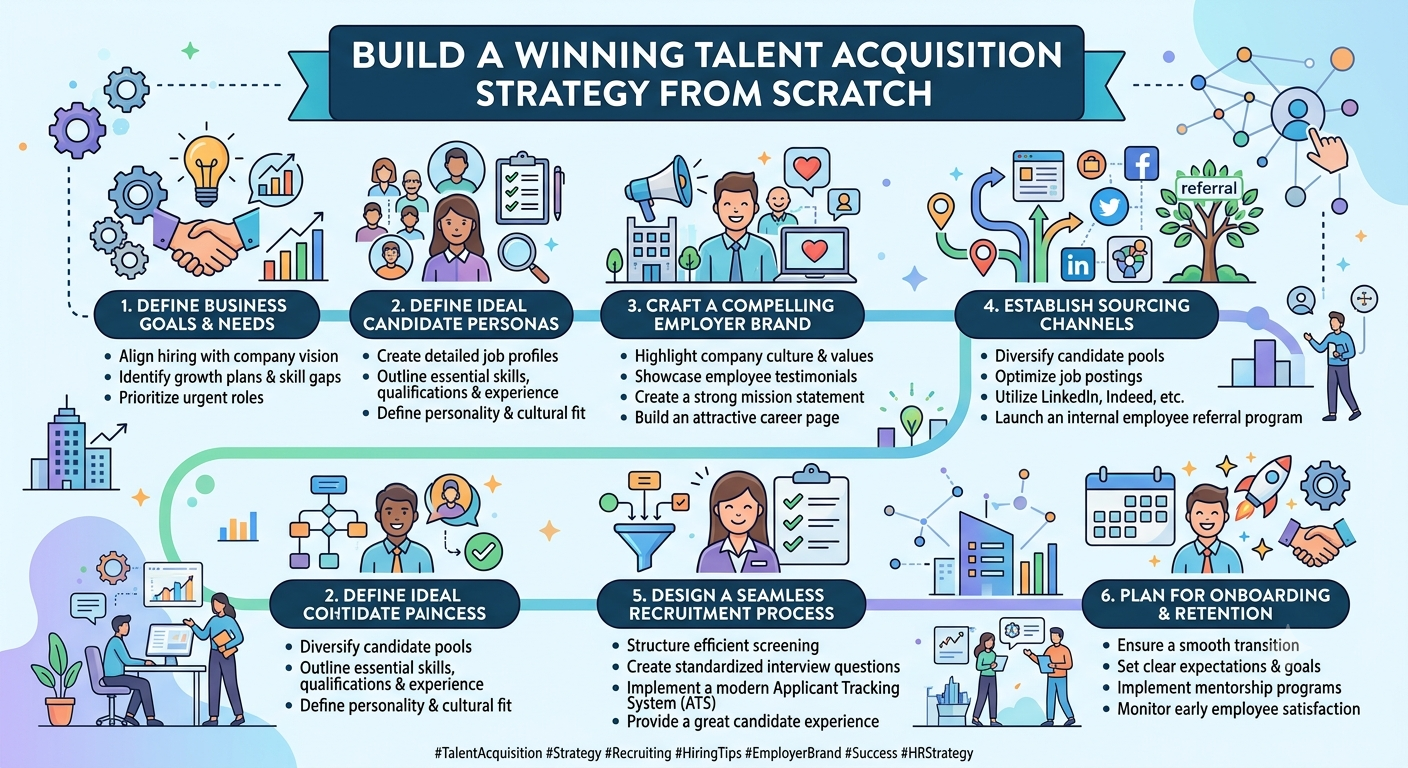
Talent acquisition entails finding, attracting, choosing, and retaining the best specialists based on specific criteria. Simultaneously, an inadequate hiring strategy results in misaligned recruitment goals and ineffective processes. How to build a talent acquisition strategy from scratch? This guide will walk through the main directions for developing the best candidate search and hiring strategy for a business.
How to Build a Talent Acquisition Strategy From Scratch?
1. Understand Business Requirements
In order to determine the requirements for potential candidates, the company needs to analyze its current needs and future goals. In this stage, the business should identify vacant positions and corresponding responsibilities, as well as the skills and experience required for these functions. Useful questions to ask at this stage include:
- What positions do we need to fill?
- What competencies and qualifications should candidates possess?
- What roles and responsibilities shall we delegate to our new hires?
- How many new workers are we planning to hire?
- What types of employees are we looking for?
This analysis will enable the company to outline the requirements for new employees and outline a realistic candidate search strategy.
2. Create Detailed Job Descriptions
An efficient hiring strategy should include detailed job descriptions. The position’s title, duties, responsibilities, qualifications, experience, salary range (if applicable), working conditions, and other details should be defined. The language of the job description should be simple and straight to the point and avoid exaggerating the requirements.
A specialist with only two years of experience may be unable to handle the tasks that the employer expects from someone with five years of experience in the field. At the same time, creating a realistic job description helps attract the right candidates.
3. Define the Ideal Candidate
An important step towards developing the best talent acquisition strategy is to establish the employer’s ideal candidate. This may seem counterintuitive, given that the business is looking for the best available specialists. Nevertheless, it is crucial to outline the candidate’s personal qualities, skills, experience, and other characteristics.
For instance, a sales manager should demonstrate high-quality communication skills, have fundamental knowledge of customer relations, and be able to perform successfully in a team. Thus, the vacancy description should be realistic but ambitious to attract the best candidates.
4. Build the Employer Brand
Many job seekers are inspired not only by compensation and benefits but also by the employer brand. In other words, the working conditions and corporate culture impact the candidate’s choice of a company. Therefore, the employer should build the strongest brand image to draw the attention of top performers.
The employer brand may be built through various platforms, such as the company’s website, social media, employee reviews, career pages, and job advertisements. Additionally, the business should highlight its competitive advantages, such as employee growth opportunities, flexible working hours, remote work options, and other benefits.
5. Design the Selection Process
The selection process should be designed in a way that minimizes the candidate’s drop-out rate. In other words, the business should develop a realistic but efficient hiring process. It should include a series of steps that will enable the employer to analyze the candidate’s qualifications and experience, such as resume screening, initial phone or video interview, skills or practical test, interview with the hiring manager, final interview, reference or background check (if applicable), and job offer.
Each step should have a specific purpose and take into account the candidate’s needs. For instance, the longer the hiring process lasts, the more likely the candidate will change their mind and abandon the application. Therefore, the employer should keep the applicants informed about the progress and their status in the selection process.
Conclusion: Talent Acquisition Strategy
How to build a talent acquisition strategy from scratch? The employer should first determine the organization’s needs, design the job description, and establish the vacancy requirements. Then, the business should focus on building the employer brand, finding the best candidates, and developing the most efficient selection process.
Most importantly, the company should provide an excellent candidate experience, which will positively impact the employer’s brand image. An effective talent acquisition strategy will enable the business to acquire the best available specialists and support the company’s long-term development.
Ready to build a talent acquisition strategy that attracts the right candidates and supports your organization’s growth? Start by defining your hiring goals, identifying the right talent sources, and creating a structured recruitment process. You can also leverage Best Job Tool.






Comments
Be the first to leave a comment.