

Introduction
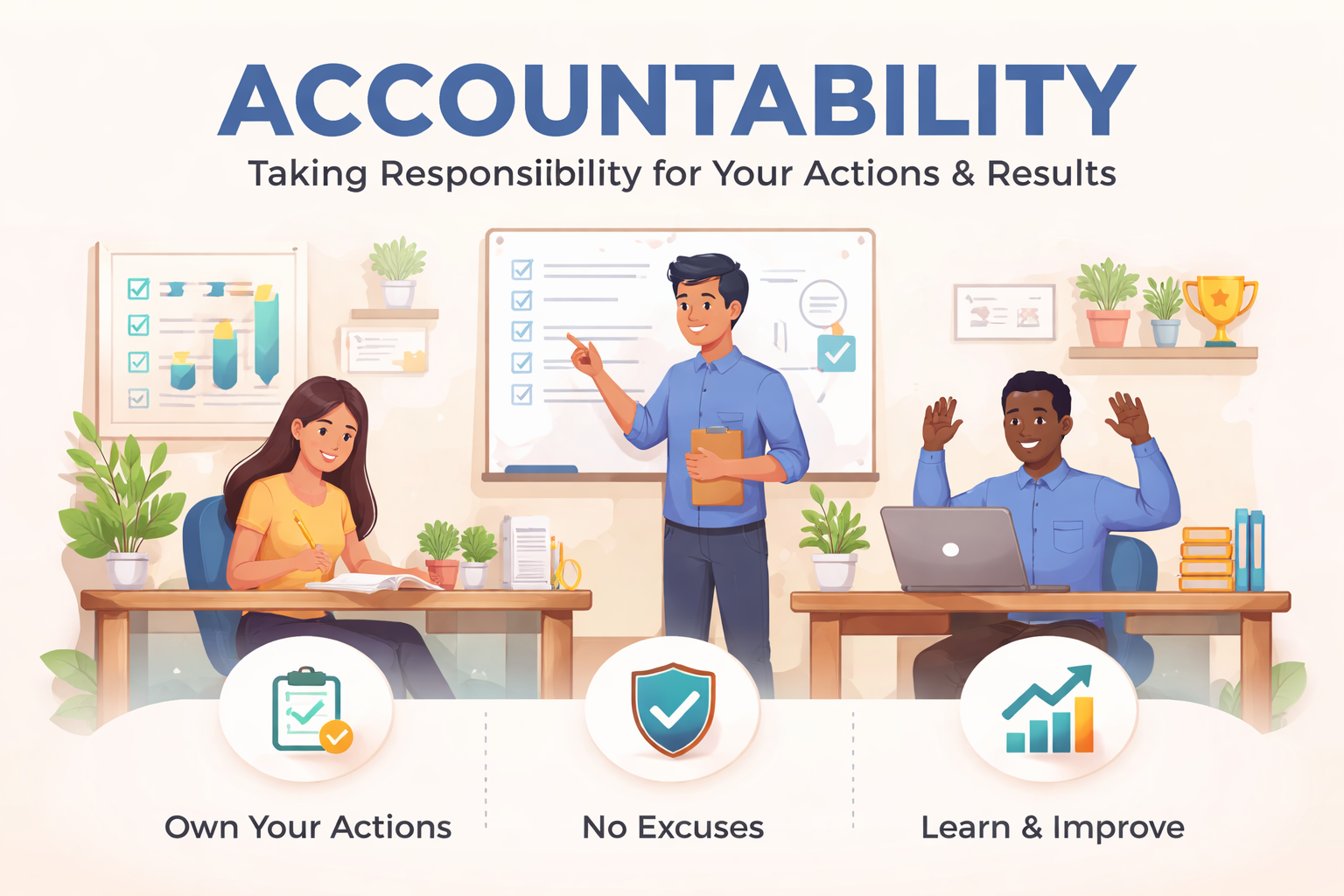
Accountability habits mean taking responsibility for the results of your actions, decisions, or tasks—whether they are positive or negative—and being answerable for them.
Building accountability habits is very important for a successful career. When we do not take responsibility for our outcomes and instead blame others, we cannot build good relationships or gain people’s trust. Because of this, our work gets affected and we are not able to build a successful career.
In this article, we will learn how you can easily build accountability habits with some simple tips.
How to Build Accountability Habits?
1. Understand What Accountability Really Means
First, it is important to understand the meaning of accountability. If you take responsibility for something and, after completing it, the result is negative, and you blame your team members or say that your job was only to complete the task and not care about the result—then that is not accountability.
The true meaning of accountability is that you are responsible not only for the task but also for the outcome. You should be ready to accept the results, whether they are positive or negative, without blaming others or making excuses.
2. Start With Clear and Specific Goals
The most effective tip to build an accountability habit is to start with clear and specific goals.
Setting goals is very important for everyone, no matter what kind of work they do—whether they are in a classroom, looking for a job, or already working. Goals help make work smoother. But while setting goals, you should keep one thing in mind: your goals should be realistic, clear, and specific. Only then will you get proper direction and be able to work easily toward it.
For example, don’t just say “I want to be productive.” Instead, say “I will write 500 words daily at 10:00 a.m.”
3. Break Goals Into Micro Tasks to Build Accountability Habits
The next step is to break your goals into micro tasks.
Setting a goal is very good because it gives you direction about what to do and how to do it. But starting a goal directly can sometimes feel difficult. That is why you should break your goals into small tasks. This makes your goals feel less stressful and helps you complete them step by step.
For example, if a content writer has a goal to write an article, they should divide it into small tasks like:
- First, choose a topic
- Second, create an outline
- Third, write the introduction
- Fourth, complete the full draft
By following these small tasks, the content writer can easily complete the goal.

4. Track Your Daily Actions
Another effective way to build an accountability habit is to track your daily actions.
You should track your work—what tasks you did each day and how much work you completed. For this, you can use a notebook, or apps like Notion or Habitica, or you can create a simple checklist. This will help you stay aware of your daily work and measure your progress easily.
5. Use the “No Excuse Rule” for Accountability Habits
When we sit down to work, there are many distractions around us that can distract us, such as social media, household chores, laziness, and many more. Because of this, we start thinking about delaying our work and doing it later. This reduces our productivity, increases stress, and affects our work.
Instead of saying, “I don’t feel like it today,” you can say, “I will do at least 10% of the task.” This helps you stay consistent. On days when you feel low, you can do a small part of your work and relax for the rest of the day. This way, your productivity does not decrease.
6. Accept Mistakes Without Excuses
If you want to build an accountability habit, the most important thing you need to understand is that you must learn to accept your mistakes without making excuses or blaming others.
Being accountable simply means taking responsibility for the results of your work, whether they are positive or negative. Since you completed the task, you are responsible for its outcome, not someone else. So, if there is any mistake in your task that leads to negative results, do not blame time, people, or situations.
Instead, think about how you can fix it. This mindset will help you build accountability and move toward a successful career.
Conclusion
Accountability is a powerful habit that shapes your growth and success. It simply means taking ownership of your actions, decisions, and results without making excuses. When you practice accountability daily, you naturally build qualities like Self-discipline and Responsibility, which are essential for both personal and professional life.
In the end, accountability is not about being perfect—it’s about being honest with yourself and consistently improving. When you start owning even the smallest actions, you create a strong foundation for bigger achievements in the future.
You can read more such blogs here.






Comments
Be the first to leave a comment.