

Introduction
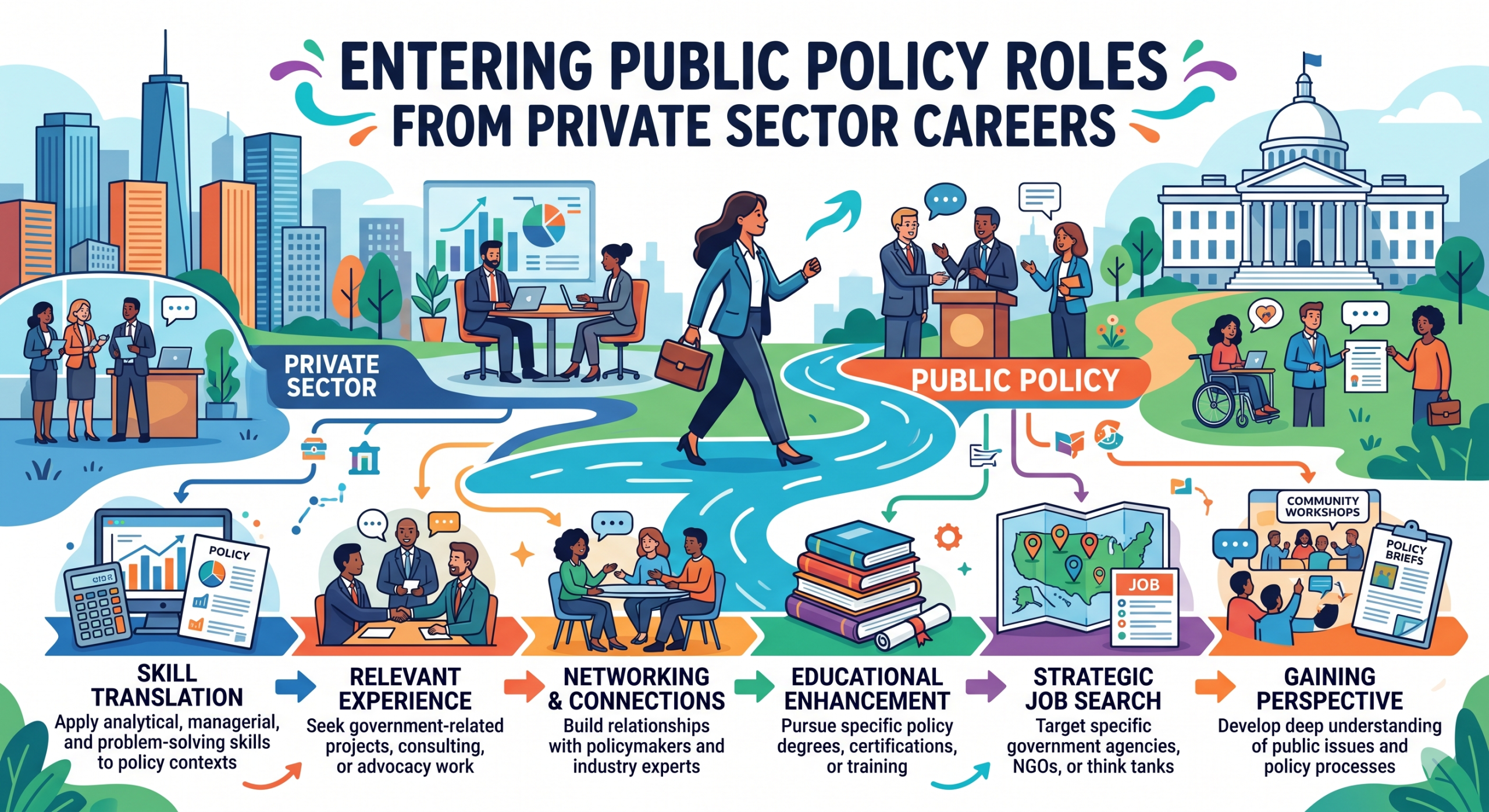
Public policy is no longer a career path reserved only for government officials, political science graduates, or academic researchers. Organizations across industries increasingly seek professionals who understand how policy decisions affect Private Sector businesses, communities, labor markets, technology, healthcare, sustainability, and economic growth.
As regulations evolve and governments work more closely with private organizations, professionals with corporate experience bring valuable perspectives to policy development and implementation. Whether you work in technology, finance, healthcare, consulting, education, operations, or human resources, your industry knowledge can become a strong foundation for a successful public policy career.
The transition, however, requires strategic planning. Understanding policy ecosystems, developing relevant skills, building professional networks, and gaining practical exposure are all essential steps. This guide outlines practical strategies to help professionals successfully move from private sector careers into public policy roles while maintaining career growth, financial stability, and flexibility.
Understanding What Public Policy Professionals Actually Do
Before making a transition, it is important to understand the broad scope of public policy careers.
Public policy professionals work on:
- Research and policy analysis
- Regulatory affairs
- Government relations
- Public administration
- Economic development initiatives
- Labor and workforce programs
- Technology and AI governance
- Environmental and sustainability policy
- Healthcare policy
- Education policy
- International development
Their responsibilities often include:
- Analyzing data and policy impacts
- Writing policy recommendations
- Engaging stakeholders
- Conducting research
- Evaluating government programs
- Developing implementation strategies
- Communicating findings to decision-makers
Many professionals discover that their existing corporate responsibilities already overlap significantly with policy-related work.
Identifying Transferable Skills From Your Private Sector Experience
One of the biggest misconceptions about public policy careers is that professionals must start from scratch. In reality, many private sector skills are highly valuable in policy environments.
Key transferable skills include:
Strategic Thinking
Businesses regularly assess market conditions, risks, and long-term planning. Policy organizations require similar analytical thinking to evaluate public challenges and potential solutions.
Data Analysis
Policy decisions increasingly rely on evidence and measurable outcomes. Professionals experienced in analytics, reporting, forecasting, or business intelligence already possess valuable capabilities.
Project Management
Public policy initiatives often involve multiple stakeholders, deadlines, and budgets. Project management experience translates directly into policy implementation work.
Communication Skills
Professionals who prepare reports, presentations, proposals, and executive briefings already have experience communicating complex information to diverse audiences.
Stakeholder Management
Private sector professionals regularly collaborate with clients, partners, vendors, and leadership teams. Public policy work similarly requires engagement with government agencies, nonprofits, community organizations, and businesses.
Documenting these transferable skills helps create a compelling narrative when applying for policy-related opportunities.
Building Public Policy Knowledge Without Leaving Your Current Job
Many professionals hesitate to switch careers because they lack formal policy education. Fortunately, practical learning opportunities are more accessible than ever.
Consider these approaches:
- Enroll in online public policy courses
- Follow government policy publications
- Read policy research reports
- Attend webinars and conferences
- Join professional associations
- Participate in policy discussion forums
- Follow think tanks and research institutions
Focus on policy areas that align with your industry expertise.
For example:
- Technology professionals can explore AI governance and digital regulation.
- Healthcare professionals can study healthcare reform and public health policy.
- HR professionals can focus on labor market and workforce development policy.
- Financial professionals can explore economic and regulatory policy.
Industry expertise combined with policy knowledge often creates a stronger candidate profile than policy education alone.
Gaining Practical Exposure Through Projects, Volunteering, and Travel-Based Learning
Practical experience is often the fastest way to enter public policy.
Rather than waiting for a formal policy role, seek opportunities to contribute to policy-related initiatives.
Examples include:
Volunteer Research Projects
Many nonprofits and advocacy organizations welcome volunteer researchers, analysts, and project contributors.
Community Engagement Programs
Participating in local development initiatives provides firsthand exposure to policy implementation challenges.
Professional Associations
Industry groups frequently develop policy recommendations and regulatory responses.
Travel-Based Learning
Travel can offer valuable insights into how different regions address public challenges.
Professionals interested in public policy can:
- Attend conferences in different cities or countries
- Visit innovation hubs
- Participate in public sector workshops
- Observe local government programs
- Study international policy approaches
Testing different environments through professional travel can help identify policy sectors that match your interests and long-term goals.
These experiences also strengthen resumes by demonstrating genuine policy engagement beyond theoretical knowledge.
Leveraging Remote Work Opportunities to Enter Policy Careers
The growth of remote work has transformed access to public policy opportunities.
Many organizations now hire remote professionals for:
- Policy research
- Program evaluation
- Regulatory analysis
- Grant management
- Public affairs support
- Government relations coordination
- Workforce development initiatives
Remote opportunities allow professionals to:
- Gain policy experience while keeping their current job
- Build a specialized portfolio
- Work with international organizations
- Access opportunities beyond their geographic location
- Expand professional networks globally
When searching for remote policy positions, platforms such as BEST JOB TOOL help professionals identify global opportunities that align with their skills and career objectives.
Remote work can serve as an effective bridge between private sector employment and full-time public policy careers.
Creating a Financial Transition Plan Before Changing Careers
Career transitions often involve temporary uncertainty. Financial preparation helps reduce risk and enables more confident decision-making.
Before entering public policy, consider the following:
Build an Emergency Fund
Aim to maintain several months of living expenses before making major career changes.
Evaluate Compensation Differences
Some policy roles may initially offer lower salaries than private sector positions, while others provide competitive compensation with strong long-term growth.
Invest in Skill Development Strategically
Choose certifications, courses, and educational programs with clear career relevance rather than pursuing expensive credentials without a defined return.
Consider Part-Time Opportunities
Freelance consulting, remote contract work, and project-based assignments can provide income while building policy experience.
Develop Multiple Career Scenarios
Create short-term, medium-term, and long-term transition plans to maintain flexibility if opportunities take longer than expected.
Financial planning reduces pressure and allows professionals to focus on gaining meaningful experience rather than making rushed career decisions.
Building a Strong Professional Network in the Policy Ecosystem
Networking remains one of the most effective methods for entering public policy careers.
Successful policy professionals often build relationships across:
- Government agencies
- Research institutions
- Universities
- Think tanks
- Nonprofit organizations
- Industry associations
- International organizations
Practical networking strategies include:
Informational Interviews
Speak with professionals currently working in policy-related roles to understand career pathways and industry expectations.
LinkedIn Engagement
Share policy insights, comment on industry developments, and participate in discussions relevant to your area of interest.
Policy Conferences and Events
Attend both virtual and in-person events to meet practitioners and decision-makers.
Publishing Thought Leadership
Writing articles, reports, and LinkedIn posts demonstrates expertise and commitment to the field.
Cross-Sector Collaboration
Seek opportunities to work on projects involving government agencies or nonprofit partners.
Strong professional networks often reveal opportunities before they become publicly advertised.
Positioning Yourself for Your First Public Policy Role
Once you’ve developed knowledge, experience, and connections, the next step is effectively positioning yourself for policy opportunities.
Your resume should emphasize:
- Research experience
- Analytical capabilities
- Stakeholder engagement
- Project leadership
- Industry expertise
- Communication skills
- Regulatory exposure
Avoid presenting yourself as someone changing careers entirely.
Instead, frame your story as:
“An experienced professional applying industry expertise to solve public challenges through policy.”
Employers often value candidates who bring practical business perspectives to policy discussions.
Global career platforms such as BEST JOB TOOL can help professionals identify policy-related positions, remote opportunities, and organizations actively seeking candidates with cross-sector experience.
The combination of domain expertise and policy knowledge often creates a competitive advantage compared to candidates with only academic backgrounds.
Conclusion
Transitioning from a private sector career into public policy is increasingly achievable in today’s interconnected professional landscape. Organizations need professionals who understand both operational realities and policy implications, making industry experience a valuable asset rather than a limitation.
The most successful transitions are rarely sudden. They result from deliberate learning, strategic networking, practical experience, financial preparation, and consistent engagement with policy-related work. By identifying transferable skills, gaining exposure through projects and travel-based learning, leveraging remote opportunities, and building meaningful professional relationships, professionals can position themselves effectively for policy careers.
Public policy offers the opportunity to influence systems, solve complex societal challenges, and create long-term impact. With a structured transition strategy and access to opportunities through platforms like BEST JOB TOOL, professionals can successfully bridge the gap between private sector expertise and meaningful policy leadership.






Comments
Be the first to leave a comment.