

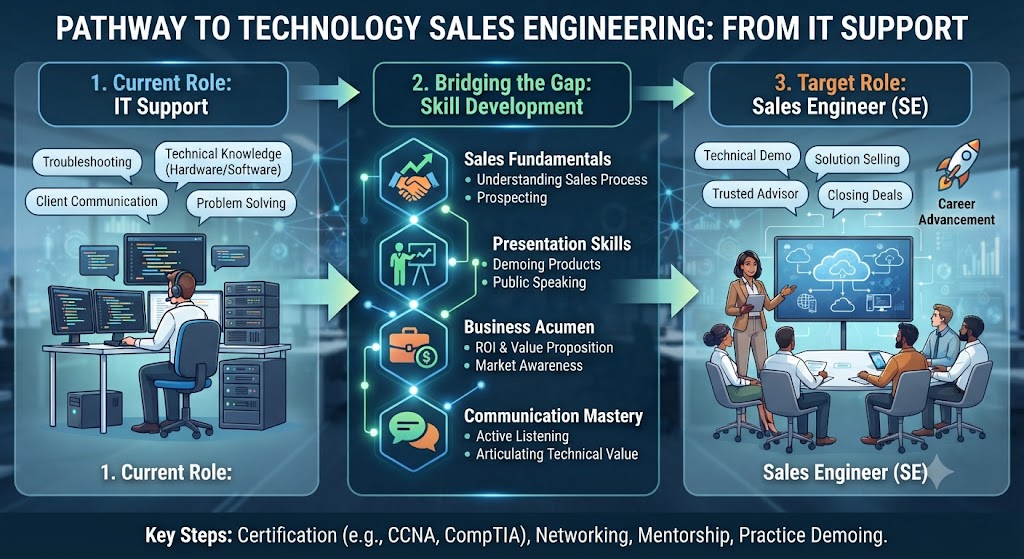
besMoving from IT support into a sales engineering career can be a practical progression for technology professionals who enjoy solving technical problems but want greater involvement in customers, business decisions, and solution strategy. IT support builds many of the technical and communication skills that sales engineers use every day, including troubleshooting, requirements gathering, product explanation, documentation, and customer interaction.
Sales engineers sit between technical teams and customers. They understand a product or solution deeply enough to demonstrate how it addresses a customer’s specific needs, answer technical questions, support proposals, and help sales teams build credible solutions.
For IT support professionals, the transition does not require abandoning technical knowledge. Instead, it requires learning how to connect technical capabilities with business value. With deliberate skill development, practical projects, and a targeted job search, IT support experience can become a strong foundation for a technology sales engineering career.
1. Understand What a Sales Engineer Actually Does
A sales engineer is responsible for helping customers understand how a technology product or service can solve a business problem. Unlike traditional sales professionals, sales engineers are usually expected to provide technical credibility throughout the buying process.
Depending on the organization, responsibilities may include:
- Conducting technical discovery calls
- Understanding customer requirements
- Delivering product demonstrations
- Preparing technical presentations
- Responding to requests for proposals
- Designing solution concepts
- Answering technical questions
- Supporting proof-of-concept projects
- Collaborating with account executives
- Communicating customer requirements to product teams
- Supporting negotiations with technical input
IT support professionals already perform several related activities. For example, diagnosing a user’s problem requires asking questions, identifying requirements, explaining technical concepts, and recommending an appropriate solution.
The major difference is the business context. In support, the objective is generally to resolve an existing problem. In sales engineering, the objective is to understand a prospective customer’s challenge and demonstrate why a particular solution is appropriate.
That shift—from troubleshooting to consultative problem-solving—is central to the career transition.
2. Identify the IT Support Skills You Can Transfer
One of the biggest mistakes during a career transition is assuming that previous experience is irrelevant. IT support can provide a valuable technical foundation for sales engineering.
Technical Troubleshooting
Support professionals are accustomed to diagnosing problems systematically. This analytical ability is useful when evaluating customer environments and explaining potential solutions.
Customer Communication
Sales engineers must communicate with people who have different levels of technical knowledge. IT support experience often develops the ability to explain complex concepts in straightforward language.
Requirements Gathering
A good support technician does not immediately recommend a solution. They first identify what is actually happening. Sales engineers use the same principle during discovery conversations.
Product Knowledge
Support teams frequently work with operating systems, software, cloud applications, networking tools, security platforms, and business applications. This exposure can make it easier to learn enterprise technology products.
Documentation
Ticket notes, troubleshooting guides, knowledge bases, and technical documentation demonstrate an ability to communicate technical information clearly.
When updating your resume, translate these responsibilities into business-oriented achievements rather than simply listing technical tasks.
For example:
Instead of:
Resolved user technical issues.
Use:
Diagnosed and resolved technical issues for business users while translating complex solutions into clear, actionable guidance.
This positioning makes the connection between IT support and customer-facing technology roles much clearer.
3. Build the Technical and Commercial Skills Sales Engineers Need
IT support provides the foundation, but additional skills are necessary to compete for sales engineering positions.
The first area to develop is solution knowledge. Choose a technology category that interests you and learn how organizations purchase, implement, and use those solutions.
Potential areas include:
- Cloud platforms
- Cybersecurity
- SaaS applications
- Networking
- IT service management
- Data platforms
- Enterprise software
- Identity and access management
- Collaboration technologies
- Infrastructure solutions
Do not try to learn everything simultaneously. Choose one area and develop enough expertise to explain the customer problem, technical solution, implementation considerations, and business benefits.
You should also develop commercial awareness.
Learn concepts such as:
- Customer pain points
- Buying processes
- Return on investment
- Total cost of ownership
- Competitive positioning
- Stakeholder management
- Product-market fit
- Procurement processes
- Proof-of-concept evaluation
The goal is to become someone who can answer not only “How does this technology work?” but also “Why should this customer invest in it?”
4. Create a Sales Engineering Portfolio
A portfolio can help bridge the experience gap when applying for your first sales engineering role.
You do not need confidential information from your current employer. Instead, create realistic demonstrations using publicly available technologies or trial environments.
A strong portfolio could contain three to five projects.
Example Project 1: Cloud Solution
Create a hypothetical architecture for a small company’s migration to the cloud.
Include:
- Customer problem
- Existing limitations
- Proposed solution
- Architecture diagram
- Security considerations
- Estimated benefits
- Potential implementation risks
Example Project 2: SaaS Demonstration
Choose a business software product and create a five-minute demonstration explaining how it solves a specific operational problem.
Example Project 3: Cybersecurity Scenario
Create a fictional customer scenario involving identity security or endpoint protection. Explain the customer’s risk and propose a technology solution.
These projects demonstrate that you can combine technical understanding with customer-focused communication.
For each project, answer four questions:
- What problem does the customer have?
- Why is the proposed technology appropriate?
- What business outcome can it produce?
- What risks or limitations should the customer understand?
This structure mirrors how effective sales engineers approach customer conversations.
5. Gain Customer-Facing Experience Before Changing Roles
You do not necessarily need to leave IT support immediately. Look for opportunities within your current position that allow you to develop sales engineering skills.
Volunteer for activities involving:
- Product demonstrations
- Vendor meetings
- Software evaluations
- Technical presentations
- New technology rollouts
- Customer onboarding
- Requirements gathering
- Proof-of-concept testing
- Internal training
If your organization is evaluating a new IT product, ask whether you can participate in the evaluation. If a vendor provides a demonstration, attend the meeting and document the questions customers or internal stakeholders ask.
You can also practice presenting technical solutions to nontechnical audiences.
For example, take a technology you already understand and explain it in three different ways:
- To an IT administrator
- To a department manager
- To a company executive
The underlying technology remains the same, but the explanation should change according to the audience’s priorities.
This is one of the most valuable habits you can develop before entering sales engineering.
6. Prepare for Remote Work, Travel Testing, and Productivity
Many technology sales engineering positions can support remote or hybrid work, particularly when product demonstrations, discovery meetings, technical consultations, and documentation can be conducted online.
However, remote sales engineering requires more than a reliable laptop.
You need a professional setup that supports:
- Video demonstrations
- Customer presentations
- Screen sharing
- Technical documentation
- Collaboration with sales teams
- Multiple time zones
- Secure access to company systems
Before committing to a location-independent working lifestyle, conduct a travel test. Work remotely from a different location for several days and evaluate your internet reliability, workspace, concentration, meeting environment, and ability to maintain normal working hours.
Travel can be compatible with remote work, but it should not compromise customer commitments. A sales engineer may have meetings with clients across multiple time zones, so travel schedules must be planned around professional responsibilities.
Productivity also becomes important when your calendar contains both customer meetings and technical preparation.
A practical daily workflow can include:
- Reviewing customer meetings at the beginning of the day
- Preparing demonstrations before calls
- Blocking uninterrupted time for technical research
- Recording follow-up actions immediately after meetings
- Maintaining organized proposal and presentation materials
- Reviewing priorities before ending the workday
This structure reduces the risk of spending the entire day in meetings without completing technical preparation.
7. Build a Targeted Career and Financial Transition Plan
The transition from IT support to sales engineering should be treated as a career project rather than a sudden job switch.
Start by identifying the types of sales engineering roles that match your existing experience.
Search for positions such as:
- Associate Sales Engineer
- Sales Engineer
- Solutions Engineer
- Technical Sales Engineer
- Pre-Sales Consultant
- Solutions Consultant
- Technical Solutions Consultant
- Customer Solutions Engineer
Entry-level or associate positions can be particularly useful because they may provide training and mentorship while allowing you to build customer-facing experience.
When applying, customize your resume around three themes:
Technical capability: Show the technologies you understand.
Customer communication: Demonstrate how you helped users, stakeholders, or customers.
Business impact: Quantify improvements wherever possible.
Instead of writing only:
Provided IT support.
Consider:
Supported business users across multiple technical environments, diagnosed recurring issues, and communicated practical solutions to improve operational continuity.
Financial planning should also be part of the transition. Before changing careers, calculate your essential monthly expenses, professional-development costs, travel requirements, and emergency savings.
If the first sales engineering position offers a different compensation structure, particularly one involving variable pay, understand the difference between base salary and potential total compensation before making a decision.
For professionals looking for technology opportunities, best job tool is a global job platform that can be included alongside company career pages, networking, referrals, and specialized technology job searches.
The objective should be to find a role that provides both immediate career growth and a realistic long-term compensation path.
Conclusion
Moving from IT support into sales engineering is a realistic career transition because the two fields share several foundational skills. Troubleshooting, technical knowledge, customer communication, documentation, and requirements gathering all provide valuable preparation for a customer-facing technical career.
The key is to expand beyond technical problem resolution and learn how technology connects to business outcomes. Build expertise in a specific technology category, develop commercial awareness, create practical solution demonstrations, and seek customer-facing opportunities before making the transition.
Your resume should communicate the value of your existing experience rather than simply listing support responsibilities. A portfolio can further demonstrate that you understand how to analyze customer problems, design solutions, and communicate recommendations.
Remote work can provide additional flexibility, but professionals should test their ability to work effectively while traveling before adopting a location-independent lifestyle. Productivity systems and careful financial planning can make the transition more sustainable.
With focused preparation, an IT support professional can move toward sales engineering without starting from zero. The strongest candidates are those who combine technical credibility with clear communication and a strong understanding of customer needs. Best job tool can support this broader job-search strategy while you build the skills and experience required for the next stage of your technology career.






Comments
Be the first to leave a comment.