

Introduction
Choosing a career path is one of the most important decisions in life. Whether you are a student, a working professional, or someone thinking about switching careers, every decision you make comes with a hidden cost. This cost is called opportunity cost.
Many people ignore this concept and later feel regret. They think, “What if I had chosen something else?” or “Was this the best decision I could make?” Understanding opportunity cost can help you avoid such doubts and make more confident career choices.
Let’s break this down in a simple and practical way.
What is Opportunity Cost?
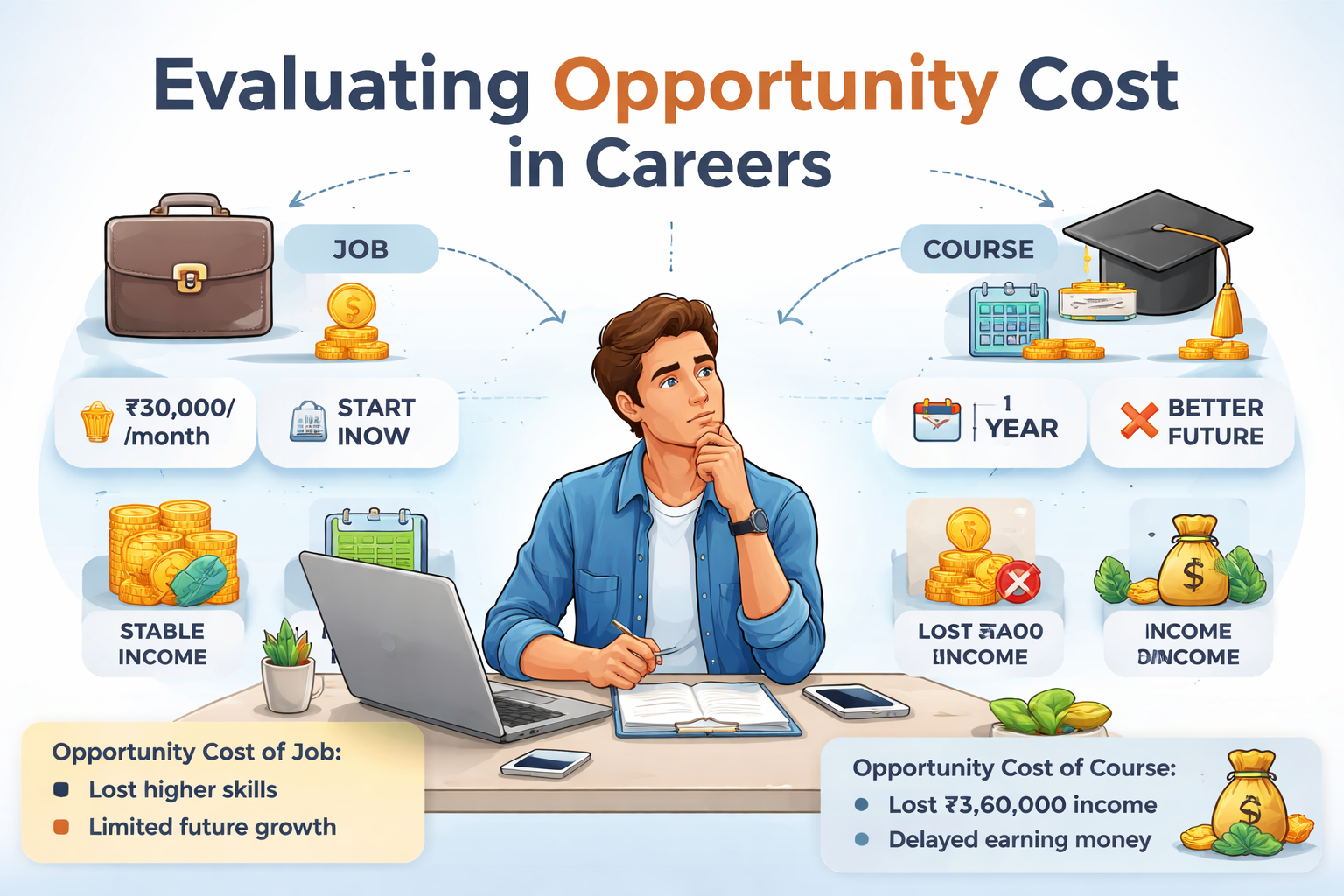
Opportunity cost means what you give up when you choose one option over another.
For example:
- If you choose a job, you give up the chance to start a business.
- If you pursue higher education, you give up earning money during that time.
It’s not just about money. It includes:
- Time
- Skills
- Experience
- Growth opportunities
- Personal satisfaction
In simple words, every “yes” to one path is a “no” to another.
Why Opportunity Cost Matters in Careers?
Career decisions are long-term. A wrong choice doesn’t just affect your present—it can impact your future growth, income, and happiness.
Here’s why evaluating opportunity cost is important:
1. It Helps You Think Clearly
Instead of making emotional decisions, you start thinking logically about what you are gaining and losing.
2. It Prevents Regret
When you evaluate options properly, you feel more confident about your decision later.
3. It Improves Decision-Making
You become more aware of your priorities and long-term goals.

Steps to Evaluate Opportunity Cost in Careers
Now let’s understand how you can evaluate opportunity cost practically.
Step 1: Identify All Available Options
Most people make decisions with only 1–2 options in mind. But you should think broader.
Ask yourself:
- What are all the possible choices I have?
- Is there a third or fourth option I am ignoring?
Example:
Instead of just choosing between job A and job B, consider:
- Job A
- Job B
- Higher studies
- Freelancing
- Starting something of your own
The more options you see, the better your decision will be.
Step 2: List the Benefits of Each Option
Write down what you will gain from each choice.
For example:
Option: Taking a Job
- Fixed salary
- Work experience
- Financial independence
Option: Higher Education
- Better knowledge
- Higher future salary
- Strong career foundation
This step helps you clearly see the positives.
Step 3: Identify What You Are Giving Up
Now comes the most important part.
Ask yourself:
- If I choose this option, what will I lose?
For example:
Choosing a Job means:
- Losing time for studies
- Missing higher qualifications
Choosing Higher Education means:
- Losing income
- Delaying financial independence
This is your real opportunity cost.
Step 4: Consider Long-Term Impact
Many people focus only on short-term benefits, but career decisions should be evaluated long-term.
Ask yourself:
- Where will this decision take me in 5 years?
- Which option has better growth?
Example:
A job with a high salary today may not have growth, while a lower-paying job may offer better future opportunities.
Step 5: Evaluate Personal Values
Opportunity cost is not just financial—it’s also emotional and personal.
Think about:
- What matters more to you: money or passion?
- Do you prefer stability or risk?
- What kind of life do you want?
Two people can make completely different decisions with the same options—and both can be right.
Step 6: Measure Risk vs Reward
Every opportunity has risk.
Ask:
- What is the worst-case scenario?
- Can I handle that risk?
Example:
- Starting a business → High risk, high reward
- Job → Low risk, moderate reward
Understanding this balance helps you make smarter choices.
Step 7: Assign Value (Optional but Powerful)
You can even assign numbers to your choices.
For example:
Rate each factor from 1 to 10:
- Salary
- Growth
- Satisfaction
- Stability
Then compare totals.
This method makes your decision more objective.
Conclusion: Opportunity Cost
Opportunity cost is a powerful concept that can completely change how you make career decisions. Every choice you make comes with a trade-off, and understanding that trade-off is the key to making smarter decisions.
Instead of rushing into decisions or following others blindly, take a step back and evaluate your options carefully. Think about what you are gaining, what you are losing, and what truly matters to you.
At the end of the day, a successful career is not about choosing the most popular path—it’s about choosing the path that aligns with your goals, values, and vision.
When you start thinking in terms of opportunity cost, you stop making random choices and start making intentional decisions.
And that is what truly builds a strong and meaningful career.






Comments
Be the first to leave a comment.