

Introduction: Market Value
Understanding your market value is one of the most important skills in your career. It helps you negotiate better salaries, avoid underpaying yourself, and make confident career decisions. But many people feel uncomfortable asking others, “How much do you earn?” or “What is my worth in the market?”
The good news is—you don’t need to ask anyone directly. You can still figure out your market value using smart research, observation, and simple analysis.
In this article, we will understand step by step how to estimate your market value without asking people directly, using basic methods that anyone can follow.
How to Figure Out Your Market Value Without Asking Anyone?
1. Understand What “Market Value” Really Means
Market value is not just your salary. It is the amount companies are willing to pay you based on:
- Your skills
- Your experience
- Your job role
- Your location
- Industry demand
- Your performance level
Two people with the same job title can have very different salaries because their value in the market is different.
So before calculating anything, understand this clearly:
Market value = what companies are ready to pay you, not what you feel you deserve.
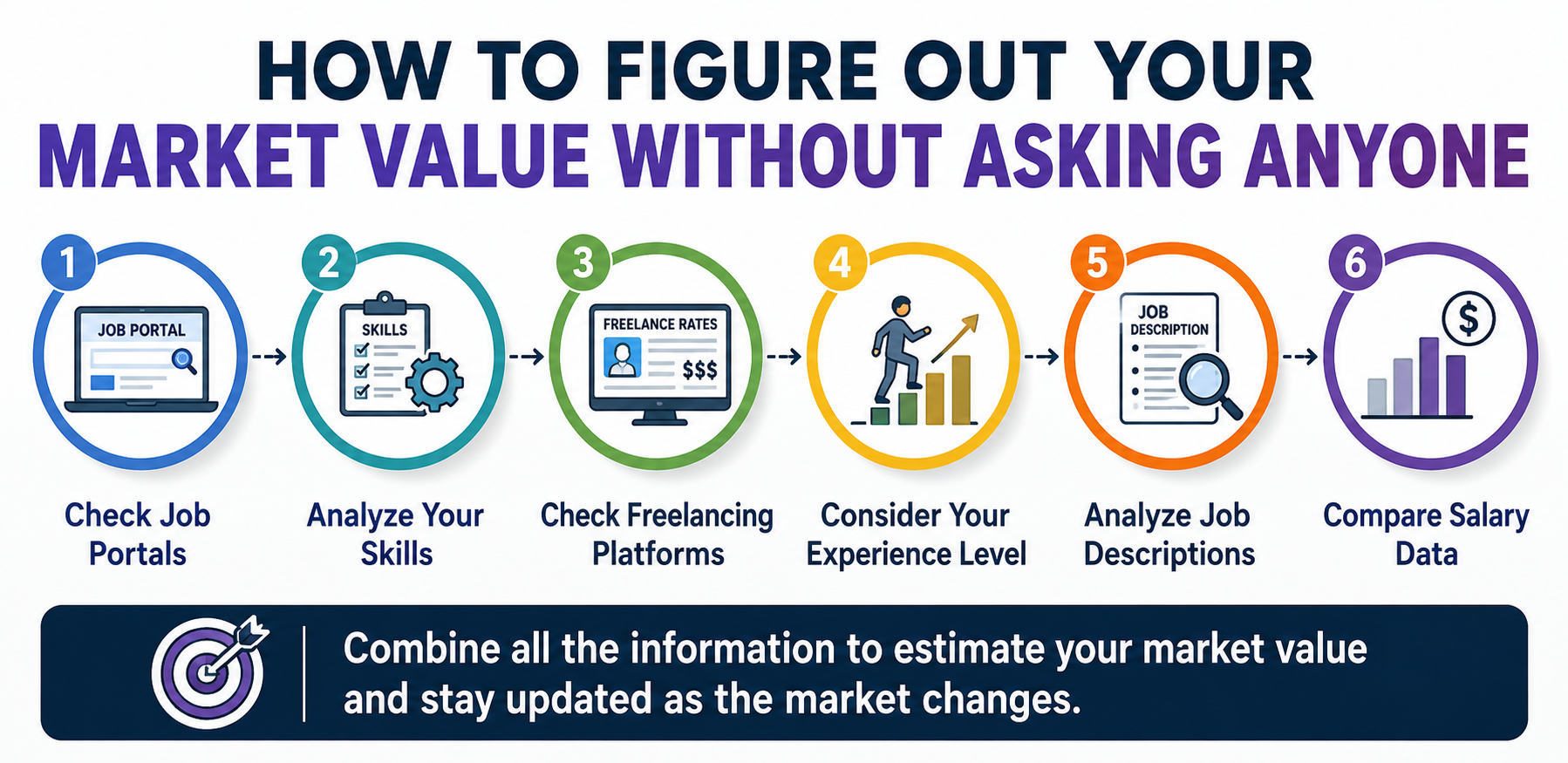
2. Start With Job Portals (The Easiest Method)
One of the simplest ways to estimate your market value is by checking job portals like:
- LinkedIn Jobs
- Indeed
- Glassdoor
- Naukri
Search your exact job role and read multiple job postings.
Focus on:
- Salary range mentioned
- Required skills
- Experience level
- Job responsibilities
If you see multiple listings for your role, note the salary range that appears most often. This gives you a basic idea of your market value.
Example:
If most companies are offering:
- ₹3–5 LPA → Junior level value
- ₹6–10 LPA → Mid level value
- ₹12+ LPA → Senior level value
This method alone can give you a strong starting point.
3. Break Down Your Skills Separately
Your market value is not based on your job title only. It is based on your skills.
Make a list of your skills like:
- Communication
- Writing
- Excel
- SEO
- Marketing
- Coding
- Design
- Analytics
Now search each skill separately in job descriptions.
You will notice:
- Some skills are highly in demand
- Some are average
- Some are rare and highly paid
For example:
- Basic writing → low to medium value
- SEO writing → higher value
- Copywriting → even higher value
When you combine skills, your value increases.
4. Check Freelancing Platforms for Real Rates
Freelancing platforms show real market demand because people are openly selling their skills there.
Check platforms like:
- Upwork
- Fiverr
- Freelancer
Search your service and observe:
- Hourly rates
- Project prices
- Beginner vs expert pricing
This helps you understand how much clients are willing to pay in real time.
Important Insight:
Freelancing rates often show the true market value because clients directly pay for skills.
5. Look at Experience Levels Carefully
Experience plays a major role in salary.
Most industries follow a basic structure:
- 0–2 years → entry level
- 2–5 years → mid level
- 5–10 years → senior level
- 10+ years → expert/lead
Now compare job postings based on experience.
Even if you are a beginner, knowing senior-level salaries helps you understand your growth potential.
6. Analyze “Skill Gap” in Job Descriptions
This is a powerful but often ignored method.
Read 10–15 job descriptions and note:
- What skills are required most
- What tools are repeatedly mentioned
- What certifications are preferred
Now compare it with your own skills.
Ask yourself:
- Do I match 50% of requirements?
- Do I match 80%?
- Do I exceed expectations?
The more you match, the higher your market value.
If you are missing high-demand skills, your current value may be lower—but your future value can increase quickly.
7. Use Salary Comparison Websites (Without Asking Anyone)
There are websites that collect anonymous salary data:
- Glassdoor
- Payscale
- AmbitionBox
These platforms show:
- Average salary
- Minimum salary
- Maximum salary
- Company-wise pay
You don’t need to ask anyone personally. The data is already available.
Tip:
Always check multiple sources because salary data can vary.
8. Observe Job Ads Instead of People
Instead of asking people directly, observe job advertisements carefully.
Look for:
- “Salary not disclosed” → still useful (compare similar roles)
- “Competitive salary” → high-paying companies
- “Based on experience” → flexible but usually higher range
When many companies hide salary, it often means they are willing to negotiate.
9. Understand Industry Demand
Your market value also depends on how much your skill is needed in the market.
Ask yourself:
- Is this skill growing or declining?
- Is it needed in multiple industries?
- Is it automated or safe from AI/tools?
For example:
- Digital marketing → high demand
- Data analysis → very high demand
- Basic admin work → moderate demand
Higher demand = higher market value.
10. Compare Similar Job Titles
Sometimes job titles are confusing. One company may call it:
- Content Writer
Another may call it: - SEO Writer
- Copywriter
- Blog Writer
But salary can differ.
So always compare:
- Responsibilities
- Not just job title
This helps you avoid underestimating your value.
Conclusion: Market Value
You do not need to ask anyone directly to know your market value. With the right research and observation, you can estimate it very accurately on your own.
The key is to combine:
- Job portals
- Skill analysis
- Freelancing rates
- Salary websites
- Industry demand
When you use all these together, you get a clear and realistic idea of what you are worth in the market.
And once you know your value, you can confidently apply for jobs, negotiate better salaries, and grow your career in the right direction.
“Understand your true market value and explore better opportunities on Best Job Tool where informed candidates make smarter career moves.”






Comments
Be the first to leave a comment.