

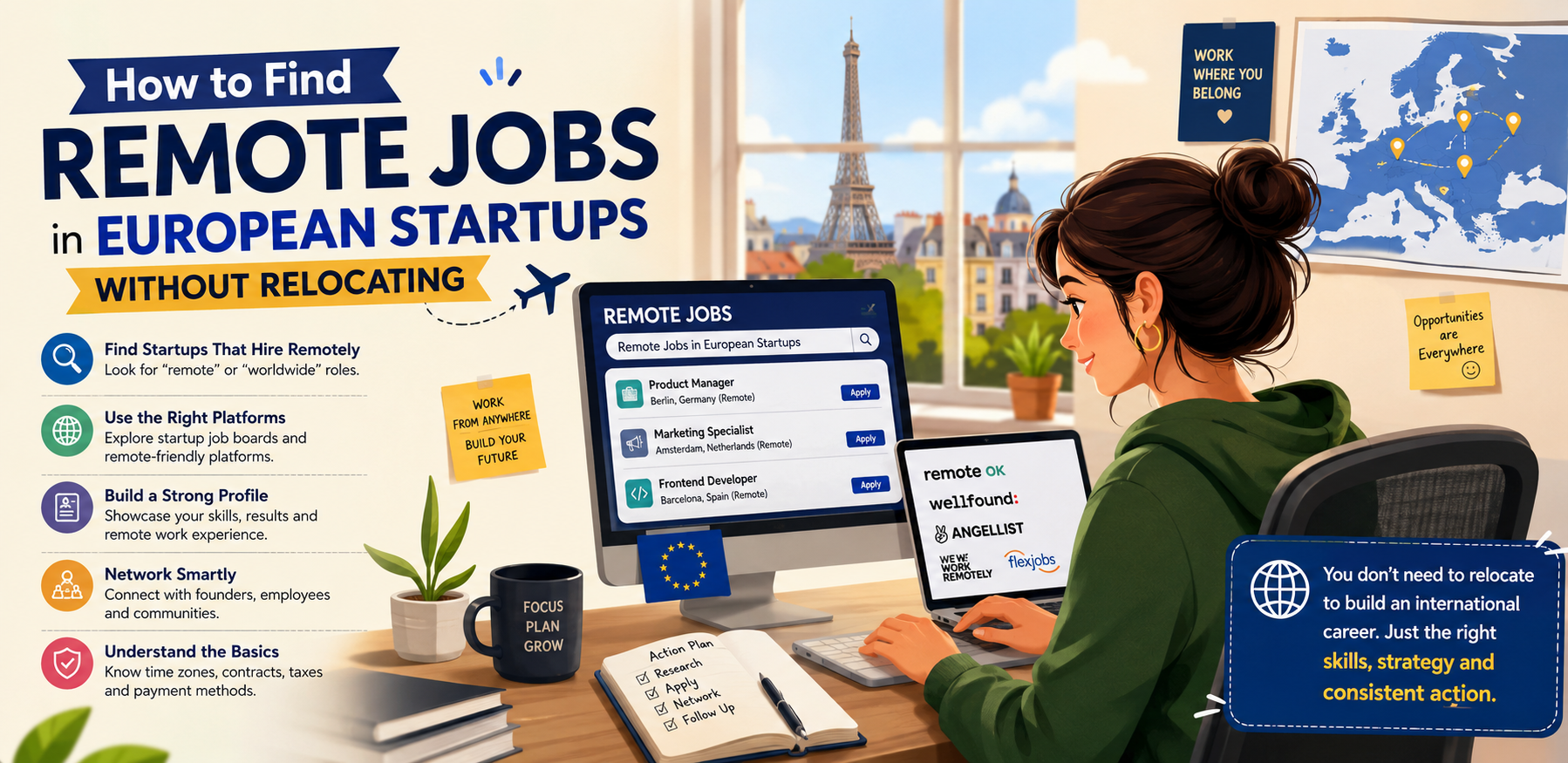
Introduction: European Startups
Remote work has transformed the way professionals search for international career opportunities. You no longer need to move to another country to work for an exciting company based in Europe. Many European startups now operate with distributed teams and hire skilled professionals from different countries.
If you have the right skills, a strong online presence, and a focused job-search strategy, you can build a career with a European startup while continuing to live in your home country.
The first step is to understand which European startups genuinely support remote work. Not every company advertising a remote position allows employees to work from anywhere. Some positions are remote only within a particular country because of tax, employment, or legal requirements.
Others may require employees to live within a specific time zone. Therefore, carefully read the location and eligibility requirements before applying.
How to Find Remote Jobs in European Startups Without Relocating?
1. Use Remote-Driven Job Sites
An “easy option” to find international opportunities is to use job sites focused on remote positions. Try searching “fully remote,” “work from anywhere,” “international remote,” or “remote Europe.” Additionally, look for specific European startup job boards for technology, marketing, sales, etc.
While looking for jobs on broader search engines, use filters to narrow the field and look for remote positions. However, examine the fine print and requirements as sometimes the “remote” positions require you to be based in the same country as the company and work on the same location.
2. Research European Startup Hubs
Another effective strategy to locate a remote job in Europe is to research specific European hubs like Berlin, Amsterdam, Stockholm, Paris, Lisbon, Dublin, Copenhagen, or Barcelona and look for opportunities there.
Research different companies and organizations by browsing their websites, networking platforms, startup directories, accelerators, technology magazines, and job sites. Shortlist interesting companies by looking for familiar names or those that seem like a good match for you.
Applying for a specific company can be a better option than posting generic applications since you’ll feel more motivated knowing your application aligns with your interests.
3. Optimize Your CV for Remote Jobs
When applying for remote jobs in Europe, ensure that your resumes and covers letters are tailored to reflect an ability to work in a distributed environment. Rather than emphasizing where you’ve worked, focus on the achievements you’ve made while working remotely.
Additionally, highlight your skills in remote environments like project management and video conferencing. Emphasize your experience with independent and async communication such as emails, project management tools, documents, and code repositories. For example, you could discuss the impact that you made in async meetings or while managing international clients without meeting face-to-face.
Finally, make sure your resume concisely reflects your accomplishments while also using straightforward language. Remember that European companies value a candidate’s abilities to contribute to their growth. So, rather than focusing on what you can offer a company, speak to what you can do for them.
4. Raise Your Online Profile
A strong online presence is often what can make or break the job candidate, so make sure you work on yours! Keep it up to date, and include things like headline, work experience, skills, and accomplishments.
Technical fields can often showcase their expertise in their portfolio or GitHub if you work in that field. Designers, however, can put together an amazing portfolio or blog, and writers or marketers can publish articles and case studies to promote themselves
Additionally, you can follow founders, recruiters, and companies alike on social media and network with them to be able to research the place you might soon be working at!
5. Use Job Boards Smartly
Don’t limit your search to job boards, because many start-ups advertise openings on their sites or even within their networks of acquaintance. Study the companies you like and explore the positions they offer.
A brief and personalized covering letter about who you are and what value you add can get your application noticed by a potential employer. Highlight your interest in their business and how you could benefit their product/services.
If there are no fitting vacancies at the moment, don’t hesitate approaching companies anyway. Some start-ups might have future needs and will welcome your note for keeping your profile in mind. Express your specialization and the value you can bring to the table.
6. Be Adaptable in Zones
Working remotely for an organization based in Europe does not always mean working the hours Europeans do. However, there’s another detail related to time zones that is important to potential employers.
If possible, work out a schedule that can partially overlap working hours in both your area and the area you are looking to employ in. If you are not in Europe anyway, take the opportunity to highlight your flexibility if their hours suit you in principle.
7. Understand Contracts and Payments
Before taking a position as a remote worker, it is essential to understand what the company’s intentions are on employing and paying you. International remote workers may be hired as employees, independent contractors, or through an Employer-of-Record service.
These factors can influence taxes, benefits, invoicing, currency, and legality. It is best not to assume that if you are working with a European company everything will be taken care of for you, and to ask the employer about how international employees are classified and paid, as well as consulting with a tax professional or legal advisor if needed.
Conclusion: European Startups
Finding a remote job in a European startup without relocating is possible if you focus on companies that already support international remote work. Start by identifying startups that hire across borders and clearly mention remote positions in their job descriptions. Build a strong online presence, highlight your skills and previous results, and tailor your applications to each role.
You should also understand time-zone differences, employment rules, and payment arrangements before accepting an offer. Networking with startup founders and employees can also help you discover opportunities that are not publicly advertised.
“You don’t always need to relocate to build a career with a European startup. Target remote-friendly companies, understand country and employment requirements, tailor your applications, and highlight your ability to work across time zones. Find international remote opportunities with confidence using Best Job Tool.”






Comments
Be the first to leave a comment.