

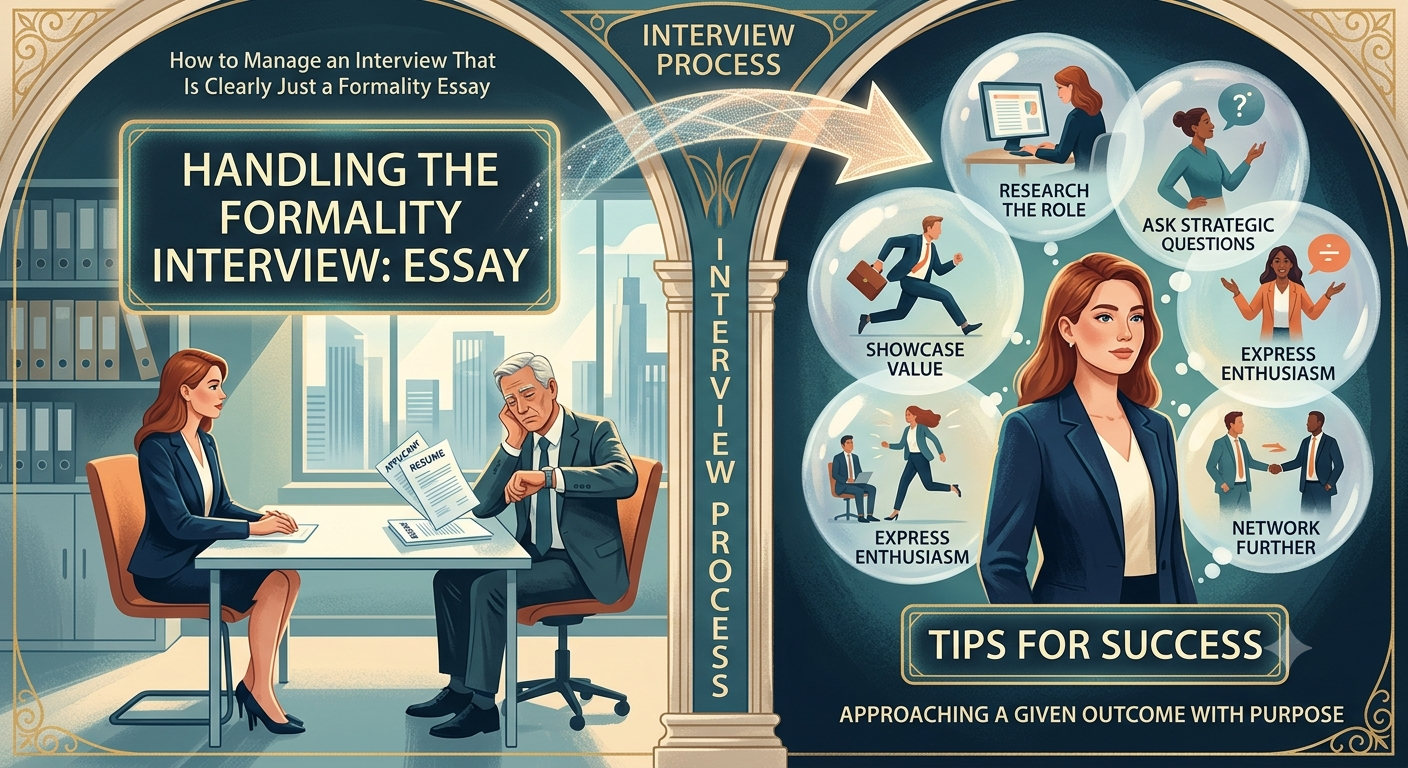
Introduction: Handle An Interview
Most people consider job interviews to be a two-way process. A candidate comes to present himself and show that he has the necessary skills to perform the job. At the same time, the interviewer asks questions to determine whether the candidate is suitable for the position. Knowing how to handle an interview professionally can help candidates stay confident, even when the hiring decision seems to have already been made.
Sometimes, however, a candidate is invited to an interview, but the interviewer is expecting to choose the candidate. In this situation, it is essential for the candidate to understand how to handle an interview that is just a formality.
Such interviews are often considered meaningless and candidates try to hide their dissatisfaction. They cannot understand their current situation and the reason for this meeting. At the same time, interviews, even if they seem to have no point, are excellent opportunities to demonstrate one’s professional skills and abilities.
How to Handle Interview That Is Clearly Just a Formality?
1. Recognizing the Situation
The first thing to do when faced with a formal interview is to realize that this is happening. Several signs usually indicate that the interviewer is not expecting to hire a candidate. To handle an interview effectively, candidates should first recognize whether the conversation is a genuine evaluation or simply a formal step in the hiring process. First, they seem disinterested in communicating with a candidate. Secondly, interviews contain several routine questions, and the applicant barely has a chance to tell about his skills and qualifications. Finally, the most obvious sign may be that the interviewer indicates that another candidate has already been selected.
However, when recognizing the situation, one should not be too hasty. The interviewer may have no interest in the applicant without any specific reasons. Moreover, some people are naturally uninvolved, and the quality of communication is not always reflected in the choice of the candidate. Instead of jumping to conclusions, one should concentrate on the current meeting and measure up to an interviewer’s expectations.
2. Do Not Change Attitude
A common mistake of applicants who realize that they have no chances on the job is to try to be careless at the interview. Candidates think that they have no reason to come on time, dress decently, and speak clearly. Nevertheless, one should remember that every interview is a business meeting, and a candidate’s attitude should meet professional standards. The ability to handle an interview with a positive attitude can leave a lasting impression on the interviewer.
Besides, one should not underestimate the importance of attitude. An employer may want to keep a candidate for future needs. Thus, even if the position on which one has applied is currently unavailable, one may seize the opportunity to demonstrate one’s skills. Preparing for the interview and delivering responses with confidence will make a positive impression, regardless of whether one gets the job or not.
3. Preparation
One should prepare for the interview as if it is a regular one. It is important to study the company, examine the position description, and practice answers to commonly asked questions. Moreover, it is also essential to prepare some questions for the interviewer. Learning how to handle an interview starts with proper preparation, regardless of how formal the meeting may seem. It will help to clarify vital details about the new workplace and demonstrate to an interviewer that one is interested in this position.
By preparing for an interview, one gives himself confidence and reduces the risk of making embarrassing mistakes. Besides, sometimes interviews that seem formal at the beginning can turn into a real discussion if the applicant meets the interviewer’s expectations.
4. Focus on Things Within One’s Power
One cannot control other people and their actions. Therefore, when faced with a clearly formal interview, one should concentrate on factors within one’s control. To handle an interview successfully, focus on your communication, body language, answers, and overall professional behavior. Instead of trying to influence the interviewer’s decision or justify why one deserves the job, one should show how one can perform it.
It means that one should not be nervous and try to do everything properly. One should speak clearly, demonstrate relevant professional skills, and maintain eye contact with the interviewer. Moreover, one should listen to the interviewer’s questions carefully before answering them instead of rushing to fill in the time.
By approaching the interview in this way, one will have fewer psychological barriers and, therefore, have more control over the interview process. Instead of thinking that one has nothing to lose, one should behave as if he is hoping to land a dream job.
5. Use the Interview as an Opportunity to Network
Even if one realizes that the interviewer has no intention to hire one, it is essential to leave this meeting as a networking opportunity. One should respect the interviewer’s time, express gratitude for the meeting, and try to leave an impression that one can be a good employee.
Companies often have many vacancies, and a person who catches an interviewer’s eye can be hired to fill another position. Another reason to network is that one will have a chance to find new vacancies that suit one’s circumstances better. Thus, even if one cannot get a job at the current meeting, one will have a referral to help apply for other positions.
6. Ask Questions
When facing a clearly formal interview, one should not try to shorten the meeting as soon as possible. Instead, one should take advantage of the opportunity to conduct a formal business conversation and ask some relevant questions. It will present the applicant in a better light as most people do not tend to speak out their concerns in a formal setting. The questions may concern professional skills required for the position, problems faced by the team, and the company’s expectations from the employees.
At the same time, it is important not to show frustration if one feels that the time spent on the interview is being wasted. A candidate should not say negative things about the interviewing company to demonstrate his professionalism. Even if it is obvious that the interviewer is not expecting to hire a candidate, it is essential to keep psychological barriers within limits.
7. Use the Experience
An interview is an opportunity not only to find a new job but to improve one’s interviewing skills in general. After an interview, it is essential to reflect on what has happened and plan necessary changes. If the problem was to provide answers to difficult questions, it will be useful to practice more before interviews. If the questions were not compelling and the interviewer kept interrupting the applicant, one should work on maintaining eye contact and psychological control.
In the first case, it is important to remember that not all the questions are intended to determine whether one is suitable for the position. Some of them are designed to observe how one handles stressful situations. If one has no problems speaking Russian or English (or any other language) when nervous, it will be helpful to practice with friends or family.
Another valuable experience is to realize that interviews have little to do with the hiring decision itself. In the best case, they help the employer make a choice between several suitable candidates. Therefore, in cases where the employer has no doubts about the choice, the applicant does not have much of the power. He should work on other things, such as non-verbal communication, or change the way of responding to questions.
Conclusion: Handle An Interview
Finally, it is essential to recognize when it is time to walk away. If one is convinced that the interviewer has no doubts about his decision and one probably wasted an hour of one’s life, it is time to move on to the next opportunity.
Of course, one should not be too rash. Perhaps the situation was misinterpreted, or the interviewer’s decision will change after more information is available. Nevertheless, one should not dwell on the idea that one has failed.
After an interview, sending a short e-mail to the interviewer to express one’s appreciation for the opportunity to participate in the interview is suitable. However, one should not spend too much time and effort thinking about what went wrong. This is how the interviewing process works: one finds a job, and the rest of the applications are automatically rejected.
Knowing how to handle an interview, even when it feels like a formality, can help candidates build confidence and prepare for better career opportunities. Even if an interview feels like a formality, every interview can be a learning and networking opportunity. Stay prepared, keep improving your communication skills, and continue exploring new career opportunities. Use the Best Job Tools to find relevant openings, prepare for interviews, and take your next step with confidence.






Comments
Be the first to leave a comment.