

Introduction
Everyone says, “Upgrade your skills.”
But which skills?
And more importantly, which skills do employers actually value?
When you’re trying to grow your career—especially as a beginner—it’s easy to feel confused.
The truth is simple: not all skills are equal in the job market. Some skills make recruiters pause and read your resume carefully. Others get ignored. Some skills increase your income over time. Others keep you stuck.
If you want real career growth, you need clarity—not just motivation.
In this article, we’ll break down how to identify skills employers truly value, how to test whether a skill has market demand, and how to build yourself around high-impact capabilities.
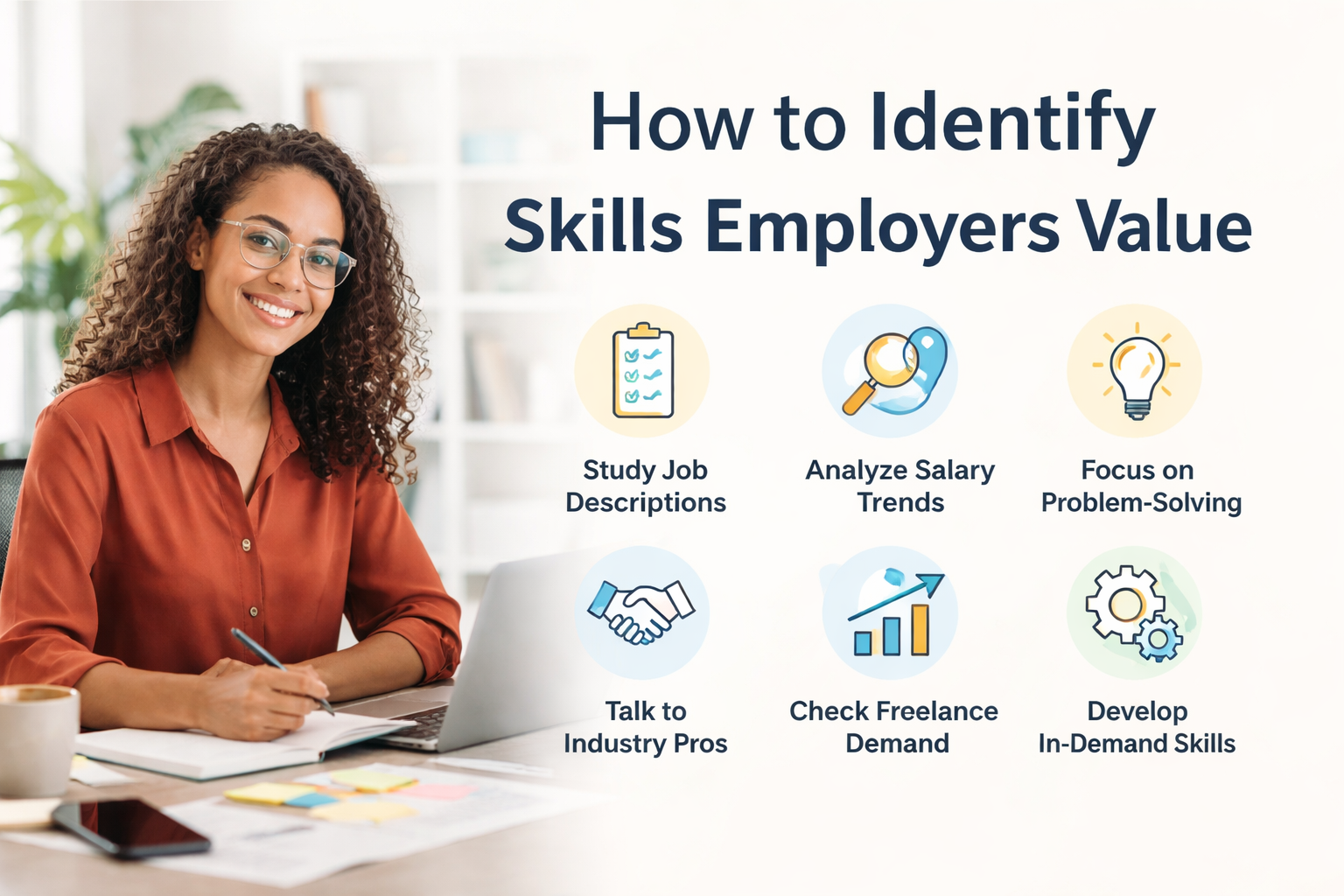
How to Identify Skills Employers Value?
1. Start With Job Descriptions (Not Opinions)
The biggest mistake people make is choosing skills based on trends, social media, or random advice.
Instead, start with job descriptions.
Employers clearly tell you what they want. You just have to read carefully.
What to Do:
- Go to platforms like LinkedIn, Indeed, or Upwork.
- Search for roles you’re interested in.
- Open 20–30 job descriptions.
- Write down the skill that appear repeatedly.
You’ll start noticing patterns.
For example, if you’re interested in content writing, you may see repeated mentions of:
- SEO knowledge
- Research ability
- Clear communication
- Deadline management
- Content strategy
If a skill appears again and again across companies, that’s a strong signal.
Frequency equals demand.
Don’t rely on what people say is important. Rely on what employers are actively hiring for.
2. Separate “Nice-to-Have” from “Must-Have”
Not all listed skills are equally important.
Job descriptions usually contain:
- Core required skills
- Preferred skills
- Bonus skills
Learn to identify the difference.
Must-have skills are:
- Mentioned early in the description
- Written under “Requirements”
- Non-negotiable for performing the job
Nice-to-have skills are:
- Mentioned later
- Labeled as “preferred”
- Helpful but not essential
Focus first on mastering the must-haves.
Many beginners waste time learning advanced tools before mastering fundamentals. Employers prefer someone strong in basics over someone average in everything.
Clarity beats complexity.
3. Look at What Employers Pay More For
Money reveals value.
If two roles look similar but one pays significantly more, ask yourself:
What extra skill is being rewarded?
For example:
- Basic content writer vs. SEO content strategist
- Social media assistant vs. performance marketing specialist
- Junior developer vs. cloud engineer
The higher-paying role usually requires:
- Specialized knowledge
- Measurable results
- Decision-making ability
- Ownership
Employers pay more for:
- Skills that increase revenue, reduce costs, improve efficiency, and reduce risk
Ask yourself:
Does this skill help a company make or save money?
If yes, it’s valuable.
4. Identify Skills That Solve Real Problems
A skill becomes valuable when it solves a real business problem.
For example:
- Writing blogs is a skill.
- Writing blogs that bring traffic and leads is a valuable skill.
See the difference?
Employers don’t hire skills.
They hire solutions.
To identify high-value skills, ask:
- What problem does this skill solve?
- Is this problem common across industries?
- Is this problem expensive if left unsolved?
For example:
- Poor communication creates confusion and delays.
- Weak marketing reduces revenue.
- Bad data analysis leads to wrong decisions.
Skills that solve these problems are always in demand.
5. Talk to Professionals (Not Just Peers)
If you’re serious about understanding employer expectations, talk to people already working in your target field.
Ask them:
- What skills helped you get hired?
- What skills are companies struggling to find?
- What skills made you more valuable over time?
- What mistakes do beginners make?
You don’t need long conversations. Even short LinkedIn interactions can give clarity.
Since you’ve been growing your LinkedIn network, this can be a powerful step for you. Instead of only connecting, start asking thoughtful questions.
Real-world insights are more reliable than online assumptions.
6. Study Industry Trends
Markets evolve.
Five years ago, some skills were optional. Today, they’re expected.
For example:
- AI tools in marketing
- Data literacy in business roles
- Automation tools in operations
To identify valuable skills:
- Follow industry newsletters
- Observe what companies are investing in
- Notice which roles are increasing
If companies are heavily investing in a new area, they’ll need skilled people in that area.
But be careful.
Don’t chase every new trend.
Focus on trends that align with your long-term direction.
Stable growth beats random switching.
7. Check Freelance Market Demand
Freelance platforms are excellent indicators of skill demand.
Go to platforms like:
- Upwork
- Fiverr
Search for:
- Services with many active job posts
- Services with high budgets
- Freelancers with strong earnings
If clients are repeatedly paying for a specific skill, it has market value.
For example:
- SEO writing
- Website development
- Email marketing
- Paid ads management
Freelance demand often reflects real-world business needs faster than traditional job boards.
Since you plan to apply on Upwork, this research can directly help you position your profile around high-demand services.

8. Look at Skills That Combine Well
Some skills become powerful when combined.
For example:
- Writing + SEO
- Design + Marketing psychology
- Data analysis + Business strategy
- Communication + Leadership
Individually, these skills are useful.
Combined, they become rare and valuable.
Employers value combinations because:
- They reduce dependency on multiple hires
- They improve cross-team communication
- They increase efficiency
Ask yourself:
What skill can I add that complements my current strengths?
As someone writing in youth motivation and health/lifestyle, adding:
- SEO
- Newsletter strategy
- Audience analytics
could multiply your value significantly.
9. Notice What Gets Promoted
Within companies, promotions reveal valued skills.
Observe:
- Who gets leadership roles?
- Who gets bigger responsibilities?
- Who is trusted with important decisions?
Often, promoted individuals show:
- Ownership
- Problem-solving ability
- Clear communication
- Reliability
- Strategic thinking
Technical skills get you hired.
Impact skills get you promoted.
Employers value people who:
- Think long-term
- Handle uncertainty calmly
- Take responsibility
These are harder to measure but highly valued.
10. Identify Skills That Are Hard to Replace
In the age of automation and AI, some skills are becoming easier to replace.
So ask:
Can this skill be easily automated?
For example:
- Basic data entry → Easily automated
- Repetitive formatting tasks → Easily automated
But:
- Strategic decision-making → Hard to automate
- Creative problem-solving → Hard to automate
- Emotional intelligence → Hard to automate
Employers increasingly value skills that:
- Require judgment
- Require empathy
- Require creativity
- Require strategic thinking
Build around irreplaceable strengths.
11. Test the Skill in the Real World
The fastest way to confirm a skill’s value is to use it.
For example:
- Write SEO blogs and track traffic growth.
- Offer a service and see if clients respond.
- Apply for jobs highlighting that skill and observe interview calls.
Results reveal truth.
If no one responds, the skill may:
- Lack demand
- Be poorly positioned
- Need better proof
If responses increase, you’re on the right track.
Don’t just learn. Validate.
12. Focus on Outcome-Based Skills
Employers think in outcomes, not effort.
Instead of saying:
“I know content writing.”
Say:
“I write SEO blogs that increase organic traffic.”
Instead of:
“I know social media.”
Say:
“I create campaigns that increase engagement by 40%.”
Outcome-based skills are valued because they:
- Show measurable impact
- Reduce hiring risk
- Increase confidence
Always connect your skill to a result.
13. Build Depth, Not Just Breadth
One of the biggest career mistakes is learning too many shallow skills.
Employers value:
- Depth
- Consistency
- Reliability
Be known for something.
Instead of:
- Trying graphic design, coding, writing, editing, marketing all at once
Choose:
- One core skill
- One complementary skill
- One outcome focus
Depth creates career security.
14. Analyze Rejections Calmly
Rejections contain data.
If you’re applying and not getting responses:
- Is your skill outdated?
- Is your portfolio weak?
- Are you highlighting the wrong abilities?
Instead of feeling discouraged, analyze patterns.
Every rejection gives feedback about market expectations.
Handle it calmly. Adjust strategically.
15. Align Skills With Long-Term Direction
Finally, don’t just chase what employers value today.
Ask:
- Where do I want to be in 5 years?
- What type of work energizes me?
- What problems do I enjoy solving?
The ideal skill sits at the intersection of:
- Market demand
- Your strengths
- Long-term direction
When you build skills aligned with both demand and interest, progress compounds.
Conclusion
Identifying valuable skills is not about guessing.
It’s about observing patterns.
Employers consistently value:
- Problem-solving
- Communication
- Ownership
- Measurable impact
- Specialized expertise
Skill is not just a tool.
They are economic assets.
If you choose carefully, practice consistently, and validate through results, your career becomes stable—even in competitive markets.
And remember:
Don’t focus on being busy.
Focus on being valuable.
That shift changes everything.






Comments
Be the first to leave a comment.