

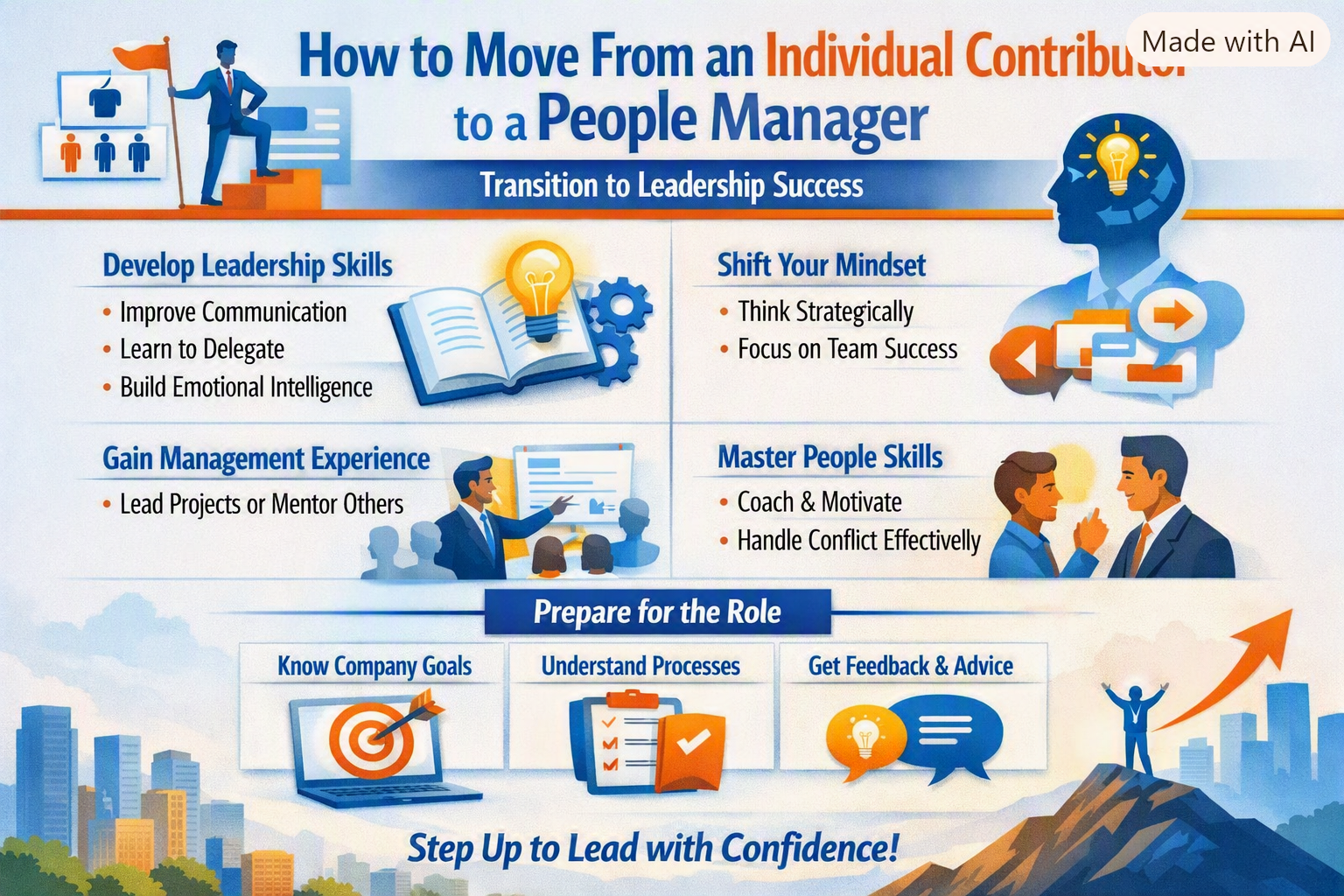
Introduction: Individual Contributor to a People Manager
Transition from an individual contributor to a people manager is a significant step in one’s career. When being an individual contributor, one has goals, targets, and KPIs, and it is up to one to achieve them. However, when shifting to a managerial position, the focus is on other people, their performance, results, and achieving collective goals.
How to move from an individual contributor to a people manager article illustrates how to lead effectively and manage people, which is an entirely different concept compared to individual contributor roles. Moreover, transitioning from individual contributor to people manager is not only about getting a raise in one’s salary or getting a new position.
This is a challenging process because it also implies that one has to change their behaviour, habits, and mindset. Simply put, being an effective employee does not necessarily mean that one can become an efficient manager.
People managers have to possess additional skills, such as leadership, communication, decision-making, motivation, patience, understanding, supporting, and many other abilities crucial for management positions.
How to Move From an Individual Contributor to a People Manager?
1. Understand Managers’ Role Is Different Essay
The first truth you must accept as a new manager is that you are no longer an individual contributor. You should realize that in previous positions, you were most likely rewarded for being able to complete your tasks efficiently and solve your problems individually. Now, your focus should shift from your own performance to the performance of your team.
In other words, you should stop trying to do everything yourself and start relying on others. Your success as a manager will be defined by the collective performance of the group you lead. It may prove challenging in the beginning, especially if your instinct is to work individually since you were successful in doing so earlier in your career.
However, if you continue to act this way, you will fail as a manager. A manager who does not delegate and continues to act as an individual contributor will eventually find their subordinates underperforming due to a lack of guidance. Thus, your role now must be to facilitate the performance of others rather than complete tasks on your own.
2. Improving Your Communication Skills
Communication skills are one of the key qualities of a people manager. The manager should strive to effectively communicate with their staff to make sure that the expectations are clear and the employees understand what has to be done, when it has to be done, how, why, and to what extent.
Moreover, a manager should be able to listen to their employees. Not only do people pay attention to when, where, how, and what they are told, but they also care about who says it. So, if someone is given an order, they would rather hear it from the boss. And while managers have the primary responsibility of delivering information to the staff, the said staff still has a lot to say.
This means that a manager should be a good listener, too. They should listen attentively to what their workers tell them. It is also wise for a manager to pay special attention to the issues that are of concern to their employees because, once a problem is identified, the manager will be better at managing the situation.
Finally, it is vital for a leader to communicate clearly and concisely. There should be no ambiguity in instructions, goals, or any other communication. In addition, it is good practice to explain the reasons why certain actions should be taken. It is important to remember that explaining why can be more important than explaining what. After all, the sense of purpose is one of the most critical motivators of human activity.
3. Learn to Give and Receive Feedback
Feedback is an integral element of personnel management. It is essential to provide a continuous flow of feedback to one’s staff, both in terms of praise and criticism. One should not refrain from giving feedback until one’s yearly performance review. If one’s employee has performed exceptionally well, one should consider expressing this orally or in writing.
On the other hand, if one’s employee made some mistakes, one should address them in detail while suggesting ways to avoid them in the future. It is important not to embarrass one’s staff publicly in an attempt to teach them a lesson.
However, one should also be open to receiving feedback, as one is not perfect and one’s staff may provide useful insight into one’s performance. Thus, one should be aware that feedback can come in handy both ways.
4. Build Trust With Your Team
Trust is essential in any working relationship. It is important that people know they can rely on you. As a manager, you must keep your word and admit when you are wrong.
Do not use micromanagement on your employees. This is a type of management that involves watching employees constantly to make sure they perform correctly. Micromanagement can lead to loss of trust and respect from your team.
You must hold people accountable for their actions.
This includes giving directions so they know what to do and have the freedom to do their job. However, you should never forget your role as a manager. It is your responsibility to ensure that everything is completed properly. Therefore, it is important to constantly monitor the progress of your team and help when needed.
5. Develop Patience and Emotional Control
Managing people can sometimes be a challenging task. Each employee has their own personality, working style, strengths, and weaknesses. They all are different, so some of them may require more attention and support than others. Some employees may be quite talkative, while others may be introverted.
As a manager, you should be patient with everyone since you cannot force anyone to work the way you want them to. You should also be emotionally stable and not upset about failures, stressful situations, misunderstandings, or disagreements. In addition, you should try to understand the needs of your team members and support them in achieving their goals.
6. Prepare Yourself for a Management Position Essay
If one aspires to climb up the management ladder, then it is necessary to learn leadership by example before holding the position. One should demonstrate leadership qualities even before being promoted to a managerial level. As such, it is essential to offer assistance to one’s juniors, be responsible for the team’s problems, and lead small projects.
In addition, one should express interest in leadership roles to one’s current supervisor. It is critical to ask to mentor someone, lead a meeting, or manage a small project in order to prepare oneself for a managerial position.
Moreover, engaging in such activities can help determine whether management is the actual goal that one should strive for. It is crucial to remember that How to Move From an Individual Contributor to a People Manager is a progressive process that entails a continuous learning curve. It takes time and effort to become a skillful leader.
Conclusion: Individual Contributor to a People Manager
Transition from individual contributor to people manager can be exciting, yet challenging at the same time. The biggest difference is that now, your professional contribution is not measured solely by your own performance – you have to lead and manage others in order to achieve organizational goals. Focus on improving your communication skills, listening, delegation, feedback, patience, and trust.
Learn how to manage people effectively without stifling their growth and development. Most importantly, accept that there will be mistakes along the way, and learn from them. A competent manager understands that he is not omnipotent and that his role is to foster a healthy environment for his team members to operate in.
By adopting the right mindset and practicing it on a daily basis, anyone can transition from an individual contributor to a confident people manager.
“Moving into management requires more than strong individual performance. Build your communication, delegation, coaching, and decision-making skills to prepare for leadership. Take your next career step with confidence using Best Job Tool.”






Comments (1)
[574391]supplies professional anti-violence equipments and solutions for the whole world with strong and perfect production capacity. anti-violence.org