

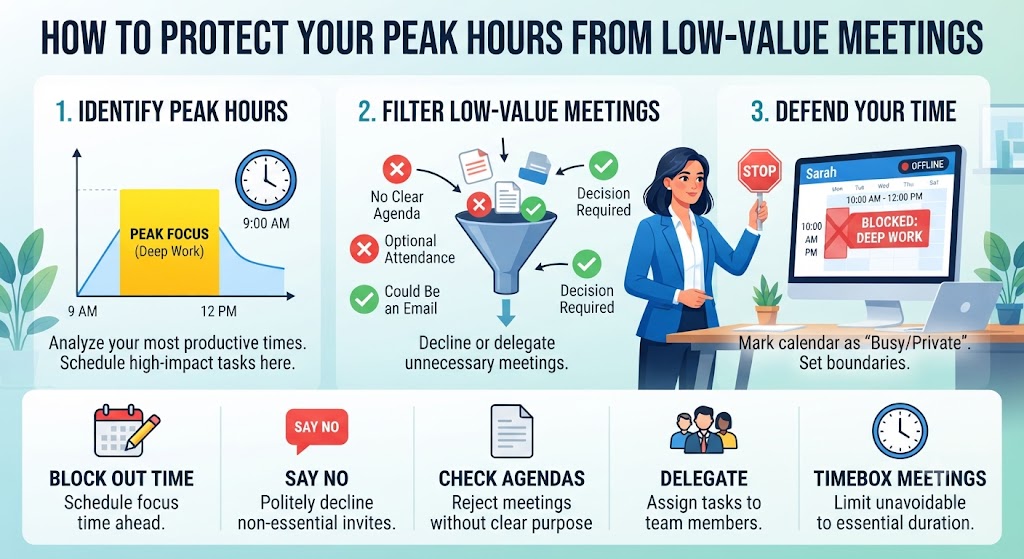
Protecting your peak hours is essential for professionals who need uninterrupted time to complete high-value work. Most employees have certain periods of the day when their concentration, creativity, and decision-making ability are strongest. However, these productive hours are often consumed by meetings that could have been handled through email, shared documents, or short updates.
Meetings are an important part of collaboration, but not every meeting requires real-time participation. When low-value meetings repeatedly interrupt focused work, professionals may spend the rest of the day trying to recover their productivity.
Learning how to protect your peak hours can help you complete important tasks more efficiently. The process involves identifying your most productive periods, evaluating meeting value, setting boundaries, and creating a work schedule that prioritizes meaningful output.
1. Identify Your Most Productive Hours
The first step to protecting your peak hours is understanding when you work best. Productivity levels are not identical throughout the day. Some professionals concentrate better in the morning, while others perform their best work later in the afternoon.
Track your energy and concentration for one or two weeks.
Record:
- When you feel most focused
- When you complete difficult tasks fastest
- When you experience the fewest distractions
- When creative thinking feels easiest
- When you usually feel mentally tired
Look for patterns rather than relying on assumptions.
If you consistently produce your best work between 9:00 a.m. and noon, treat those hours as protected work time whenever possible.
Do not automatically schedule meetings during this period simply because your calendar is available. Your calendar should reflect your priorities, not only other people’s availability.
2. Evaluate Whether Every Meeting Is Necessary
Not every meeting deserves a place in your schedule. Before accepting an invitation, determine whether your participation is genuinely required.
Ask:
- Is there a clear agenda?
- Do I need to make a decision?
- Do I need to provide information?
- Could this be handled through email?
- Could an update be shared in a document?
- Is my presence required for the entire meeting?
If you cannot identify a specific reason for attending, request additional information before accepting.
For recurring meetings, conduct a monthly or quarterly review. A meeting that was valuable when created may no longer be necessary.
You can also suggest alternatives such as written updates, project dashboards, shared documents, or short recorded messages.
Reducing unnecessary meetings is one of the most effective ways to protect your peak hours.
3. Create a Meeting Policy for Your Calendar
A personal meeting policy can make it easier to protect your peak hours consistently.
For example, you can establish rules such as:
- No routine meetings during peak focus hours.
- Meetings should have a clear purpose.
- Recurring meetings should be reviewed regularly.
- Short meetings should replace longer meetings when possible.
- Meeting agendas should be shared in advance.
- Deep-work blocks should be visible on the calendar.
You can also create specific meeting windows.
For example, if your strongest focus period is in the morning, schedule collaboration between 1:00 p.m. and 4:00 p.m. instead.
This approach gives colleagues predictable availability while protecting your most valuable working time.
The key is consistency. If you repeatedly make exceptions, your protected hours will gradually become available meeting time.
4. Learn How to Decline Low-Value Meetings Professionally
Declining a meeting does not have to damage professional relationships. The important factor is how you communicate the decision.
Explain that you are protecting focused work time and offer an alternative when appropriate.
You can say that you are unable to attend but can review the notes afterward. Alternatively, ask the organizer to send the specific question or decision that requires your input.
This approach demonstrates that you are not avoiding collaboration. Instead, you are choosing a more efficient way to contribute.
For recurring meetings, you can also request to attend only when your input is needed.
Managers should encourage this behavior as well. Teams become more productive when employees can distinguish between essential collaboration and unnecessary attendance.
5. Protect Peak Hours When Working Remotely
Remote workers often have more control over their schedules, but they can also face more digital interruptions.
Email, instant messaging, video calls, notifications, and informal conversations can quickly consume focused work periods.
To protect your peak hours while working remotely:
- Turn off non-essential notifications.
- Use a visible focus status.
- Block deep-work time on your calendar.
- Keep your phone away during important tasks.
- Schedule communication windows.
- Use written updates when possible.
- Communicate your availability clearly.
Remote teams should also establish expectations around urgent communication. Not every message requires an immediate response.
A clear communication system can prevent employees from feeling that they must remain constantly available.
A global job platform such as best job tool can help professionals discover remote work opportunities, but productivity in remote roles still depends on creating boundaries around communication and meetings.
6. Protect Your Schedule While Traveling
Travel can make productivity more challenging because your environment and schedule may change. If you work remotely while traveling, protecting your peak hours requires additional planning.
Before traveling, identify the working hours that are most important for your role. Then check whether the destination’s time zone creates conflicts with your team.
For example, working from a different country may mean that your normal morning focus period overlaps with meetings scheduled by colleagues in another time zone.
Before committing to a longer trip, conduct a short travel test.
Evaluate:
- Internet reliability
- Workspace quality
- Time-zone differences
- Meeting schedules
- Noise levels
- Electricity reliability
- Daily productivity
- Travel expenses
During travel, avoid filling every free period with sightseeing or personal activities. Protect the hours required for important professional responsibilities first.
This makes it easier to enjoy travel without allowing it to interfere with career commitments.
7. Measure Productivity and Plan Your Finances
Protecting your peak hours should improve measurable work outcomes. Track your results rather than assuming that fewer meetings automatically mean greater productivity.
Compare:
- Focused work hours
- Important tasks completed
- Meeting hours
- Project completion time
- Missed deadlines
- Quality of completed work
At the end of each week, identify which meetings created genuine value and which interrupted important work.
You can also calculate the financial cost of excessive meetings. If several employees spend one hour in a meeting that produces little value, the organization is effectively paying for that lost working time.
The same principle applies to remote professionals and freelancers. Time spent in unnecessary meetings is time that cannot be used for billable work, skill development, or business growth.
Use your findings to improve your calendar and working habits.
Conclusion
Learning to protect your peak hours can significantly improve productivity and work quality. Instead of allowing meetings to determine how your day is structured, identify your most productive periods and reserve them for high-value tasks.
Start by tracking your energy and concentration levels. Then evaluate meetings based on their purpose, agenda, and required participation. Remove unnecessary meetings and replace them with written updates or other asynchronous communication when appropriate.
Create clear calendar boundaries and communicate them professionally. Remote workers should also establish notification and communication rules so that digital tools do not interrupt focused work.
If you work while traveling, test your schedule, internet connection, workspace, and time-zone compatibility before making longer commitments.
Finally, measure the results. Track meeting hours, focused work, completed tasks, and project outcomes. Use this information to continuously improve your schedule.
The goal is not to eliminate meetings completely. The goal is to ensure that meetings support productive work rather than consume the hours when you are capable of producing your best results.






Comments
Be the first to leave a comment.