

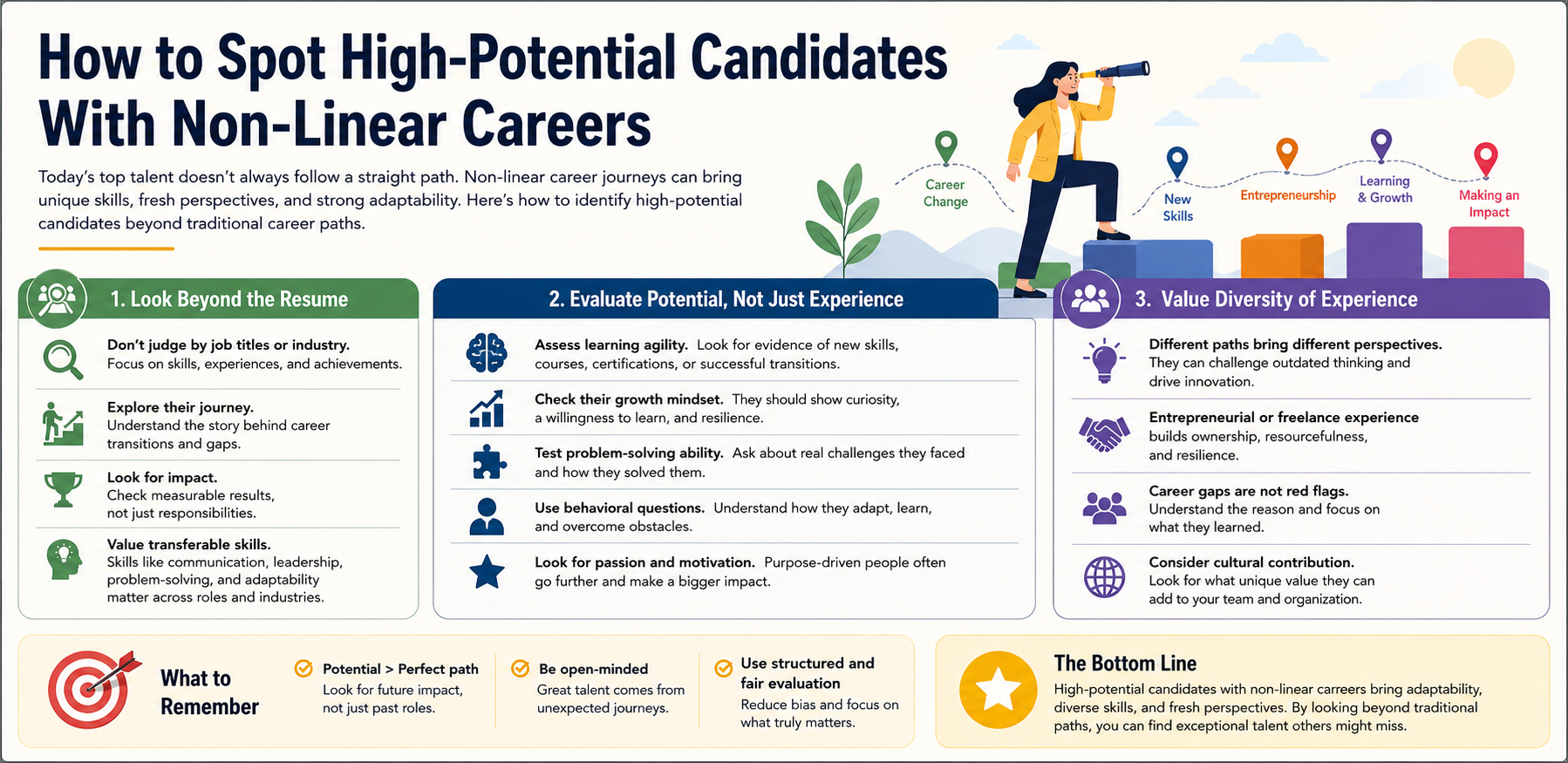
Introduction: Spot High-Potential Candidates
Hiring the right people is one of the most important responsibilities for recruiters and hiring managers. Traditionally, many companies preferred candidates who followed a straight career path. They looked for people who studied in a specific field, worked in similar roles, and gradually moved up the career ladder.
However, today’s job market is different. Many talented professionals have non-linear careers. They may have changed industries, switched job roles, taken career breaks, started businesses, freelanced, volunteered, or learned new skills outside their formal education.
Unfortunately, these candidates are often overlooked because their career paths do not fit traditional expectations. This can cause companies to miss out on highly capable individuals who bring unique perspectives, adaptability, and valuable experiences.
The key is learning how to spot high-potential candidates even when their career journey does not look conventional.
What Is a Non-Linear Career?
A non-linear career is a career path that does not follow a predictable progression within a single profession or industry.
For example, a person may:
- Start as a teacher and later become a content writer.
- Work in customer service before moving into marketing.
- Leave a corporate job to start a small business.
- Take a career break to care for family members.
- Move from engineering to product management.
- Work as a freelancer across multiple industries.
These career paths may look unusual on paper, but they often provide valuable experiences that traditional career paths cannot.
How to Spot High-Potential Candidates With Non-Linear Careers?
1. Avoid Judging Candidates Too Quickly
One of the biggest mistakes recruiters make is rejecting candidates simply because their resumes look different.
A career change does not automatically indicate a lack of commitment or focus.
In many cases, it demonstrates courage, curiosity, and a willingness to learn.
Instead of asking:
“Why did this person change careers so many times?”
Ask:
“What valuable skills did this person gain from these experiences?”
This mindset shift can help uncover hidden talent.
2. Focus on Transferable Skills
Transferable skills are abilities that can be applied across different jobs and industries.
These skills often matter more than industry-specific experience.
Some examples include:
- Communication
- Leadership
- Problem-solving
- Time management
- Project management
- Teamwork
- Critical thinking
- Adaptability
- Creativity
For example, a teacher moving into corporate training already has strong communication, presentation, and coaching skills.
Similarly, a customer service professional may possess excellent problem-solving and relationship-building abilities.
When evaluating candidates, focus on the skills they bring rather than just their previous job titles.
3. Look for Evidence of Learning Agility
Learning agility refers to a person’s ability to learn new skills and adapt to unfamiliar situations.
This is one of the strongest indicators of future success.
Candidates with non-linear careers often demonstrate learning agility because they have repeatedly adapted to new environments.
Look for signs such as:
- Professional certifications
- Online courses
- Self-directed learning
- Industry transitions
- New technical skills
- Successful role changes
Someone who has successfully switched industries may be more adaptable than someone who has remained in the same role for ten years.
4. Evaluate Their Growth Mindset
A growth mindset is the belief that abilities can be developed through effort, learning, and persistence.
High-potential candidates often embrace challenges and view failures as learning opportunities.
You can identify a growth mindset by asking questions like:
- What is the most difficult skill you have learned recently?
- Tell me about a professional challenge you overcame.
- How do you stay updated in your field?
- What motivated your career transition?
Their responses can reveal whether they actively pursue growth and improvement.
5. Pay Attention to Career Transitions
Career transitions can reveal valuable qualities about a candidate.
Successfully changing careers often requires:
- Resilience
- Self-discipline
- Learning ability
- Confidence
- Determination
For example, someone who moved from sales to digital marketing likely invested significant time learning new tools and concepts.
That effort demonstrates commitment and initiative.
Instead of viewing career changes as red flags, examine what the candidate accomplished during those transitions.
6. Assess Problem-Solving Ability
People with diverse career experiences often develop strong problem-solving skills.
Working in different industries exposes them to various challenges and ways of thinking.
During interviews, ask candidates to explain:
- Problems they faced.
- How they approached solutions.
- What results they achieved.
Focus on their thought process rather than whether their previous industry matches your own.
Strong problem solvers can often succeed regardless of industry background.
Conclusion: Spot High-Potential Candidates
The modern workforce is evolving, and career paths are no longer as predictable as they once were. Many highly capable professionals build careers through exploration, learning, career changes, freelancing, entrepreneurship, and personal growth.
Instead of viewing non-linear careers as a weakness, recruiters should recognize the strengths they often represent. By focusing on transferable skills, adaptability, learning agility, resilience, achievements, and potential, organizations can discover exceptional candidates who might otherwise be overlooked.
The best candidate is not always the one with the most traditional resume. Often, it is the person who has demonstrated the ability to learn, adapt, overcome challenges, and create value across different experiences. Companies that recognize this reality will be better positioned to attract, hire, and retain high-potential talent in an ever-changing world.






Comments
Be the first to leave a comment.