

Introduction: Stay Technically Relevant
Technology in the workplace keeps evolving and changing how professionals communicate, collaborate, and carry out tasks. It can be overwhelming for seasoned professionals to keep up, especially if younger workers grew up surrounded by digital devices and social media. To stay technically relevant, one has to constantly update one’s digital skills and adapt to new technologies.
Professionals do not need to feel defeated by how early their junior colleagues adopted technology. Their experience in the industry and expertise enables them to execute their jobs more efficiently, making them valuable assets despite the technological gap. Professionals must learn new digital skills to stay technically relevant.
There are several ways to ensure that older professionals remain technically relevant. These include identifying their industry’s required technical skills, learning continuously, and gaining experience with modern technology. Experienced professionals can utilize these strategies to remain relevant:
How to Stay Technically Relevant When Younger Peers Grew Up Digital?
1. Know Their Industry’s Required Technical Skills
The first step towards staying relevant is understanding the technical skills their industry requires. Technology keeps evolving, and every sector adopts new digital tools at different rates. Therefore, older professionals do not need to learn each new technological advancement. Learn industry-specific technologies to stay technically relevant.
Professionals should research the technical skills that recruiters look for in their industry. Individuals can search for job descriptions and analyze the skills spammers value. They should also identify the abilities required for their dream jobs and highlight their proficiencies if they are a good fit. This way, professionals can focus on mastering digital competencies relevant to their career aspirations instead of trying to keep up with every technological advancement.
2. Learn Continuously
Technology changes, and professionals need to keep learning to remain relevant. Many companies adopt new software and digital tools, and older workers should not be afraid to acquire new skills. Continuous learning helps professionals stay technically relevant. There are various ways to keep learning, including enrolling in online courses, attending webinars, and finding tutorials. Individuals can invest in formal education or find free resources that help them learn something new.
Older workers should allocate some time every week to continue learning. They can spend 20 or 30 minutes watching a tutorial or invest an hour discovering something new every month. It is important to continue learning because it helps individuals keep up with the latest trends and acquire new skills. Moreover, it increases self-confidence and exposes professionals to new things that enable them to grow.
3. Learn How to Use Artificial Intelligence
Artificial intelligence (AI) is growing increasingly popular as a workplace tool. Organizations use it for research, data analysis, ideation, and customer service. Older professionals should be willing to embrace the new technology to advance their careers.
Individuals should invest time discovering how AI can be useful in their fields. For example, professionals may use AI to help with research, write reports, and complete basic calculations. They can leverage the technology to make their jobs easier and increase their productivity.
Older workers should learn how to use AI to solve common problems, organize, ideate, and summarize. However, it is important to note that AI can generate false information and should not replace human intellect. Individuals should ensure that the information they share is credible and safe to use.
Experienced professionals can use their years of expertise to detect errors generated by AI and understand how the information they provide may be applied. Their industry knowledge can also help them determine tasks that AI cannot do and when to use human intellect. AI skills help professionals stay technically relevant.
4. Gaining Experience Using Technology
Reading or watching tutorials about technology will only give people an introduction. Individuals should use what they learn to complete an actual project to develop a strong foundation. For instance, if someone is learning how to use a new application, they should try each of its functions and gain hands-on experience. People learning to use a data analysis tool, for example, can start by organizing and analyzing a sample data set.
Experienced professionals can also try out new technology to complete smaller projects at work if they can get the required authorization. Gaining practical experience with new digital tools helps individuals become confident in their abilities. Moreover, it offers them something to boast about and a skill to add to their resumes.
5. Learn from Younger Peers But Avoid Comparison
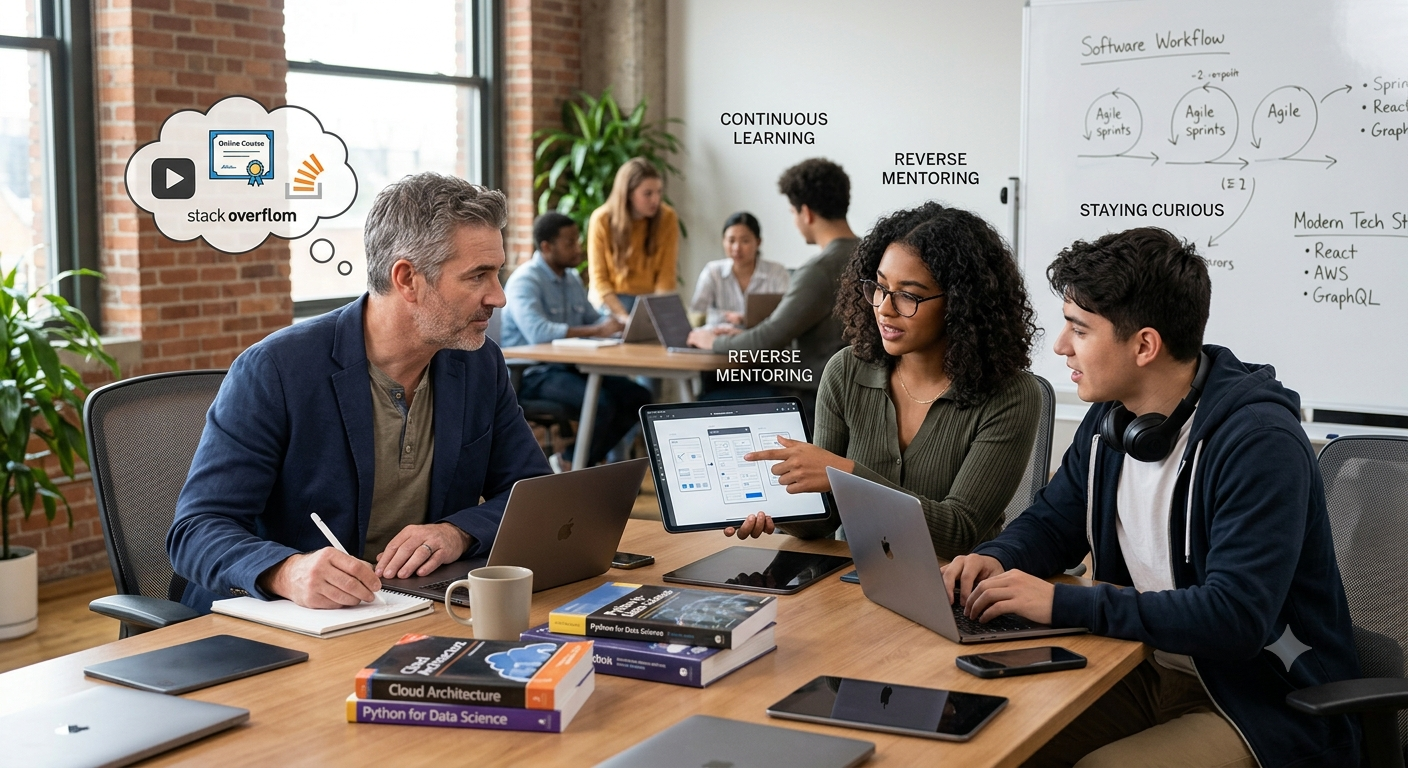
Junior workers have a natural affinity for modern technology that can be advantageous to senior employees willing to learn. Older professionals should ask their younger colleagues to show them how to use digital tools they do not know. Asking for help is not a weakness but rather a display of courage and humility.
Younger workers can teach their senior colleagues how to use new applications, respond to emails faster, and complete other tasks. Moreover, they may share tips that help more experienced workers become more productive.
However, it is important for older workers not to compare their progress with that of their junior peers. Everyone learns at different paces, and some people may need more time to acquire new technological skills. The ultimate goal is not to be the fastest but to continue learning and gain confidence in their abilities. Older professionals should also share their expertise with junior workers and engage in a two-way mentorship. This helps them stay connected with younger generations and learn new technological skills.
6. Leverage Their Technical Skills
People often overlook the value of technical skills when developing their career strategies. However, experienced professionals should highlight the competencies they have acquired throughout their years in the industry.
Their practical experience and expertise can be critical in enabling them to interpret data and make informed business decisions. Anyone who has been in the industry for a while should identify the skills they have honed and leverage them to further their careers.
For instance, if someone has been working as a marketing professional for more than five years, they should capitalize on the experience and technical skills they possess. This could include using their analytical skills to interpret data, understand consumer behavior, and help the company make informed marketing decisions.
Professionals can include their technical skills and achievements on their resumes and update their LinkedIn accounts. For instance, they may highlight their latest accomplishments, certifications, and the new competencies they have acquired. Exhibiting expertise and experience demonstrates to employers that older workers have valuable insights that can benefit their organizations.
7. Be Confident about Their Abilities
Many older professionals hesitate to learn new technological skills because they believe they are too old to acquire new competencies. Others may feel embarrassed asking junior colleagues for help with newer applications, programs, or gadgets. However, this should not be a reason for older workers to lag behind in adopting new digital tools. The truth is, they may find themselves in a worse position if they refuse to budge.
Experienced employees should embrace a growth mindset and be excited about new possibilities rather than fear the unknown. They must understand that their years of expertise will always be relevant and enable them to be more productive. Their confidence in their abilities will also make it easier to learn new tools and complete tasks more efficiently and effectively.
8. Learn Through Reverse Mentoring
Experienced workers have an opportunity to teach younger ones and, in their turn, to learn something new. They can ask questions about new technologies and ways of working. More experienced workers can give advice concerning different spheres of activity or even teach less experienced people. In such a way, everyone will obtain some new knowledge and skillful competence.
Conclusion: Stay Technically Relevant
There are various ways older professionals can stay relevant in a technology-driven world full of younger workers. These include identifying their industry’s required technical skills, gaining experience using modern technology, and leveraging their expertise. Keep learning to stay technically relevant in a changing workplace.
While people are often quick to embrace new digital tools, it is also essential to keep learning continuously and update their skill sets. It is also critical to be confident in their abilities and know that their experience can be more valuable than years of formal education.
Technology in the workplace will continue to evolve, but older professionals will always have an advantage over their junior colleagues because of their experience. However, the key is to continue to update their knowledge and hone their skill sets.
It is time to start investing in their careers and make their experience and expertise count. Individuals can visit the best job sites to discover the latest trends in their industries and learn new skills that will make them stand out from the competition.
Ready to take the next step in your career? Explore the best job tools to identify in-demand technical skills, update your resume, and find opportunities that value your experience and digital expertise.






Comments
Be the first to leave a comment.