

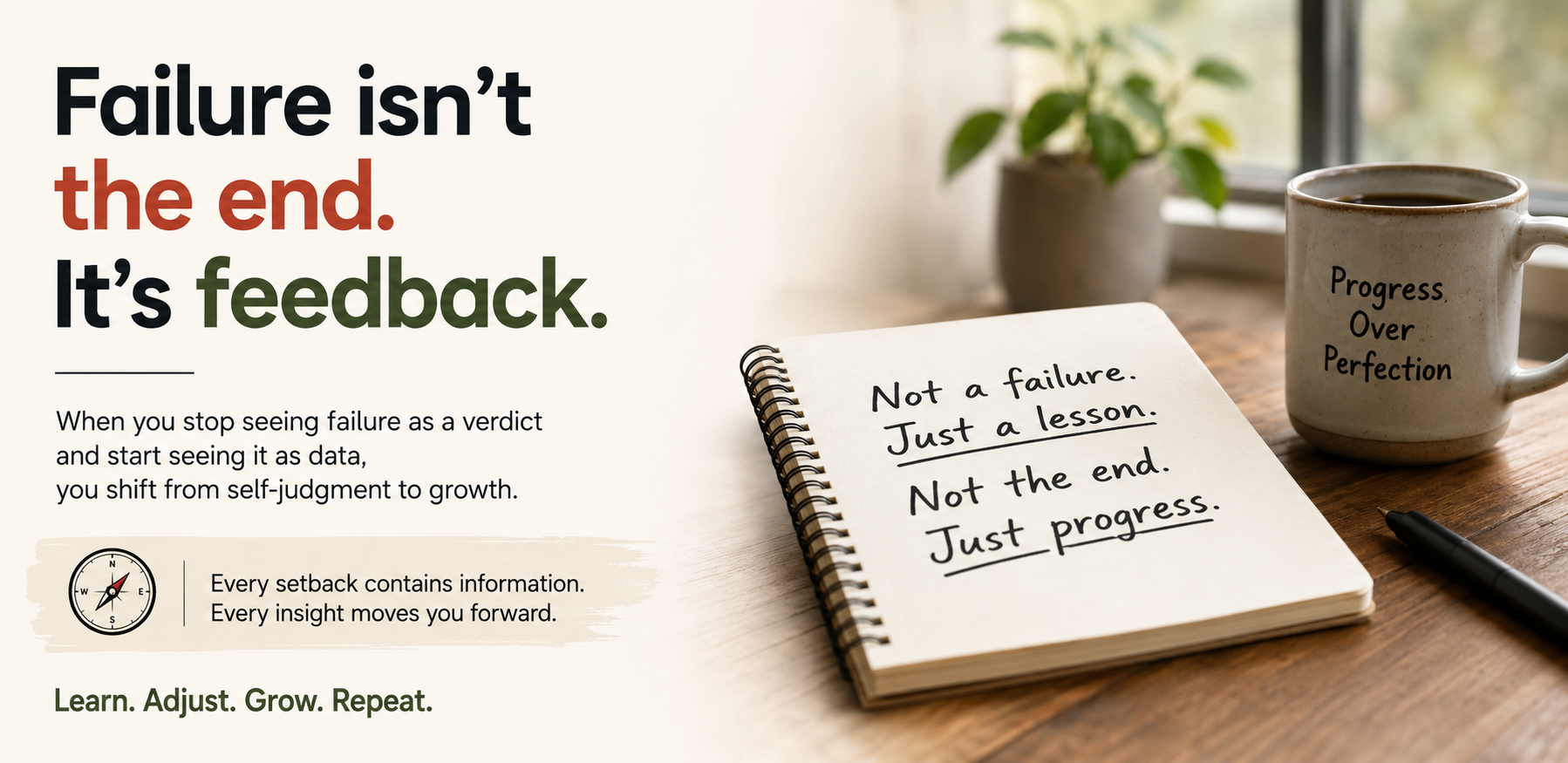
Introduction: Use Failure as Data
Do you know how can you use failure as data instead of drama?
Are you dealing with failure and feeling demotivated right now? You don’t need to feel disheartened by failure — it’s the next step to improve yourself a little more. If you want to remove failure and start your journey then you must read this article.
This article will motivate you and help you stay strong so you can confidently try for the next opportunity.
How to Use Failure as Data Instead of Drama?
1. Stop asking “Why did this happen to me?” and start asking “What exactly happened?”
Take time to think about the area of improvement after every rejection. Maybe you need to improve your communication skills, interview techniques, or your resume. Rejection doesn’t mean failure it is just a signal to improve yourself a little more.
Join online courses, take mock interviews, and learn from industry experts through networking to upgrade your skills. When you learn from your mistakes and develop new skills then your confidence increases automatically.
Always keep a growth mind. Continuous learning makes you ready for the next opportunity.
2. Separate outcome from process
If a company rejects your application or does not respond after you apply, it does not mean that you are not talented or skilled.
Many people start comparing themselves to others, which can make them feel hopeless and discouraged. But it is important to understand that hiring decisions are based on many factors, not just your skills.
You may be a highly talented candidate, but a company might reject your application because they do not have the budget, they may have changed their hiring plans, or they may have other business reasons. These factors are often beyond your control.
That is why you should not measure your value or abilities based on a company’s response. Rejection does not define your talent or skills.
3. Convert every failure into a “debug report”
It is not possible to judge the whole interview at once because you may get confused by many things. That is why you should break the interview into sections and review each section separately to understand how you performed in every part.
You can divide the interview into five sections:
- Introduction
- Technical and skill-based questions
- Behavioral questions
- Your questions to them
- Closing conversation
When you divide the interview into sections, it becomes easier to remember everything and understand how you performed in the interview. This will help you know where you performed well and where you performed poorly.
4. Understand the Root Cause of Repeated Rejections
You need to find out the root cause of your rejection, understand it well, and then work on improving it completely. The root cause can be anything — a skill mismatch, a role mismatch, a weak resume, ATS issues, poor interview performance, lack of confidence, unclear answers, or not researching the company properly.
Once you identify the root cause, you must work on it, fix it, and then go back for interviews again. But before attending your next interview, make sure you research the company properly. How to do that is already explained in the article.
5. Build a Better Job Search Strategy for Rejection
To remove job rejection patterns, you need a smart strategy. Strategy will help you to guide step by step to remove job rejection. You can include important things in strategy like;
- Apply to the right number of jobs
- Target the right job roles for your profile
- Avoid mass applying; choose quality
- Write better email pitches to hiring managers
Conclusion: Use Failure as Data
Failure only feels heavy when it’s treated as a personal story. The moment you shift it into data, it stops being emotional noise and starts becoming useful input.
Instead of asking “What does this say about me?”, you start asking “What can this teach me about my process?” That single shift changes everything.
When you consistently break failure into patterns, specific mistakes, and clear next steps, you remove drama and build a feedback loop. Over time, you don’t just “recover” from failure—you actually improve because of it.






Comments
Be the first to leave a comment.