

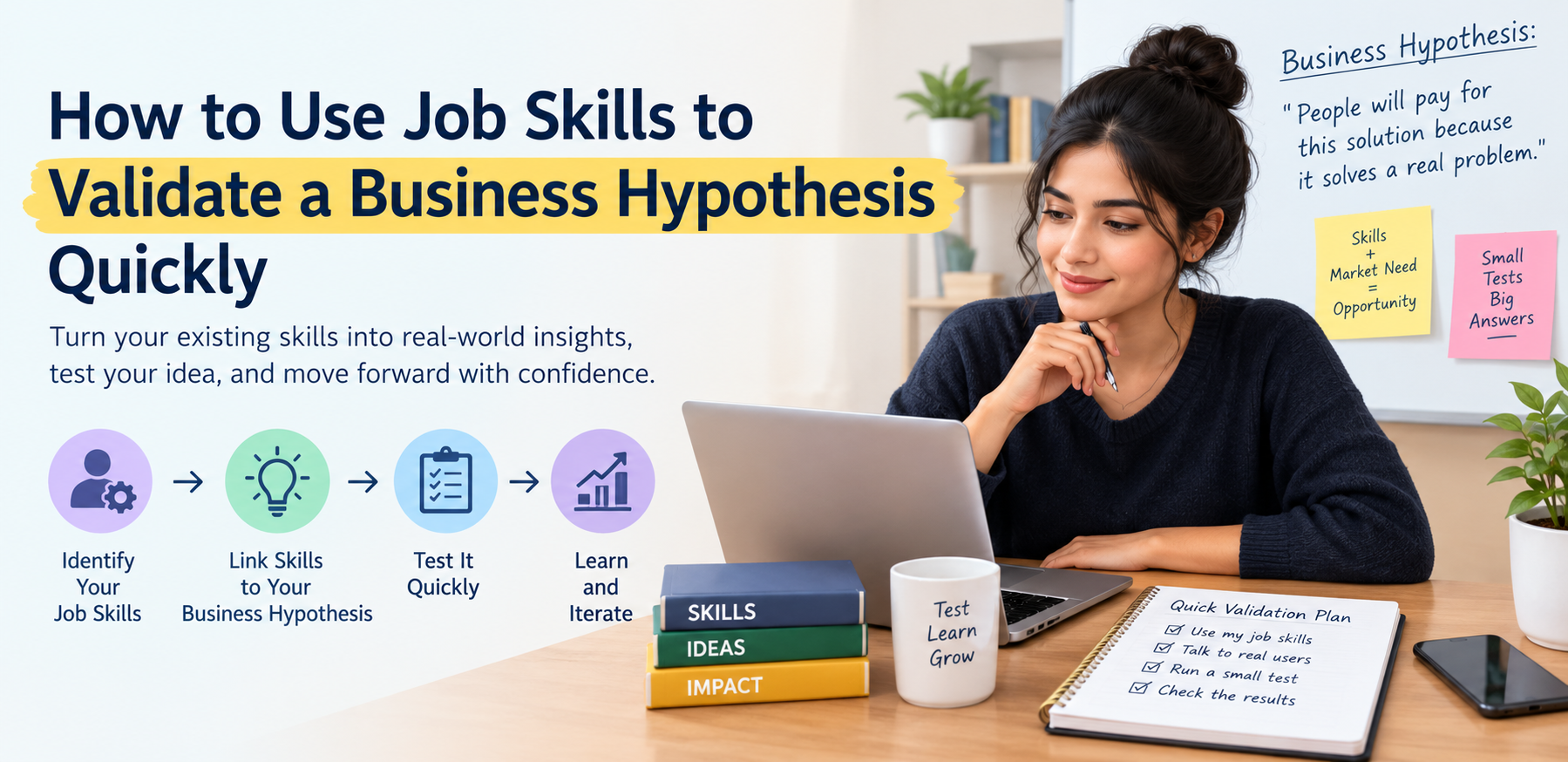
Introduction: Business Hypothesis
The journey of any business is not necessarily the journey of a huge investment and a complex business plan. Sometimes, what is necessary is to initially test a hypothesis of business viability. A business hypothesis implies an assumption about the presence of a problem, consumer, product or market. But before months or even years of product development, you can test this assumption with the skills you already possess.
How to use job skills to validate a business hypothesis quickly is an incredible opportunity for professionals to enterprising through the lens of exploring their existing professional expertise.
How to Use Job Skills to Validate a Business Hypothesis Quickly?
1. Begin With a Clarified Business Hypothesis
The first step to testing your business hypothesis is, obviously, to actually have a business hypothesis. Avoid vague statements such as “People will like my product”. Try to formulate what you want to prove to yourself.
For example, your hypothesis might be that small businesses are willing to spend money on an affordable social media manager. Your hypothesis would then be: “Local small businesses will be willing to spend money on a simple monthly social media management service for time saving”.
Having a clear hypothesis helps simplify the testing experience as you know what you are trying to prove.
2. Leverage Your Existing Professional Skills
Your existing skill set may have a number of talents that are directly applicable to the business you want to test. Your job skills might be writing, sales, customer support, marketing, research, design, data analysis, project management or something else entirely. These skills can all be leveraged to test your business hypothesis with little to no time investment.
For example, a content writer can pitch a sample article for a prospective customer. A salesperson can contact prospects and explain the value of what they need. A designer can come up with a mockup for a prospective customer. Someone with research skills can research competition and customer pain points.
You do not need to learn everything from scratch. You can learn to apply the skills you already have.
3. Converse With Potential Customers
One of the most straightforward ways to test your business hypothesis is to speak with your future customers.
Avoid speaking to them about what you want to sell them. Instead, identify their problems, how they currently solve these problems, what they do not like about the current solutions and how important it is for them to solve this problem.
For example, if you want to open a resume writing service, you may want to speak with job seekers about their resume writing problems, how they do it now, if they have ever paid someone to do their resume for them and what their expectations are from such services.
Direct observation of the problems and needs of your future customers may be more useful than any assumptions you can make on their behalf.
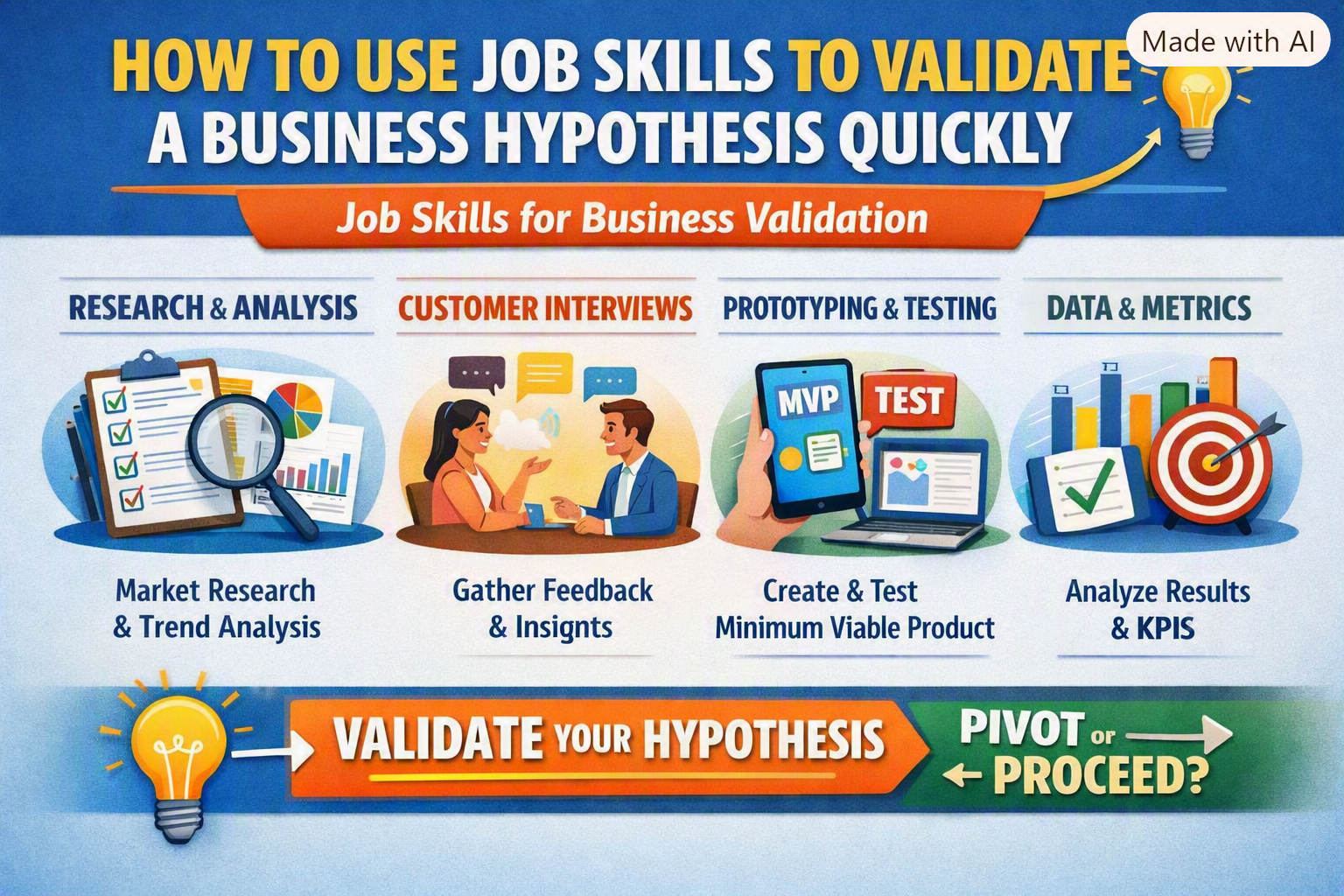
4. Design a Simple Test
You do not need a complete end product to test whether there is a market for it. All you need is a prototype — or a simple proof of concept.
A simple sample of your service, a landing page, a social media post, a brief presentation, a demo, a simplified product — anything can act as a useful tool to get a pulse on how the market may react to your product. Use your job skills to create something that allows you to collect evidence.
If you are a competent writer, create a compelling sales page. If you are a digital marketer, create a mini campaign for your product. If you know how to sell to people, develop a simple feedback mechanism.
Do not aim for perfection. Aim for evidence collection.
5. Focus On Real Behavior, Not Words
While positive reinforcement and encouragement from people can be useful, focus on people’s actions rather than what they say.
Ask them to engage in behaviour that shows you their intentions. Sign up for your email newsletter, schedule a discovery call, request a sample, place a small order, make a deposit for a trial session. Use their behaviour as a tool for your business hypothesis testing.
If people are not likely to take action, your hypothesis is unlikely to be successful. However, if they continue to express interest, you likely have a winning business opportunity.
6. Make Sure to Use Your Workplace Experience Wisely
Your professional workplace skills can be an incredible toolkit for exploring your business opportunities, but avoid using sensitive, confidential corporate information or resources for your personal business venture.
Instead, use your professional toolbox to build your business plan. Your professional experience with customers, processes, communication or problem-solving can help you identify incredible opportunities to enterprising without crossing the boundaries of your profession.
This way, you can also develop an entrepreneurial spirit without losing your livelihood.
Conclusion: Business Hypothesis
Your job skills can be leveraged to test your business hypothesis. Writing, research, sales, design, customer support, project management, communications or data analysis skills can be useful in running a series of small experiments with people.
You must begin with a clear business hypothesis, leverage your professional skills, converse with your customers and keep track of your evidence. A single small experiment can help you discover if your business has potential.
Ready to turn your professional skills into actionable business insights? Use your existing job skills to test assumptions, gather real-world feedback, and validate your business hypothesis before investing significant time or resources. Explore Best Job Tool to discover opportunities that can help you strengthen your skills, gain practical experience, and move closer to your business goals.






Comments
Be the first to leave a comment.