

Learning new skills has become one of the most important parts of career growth in today’s competitive world. Whether someone wants to learn coding, digital marketing, graphic design, communication skills, content writing, SEO, or video editing, the biggest challenge is usually not intelligence or talent. The real challenge is consistency and focus. Many people begin learning with excitement, but after a few days they lose motivation because the process feels overwhelming, tiring, or difficult to manage alongside work and personal responsibilities.
This is where the Pomodoro Technique becomes extremely useful. The Pomodoro Technique is a simple productivity system designed to improve focus and reduce mental fatigue by dividing work into small and manageable sessions. Instead of trying to study or practice for many hours continuously, learners focus deeply for shorter periods followed by short breaks. This structure helps people stay mentally fresh while maintaining long-term consistency.
Using the Pomodoro Technique for skill building can transform the way people learn. It reduces distractions, improves concentration, builds discipline, and makes learning feel less stressful. The technique is especially valuable for remote workers, students, freelancers, creators, and professionals trying to improve skills while managing busy schedules.
In this blog, we will explore how the Pomodoro Technique works, why it is highly effective for learning new skills, practical ways to use it daily, common mistakes people make, and how consistent focus sessions can create major long-term growth.
Understanding How the Pomodoro Technique Works
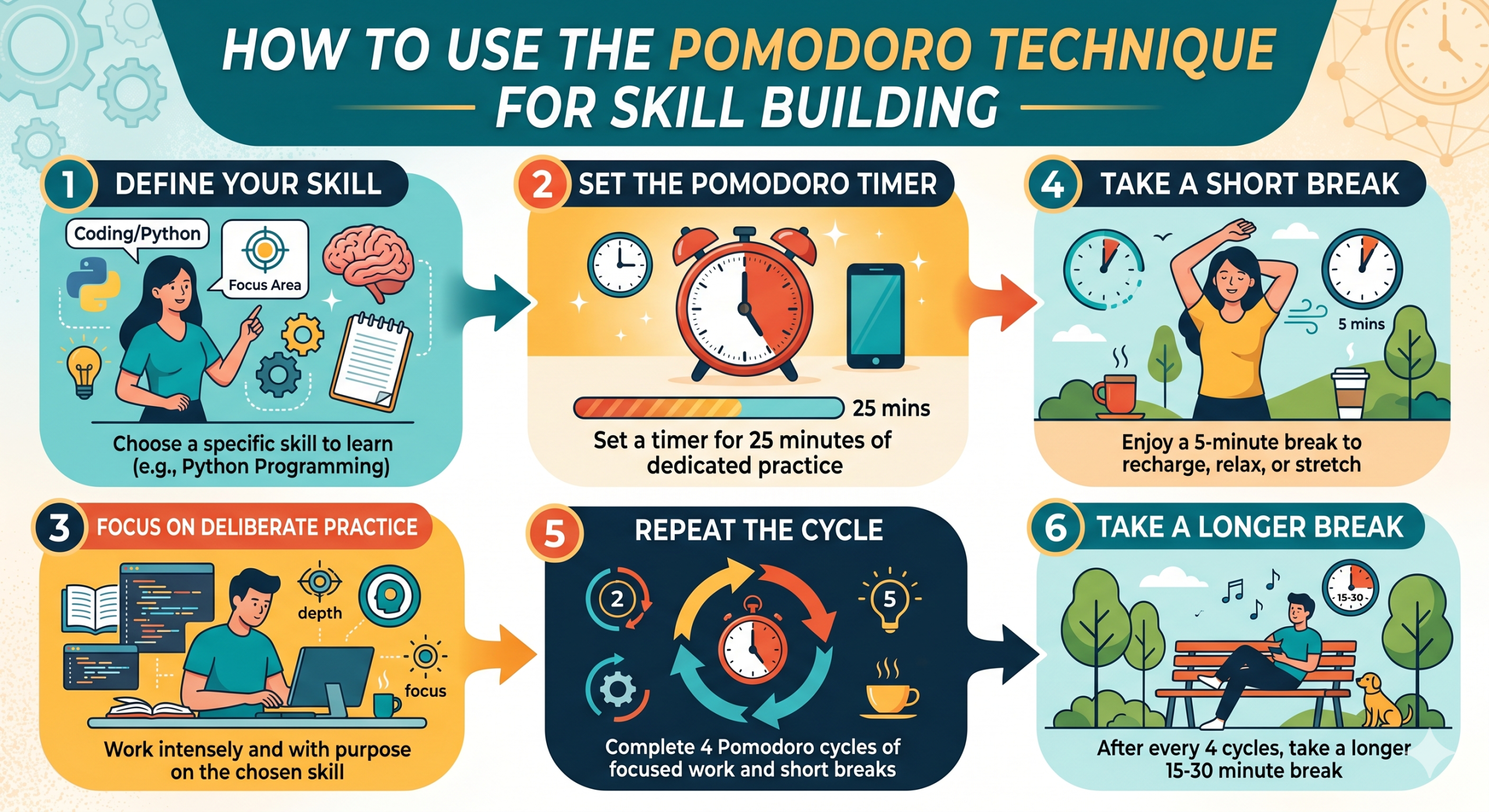
The Pomodoro Technique is based on a very simple idea. Instead of working endlessly until mental exhaustion appears, people work in short focused sessions with planned breaks. Traditionally, the technique follows this structure:
- Work for 25 minutes
- Take a 5-minute break
- Repeat the process
- After four sessions, take a longer break
Each focused session is called a “Pomodoro.” During those 25 minutes, the goal is complete concentration on one task only. There should be no distractions, no multitasking, and no interruptions.
This method works because the brain handles short-term focus more effectively than long periods of intense concentration. When people know a break is coming soon, it becomes easier to stay committed and mentally engaged during work sessions.
Many learners struggle because they sit for long study sessions without structure. After some time, focus decreases, distractions increase, and learning quality becomes weaker. The Pomodoro Technique solves this problem by creating a balanced rhythm between productivity and recovery.
Another important advantage is psychological simplicity. Telling yourself to focus for only 25 minutes feels much easier than committing to several hours of study. This reduces procrastination and mental resistance significantly.
Why the Pomodoro Technique Is Powerful for Skill Building
Skill development requires repetition, consistency, and active focus. Most people fail to build valuable skills because they depend too heavily on motivation instead of systems and routines. Motivation changes daily, but structured habits create long-term progress.
The Pomodoro Technique supports skill building because it helps learners stay consistent without becoming mentally exhausted. Short focus sessions improve concentration quality, while regular breaks help the brain recover and process information more effectively.
The method is especially useful for mentally demanding skills such as coding, writing, analytics, language learning, design, or technical certifications. These skills require deep thinking and continuous practice, which becomes difficult when attention is constantly interrupted.
Another major benefit is reduced overwhelm. Many people avoid learning because goals feel too large. For example, becoming a software developer or SEO specialist may seem intimidating initially. However, focusing on one 25-minute session at a time makes learning feel manageable.
Consistency also improves confidence. When learners complete focused sessions regularly, they begin noticing progress naturally. Small improvements accumulate over time, eventually creating significant expertise.
The Pomodoro Technique additionally improves time awareness. Many people underestimate how much time they waste through social media, multitasking, or distractions. Structured sessions reveal how productive focused attention can actually become.
How to Use the Pomodoro Technique Effectively for Learning
Using the Pomodoro Technique correctly is important for achieving the best results. The process itself is simple, but discipline and environment matter significantly.
The first step is choosing one specific skill or task to focus on. Instead of vaguely deciding to “study marketing,” learners should define precise goals such as keyword research, analytics learning, campaign analysis, or SEO writing.
Before beginning a Pomodoro session, it is important to remove distractions completely. Notifications should be turned off, unnecessary tabs closed, and phones kept away whenever possible. The quality of focus during those 25 minutes matters more than the total number of hours spent studying.
A timer should then be set for 25 minutes. During this period, the learner should focus only on the selected activity. If unrelated thoughts appear, they can be written down quickly and ignored until the session ends.
After completing the session, a short five-minute break helps refresh the mind. During breaks, it is better to stretch, walk, drink water, or rest briefly instead of scrolling endlessly through social media. Healthy breaks improve mental recovery and prepare the brain for the next focus session.
After four Pomodoro sessions, learners should take a longer break of around 15 to 30 minutes. This prevents burnout and helps maintain productivity over longer periods.
Best Skills to Learn Using the Pomodoro Technique
The Pomodoro Technique works extremely well for almost every type of learning or productivity task. However, it is especially effective for skills requiring deep concentration and consistent practice.
Professionals learning coding can dedicate separate Pomodoro sessions to syntax practice, debugging, project building, and theory learning. Writers can use sessions for outlining, drafting, editing, and research. Digital marketers can divide sessions between analytics, SEO optimization, content planning, and advertising strategy.
The technique also works well for language learning. One session may focus on vocabulary, another on listening practice, and another on speaking exercises. Breaking learning into focused categories improves retention and prevents mental overload.
Creative professionals such as designers and video editors also benefit because short focus sessions encourage sustained creativity without exhaustion. Long creative sessions often reduce quality after a certain point, while structured breaks help maintain fresh thinking.
Students preparing for exams can also improve productivity significantly using Pomodoro-based study routines. Instead of spending entire days passively reading, focused sessions improve active learning and concentration.
How the Pomodoro Technique Improves Focus and Discipline
Modern attention spans are constantly affected by smartphones, notifications, social media, and multitasking habits. Many people find it difficult to focus deeply even for short periods because the brain becomes used to continuous stimulation.
The Pomodoro Technique improves focus because it trains the brain to concentrate intentionally for structured periods. Over time, repeated focus sessions strengthen mental discipline naturally.
Another important advantage is reduced procrastination. Large tasks often create anxiety and avoidance. However, starting a single 25-minute session feels much easier psychologically. Once momentum begins, continuing becomes easier as well.
The method also creates stronger learning habits. When people repeat focused sessions daily, studying becomes part of routine instead of depending on emotional motivation.
Consistency eventually becomes automatic, which is extremely important for mastering any skill.
Common Mistakes People Make With the Pomodoro Technique
Although the Pomodoro Technique is simple, many people use it incorrectly and reduce its effectiveness.
One common mistake is multitasking during sessions. Some learners try checking messages, browsing social media, or switching between tasks while the timer runs. This destroys deep focus and weakens learning quality.
Another mistake is skipping breaks completely. Some people believe longer work sessions mean better productivity, but mental fatigue reduces concentration significantly after extended periods. Short breaks are essential for maintaining performance.
Unrealistic scheduling is another issue. Beginners sometimes plan too many sessions in one day and become exhausted quickly. It is better to start with a few quality sessions consistently rather than attempting extreme productivity immediately.
Using breaks poorly can also reduce effectiveness. Endless social media scrolling during breaks often overstimulates the brain instead of helping recovery. Physical movement, hydration, or simple relaxation usually works much better.
Why Small Daily Sessions Create Long-Term Success
Many people underestimate the power of small daily efforts. However, consistent focused sessions create major improvement over time.
For example, completing four Pomodoro sessions daily equals around two hours of deep focused learning. Over weeks and months, this becomes a significant amount of skill development.
The biggest advantage of the technique is sustainability. Most people fail because they try extreme schedules they cannot maintain long term. The Pomodoro Technique encourages balanced and realistic productivity that supports continuous progress.
Skill building is not about studying intensely for a few days. It is about repeated focused effort over long periods. Small improvements compound into expertise gradually.
This principle applies to almost every career field. Writers improve through daily writing sessions. Developers improve through consistent coding practice. Marketers improve through continuous experimentation and analysis.
Long-term success often depends more on consistency than talent alone.
Conclusion
Using the Pomodoro Technique for skill building is one of the most effective ways to improve focus, productivity, consistency, and long-term learning success. The technique simplifies learning by breaking large goals into manageable sessions, making progress feel less stressful and more achievable.
Short focused work periods help reduce distractions, strengthen concentration, and prevent burnout. Regular breaks improve mental recovery, while structured routines encourage long-term discipline and habit formation.
The technique works especially well for modern professionals trying to learn valuable skills alongside busy schedules. Whether someone is studying coding, SEO, communication, design, writing, analytics, or digital marketing, the Pomodoro Technique provides a sustainable system for growth.
Most importantly, the method teaches that small consistent actions create powerful long-term results. Skill development does not require endless motivation or exhausting study sessions. It requires focus, repetition, and systems that support consistency.
In a world where continuous learning is becoming essential for career growth, mastering productivity methods like the Pomodoro Technique can help professionals stay competitive, adaptable, and confident in their long-term development journey.
As a result, individuals can build expertise more effectively while maintaining a healthy work-life balance. In addition, professionals looking to improve productivity, develop valuable skills, and grow in modern remote careers can explore platforms like “Best Job Tool” to discover smarter career-building opportunities and long-term professional growth strategies.
Furthermore, combining structured learning methods with disciplined routines can significantly increase motivation, confidence, and career success over time.






Comments
Be the first to leave a comment.