

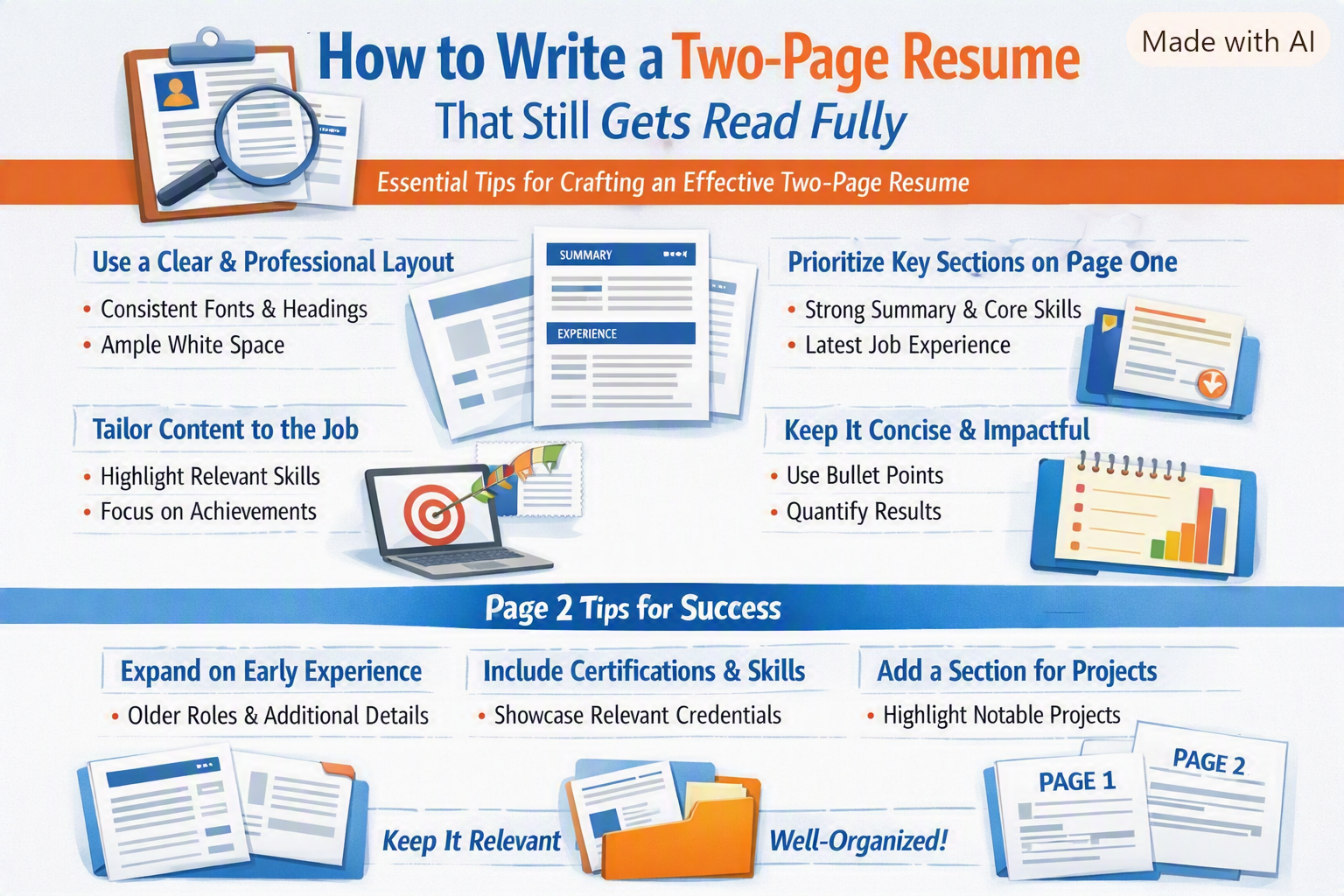
Introduction: Two-Page Resume
Many job seekers think that a resume should always be limited to one page, while in fact, a one-page document is only suitable for entry-level or inexperienced workers. Those with a few years of experience, a variety of roles, impressive achievements and skills, and other valuable qualifications need more space to present themselves fully. A two-page resume is appropriate in such cases, provided that the job seeker manages to maintain the reader’s attention.
How to write a two-page resume that still gets read fully focuses on methods of keeping the reader’s attention by getting the most out of the two pages. It does not aim to encourage job seekers to fill space with useless information but rather to maximize the value of each section to help the hiring manager identify the candidate as the best fit for the position.
How to Write a Two-Page Resume That Still Gets Read Fully?
1. Start With the Most Important Information
The truth is that recruiters spend only a short amount of time skimming through your resume before deciding whether to move forward. This is why it is so important to put the most relevant information at the top of the document. After your contact information, give a brief professional summary of your experience, skills, and the type of work you do. Keep it simple and to the point.
Instead of writing a paragraph about your professional background, try something like this: Content writer with four years of experience in blog writing, SEO content creation, and social media content creation. Proficient in research, editing, and other various writing skills for different industries.
This way, the recruiter can get a good sense of what you do in just a few seconds. Do not fill the second page with unnecessary information
The second common mistake is putting all of your old job descriptions, achievements, courses, and skills on the second page. While some of this information may be relevant, it is important to be selective about what you include. Remember that a two-page resume should still be concise.
If you have a lot of information that does not directly relate to the position you are applying for, it is best to leave it out. The second page should seamlessly continue the information from the first page. You can include old, but relevant, work experience, education, projects, skills, certifications, or achievements.
The bottom line is that the How to Write a Two-Page Resume That Still Gets Read Fully guide is focused on helping you avoid the most common pitfalls. Most importantly, remember that your second page should not feel like an afterthought. The recruiter should not get the sense that all of the good information is on the first page and the second page is just fluff
2. Write Your Achievements With Bullet Points
Using bullet points is better than writing long paragraphs on your resume. You want to make it as easy as possible for hiring managers to scan your resume and pick out the most important details. This is especially the case if they are skimming your resume rather than reading it word for word.
When using bullet points for your work experience, write concise statements that briefly highlight your responsibilities and accomplishments in the role. Where possible, try to focus more on your accomplishments rather than just listing what you did.
For example: Wrote SEO-friendly articles for multiple websites Edited articles for proper grammar and clarity before publication, collaborated with the marketing team on content development for various campaigns, conducted keyword research to improve website traffic.
As you can see, these bullet points are much easier to read than a lengthy paragraph. On the other hand, avoid writing too many bullet points for each role. If you have held multiple senior-level positions during your career, four to six bullet points for each should be sufficient. And for older roles that you gained a lot of your experience in, two to three bullet points should be enough.
3. Make the Resume Easy to Scan
It is essential to make the resume easy to scan when you have two pages. The best way to do that is to make sure it has a good format. Use headings such as Professional Summary, Work Experience, Skills, Education, and Certifications.
Make sure that there is enough space between sections. It is important not to make the resume too cramped, as this may be tiring to the eyes. On the other hand, avoid leaving too much space, as this will make the resume look too stretched.
It is essential to choose a simple and professional font and make sure it is easy to read. Avoid using different colors, special effects, and fancy fonts. A resume should not have them as it may distract the recruiter, and they will not be able to find the information they need quickly.
A good resume should have a clean and simple design so that the recruiter can scan it fast.
Finally, make sure that on the second page, the name and page number are in the header/footer. It will help if the pages are somehow separated.
4. Keep Older Experience Short
While you may have worked for many years, you don’t have to describe each position in detail. Your recent experience will likely be the most relevant since it reflects your current skill level and the type of work you’re doing now.
The best way to do this is to devote more space to your most recent and relevant positions while keeping earlier jobs brief, especially if they’re not directly related to the ones you want to pursue. This approach will allow you to keep your resume within two pages while still showcasing your qualifications.
Conclusion: Two-Page Resume
In my humble opinion, a two-page resume is not necessarily a two-page long document. This is because one can simply write more than one can fit on a single page in order to present their information clearly and concisely. However, the key to doing so lies in making every part of the document count.
After reading ‘How to Write a Two-Page Resume That Still Gets Read Fully’, I realized that a two-page resume is not about simply writing more information in order to fill an additional page. Instead, the most important aspects are being clear and concise in the presentation of your information.
Additionally, being precise with the choice of information is essential. One should highlight their best experiences and qualities first and foremost. Furthermore, using bullet points, keeping descriptions short and making sure both pages are informative will keep the recruiter interested.
“A two-page resume can still make a strong impression when every section adds value. Highlight your most relevant experience, use clear formatting, focus on measurable achievements, and remove unnecessary details. Create a resume that gets noticed with Best Job Tool.”






Comments (1)
[4431]phpopular Official Login | Best GCash Online Casino Philippines,phpopular provides a secure way to access top online slot sites in the Philippines. Get the app download today and learn how to play baccarat. Join now for fast GCash play. visit: phpopular