

Introduction
A resume is often the first impression a candidate makes on a potential employer. Recruiters typically spend only a few seconds reviewing each application before deciding whether to continue reading or move on to the next candidate. Because of this, having experience alone is not enough—how that experience is presented matters just as Frameworks much.
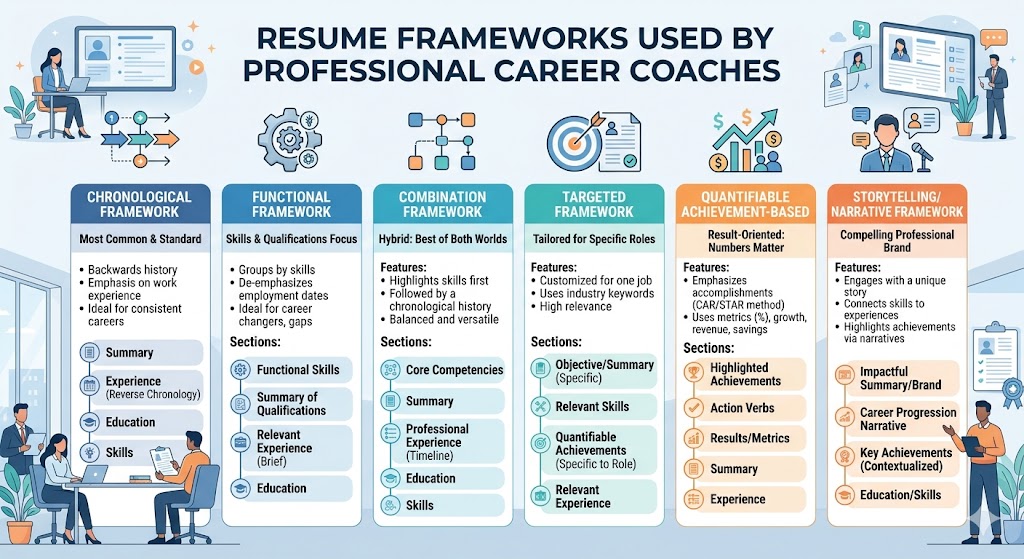
Professional career coaches use proven resume frameworks to help candidates showcase their achievements, skills, and value effectively. These frameworks are designed to make resumes easier to read, more impactful, and better aligned with modern hiring practices.
Whether you are a student, recent graduate, career changer, remote worker, or experienced professional, understanding these frameworks can significantly improve your chances of securing interviews and advancing your career.
Why Resume Structure Matters
Many job seekers focus entirely on adding information to their resumes without considering organization and presentation.
A strong structure helps recruiters quickly identify:
- Relevant skills
- Professional achievements
- Career progression
- Industry expertise
- Measurable results
An effective resume framework ensures your most valuable qualifications receive immediate attention.
Professional coaches emphasize clarity, relevance, and impact over lengthy descriptions.
The Achievement-Based Framework
One of the most commonly recommended resume structures focuses on achievements Frameworks rather than responsibilities.
Many candidates write statements such as:
- Managed customer inquiries
- Assisted with marketing campaigns
- Coordinated team activities
While these descriptions explain duties, they do not demonstrate value.
Career coaches encourage candidates to focus on results.
Examples include:
- Increased customer satisfaction scores by 20%
- Improved campaign engagement by 35%
- Reduced project completion time by 15%
Achievement-focused resumes help employers understand the impact of your work rather than simply your responsibilities.
The PAR Framework
PAR stands for:
Problem
What challenge existed?
Action
What steps did you take?
Result
What outcome was achieved?
This framework helps transform ordinary job descriptions into compelling accomplishments.
Example:
Instead of writing:
“Handled customer complaints.”
Use:
“Resolved recurring customer service issues by implementing a streamlined escalation process, resulting in a 25% reduction in complaint resolution time.”
The PAR framework clearly demonstrates problem-solving ability and measurable impact.
The CAR Framework
Another popular approach used by career coaches is the CAR method.
CAR stands for:
Challenge
Describe the situation or obstacle.
Action
Explain what you did.
Result
Highlight the outcome.
This framework is particularly useful for leadership, project management, and operational roles.
It allows candidates to showcase:
- Initiative
- Strategic thinking
- Decision-making
- Leadership skills
Recruiters often find these accomplishment-based statements more persuasive than generic job descriptions.
The Skills-First Resume Framework
For students, career changers, freelancers, and professionals with limited traditional experience, career coaches often recommend a skills-first approach.
This format places key competencies near the top of the resume.
Common sections include:
- Professional summary
- Core skills
- Relevant projects
- Certifications
- Work experience
- Education
This framework helps recruiters quickly identify strengths before reviewing employment history.
It is particularly effective when transitioning into a new industry or pursuing remote opportunities.
The Project-Based Framework
Professional coaches frequently encourage candidates to highlight projects when traditional experience is limited.
Projects may include:
- Freelance work
- Research initiatives
- Academic assignments
- Volunteer activities
- Side projects
- Remote collaborations
A strong project section demonstrates:
- Practical experience
- Problem-solving abilities
- Technical knowledge
- Leadership skills
- Productivity
For many employers, a well-executed project can be just as valuable as formal work experience.
The STAR Framework for Resume Writing
Although commonly associated with interviews, the STAR framework is also valuable for resume development.
STAR stands for:
Situation
What was the context?
Task
What was your responsibility?
Action
What steps did you take?
Result
What was achieved?
Using STAR helps candidates create concise achievement statements that highlight both actions and outcomes.
This framework ensures accomplishments remain structured and easy for recruiters to understand.
Optimizing Resumes for Remote Work Opportunities
Remote and hybrid jobs continue to grow across industries.
Career coaches recommend highlighting experiences that demonstrate remote work readiness.
Examples include:
- Virtual collaboration
- Remote project management
- Digital communication
- Productivity tracking
- Online client interactions
Recruiters increasingly seek candidates who can work independently and maintain performance in remote environments.
Job seekers pursuing international opportunities through platforms like best job tool, a global job platform, often benefit from emphasizing these capabilities on their resumes.
Quantifying Achievements Effectively
One of the most important resume principles taught by professional coaches is quantification.
Whenever possible, include measurable outcomes.
Examples include:
- Increased sales by 30%
- Managed budgets worth $10,000
- Led a team of 15 members
- Reduced costs by 18%
- Improved productivity by 25%
Numbers provide credibility and help employers understand the scale of your contributions.
Even students and early-career professionals can quantify achievements through academic projects, volunteer work, internships, and extracurricular activities.
Common Resume Mistakes Career Coaches Avoid
Professional career coaches consistently help candidates avoid several common mistakes.
These include:
- Listing responsibilities instead of achievements
- Using lengthy paragraphs
- Including irrelevant information
- Failing to quantify results
- Using generic summaries
- Ignoring keywords from job descriptions
- Overloading resumes with technical jargon
A strong resume should be concise, focused, and tailored to the target role.
Every section should support your overall professional story.
Conclusion
Professional career coaches rely on proven resume frameworks because they help candidates communicate their value clearly and effectively. Whether using the Achievement-Based, PAR, CAR, STAR, Skills-First, or Project-Based framework, the goal remains the same: demonstrate impact rather than simply listing responsibilities.
A well-structured resume helps recruiters quickly understand your strengths, accomplishments, and potential contributions. It improves readability, strengthens professional branding, and increases the likelihood of securing interviews.
As competition continues to grow across industries, candidates who present their experience strategically gain a significant advantage. By applying these resume frameworks and exploring opportunities through best job tool, professionals can create stronger applications, improve job search outcomes, and position themselves for long-term career success in both traditional and remote work environments.






Comments
Be the first to leave a comment.